Haplogroup R1b1a1b1a1a1e1b

– 6 min read


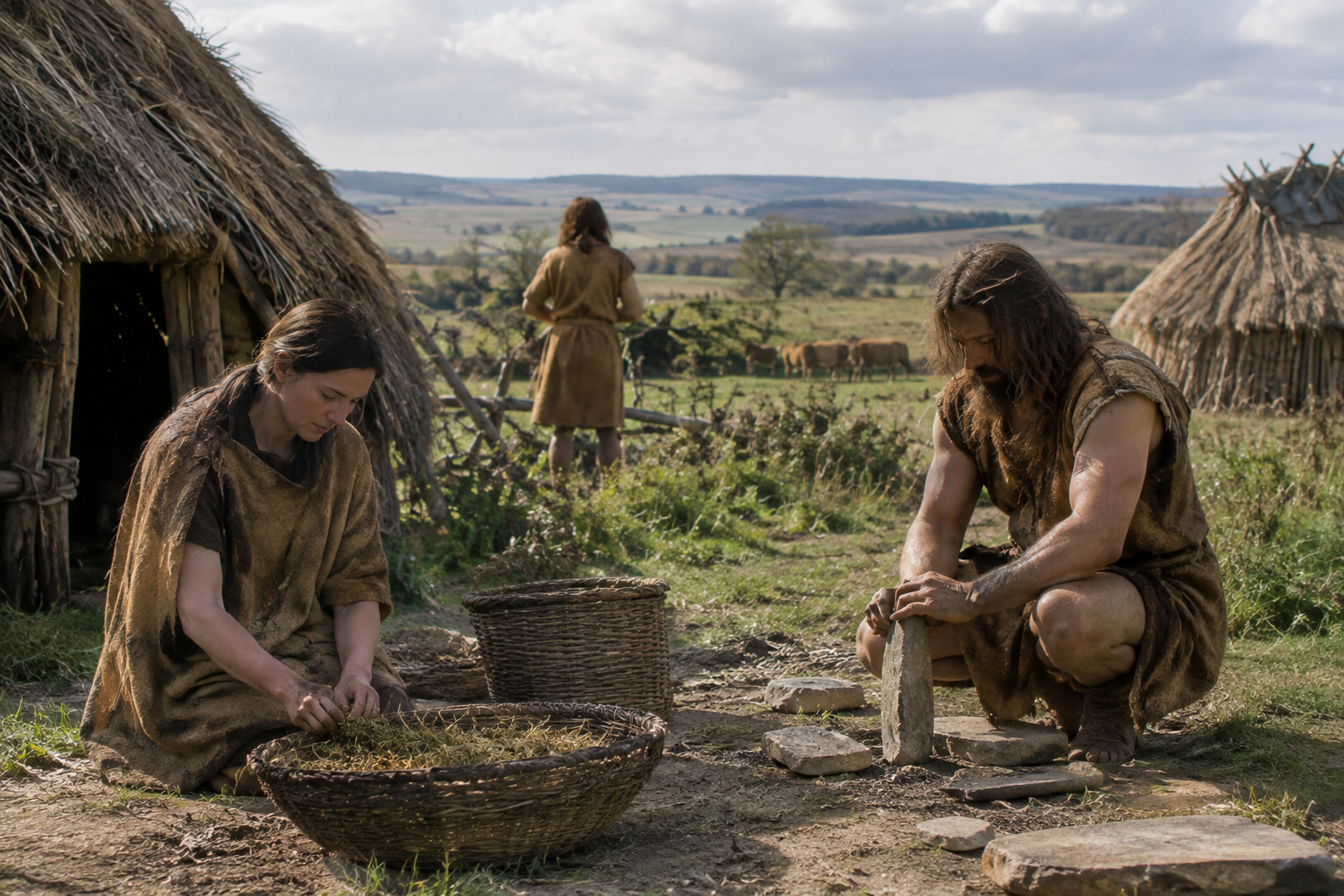
Some Y-chromosome lineages are famous because they turn up in royal tombs or sweep across ancient maps in great demographic surges. Others are interesting for a subtler reason: they remind us that history is built from many layers, and that a very specific paternal branch can sit inside a much larger European story. Haplogroup R1b1a1b1a1a1e1b belongs to that second category. It is a narrow branch within the broader R1b family, a major Y-DNA lineage in western Europe, but the point of studying a branch this specific is not to pretend that one label explains a whole people. It is to see how one paternal line fits into the longer archaeological record.
That is especially revealing in Britain and Scotland, where ancient DNA, medieval lordship, and the surviving shells of noble residences all sit within the same landscape. Y-DNA traces one direct paternal line only - father to son, and so on - and does not represent a person's entire ancestry. Even so, when a lineage appears in ancient burials and later becomes associated with historically important regions, it gives us a useful way to think about continuity, migration, and the limits of what genetics can actually say.
R1b1a1b1a1a1e1b is part of the wider R1b tree, a vast and internally diverse Y-chromosome lineage with deep importance in the prehistoric and historic population history of western Eurasia. In Europe, many R1b branches are often discussed in connection with later prehistoric movements, especially those linked to Bronze Age societies and the spread of steppe-related ancestry. But one must be careful here. The broad success of R1b in Europe does not mean every downstream branch has the same age, route, or historical role.
What can be said responsibly is that this haplogroup belongs within a paternal family that became significant across much of western Europe, including Britain. For a lineage found in Britain, one plausible context is the long reshaping of the islands during the later Neolithic and Bronze Age, when new ancestry profiles, new burial practices, and new paternal lineages became prominent. Ancient DNA has transformed that discussion by replacing guesswork with actual individuals.
Explore Ancient DNA and Archaeogenetics
The most immediate evidence supplied here comes from West Heslerton in North Yorkshire, one of the most informative long-lived archaeological landscapes in northern England. Two ancient individuals from this area, KD040_4 and KD040, are dated to 1800 BC and identified as Bronze Age North Yorkshire Britain West Heslerton.
That matters because 1800 BC is not some vague prehistoric blur. This is Britain deep in the Bronze Age, when communities were farming, burying their dead in ways meaningful to local custom, moving goods across regions, and living in a world already transformed by earlier population changes. West Heslerton sits in Yorkshire, but it also sits in a bigger European conversation about how paternal lineages spread, persisted, or were replaced.
These two men do not prove the origin of the exact subclade, nor do they prove direct descent to any later family. What they do provide is solid archaeological footing: this paternal branch, or a very closely related placement within the Y-tree, was present in Bronze Age Britain. That is a valuable anchor. It tells us that the history of this lineage in Britain reaches back well before Roman rule, before Anglo-Saxon kingdoms, and before medieval surnames.
And here archaeology performs one of its little miracles. Without ancient DNA, men like KD040_4 and KD040 would be known only as burials from a Bronze Age site. With ancient DNA, they become evidence for how paternal ancestry was structured in prehistoric communities and how some male lines were already established in Britain long before the historical record begins to chatter.
Once a paternal lineage is attested in Bronze Age Britain, the obvious temptation is to draw a neat line from prehistory to the medieval and early modern world. Historians, as ever, should resist the neat line. Still, geography matters. Northern England and lowland Scotland were never sealed compartments. Across later prehistory, the Iron Age, the Roman period, and the early medieval centuries, people moved through these connected zones by trade, marriage, warfare, lordship, and settlement.
So if a branch of R1b appears in Bronze Age Yorkshire, it is not hard to see why related paternal lines might later be found across the wider British and Scottish world. That is not proof of unbroken elite descent. It is, rather, a reminder that many medieval lordships were planted in regions with much older demographic histories beneath them. Castles may be late, but the populations around them were not.
This is also where Y-DNA becomes most useful when handled properly. It does not hand us a surname in 1800 BC. It does not identify a Celt, a Scot, or a nobleman by essence. What it does is show that some direct paternal lines can endure across very long periods, even while language, identity, politics, and culture change repeatedly around them.
Read About Ancient DNA in Post-Roman Britain
The later historical associations supplied for this haplogroup bring us north into Scotland, and into two great noble settings: Clan Seton at Winton Castle in East Lothian, and Clan Gordon at Huntly Castle in Aberdeenshire.
Winton Castle began as a medieval tower house of the Seton family, probably in the 15th century, close to the old route east from Edinburgh. That location alone says much about power: roads mattered, movement mattered, and noble houses were rarely planted at random. The castle was damaged after the battle of Pinkie in 1547, later became caught up in the downfall of the Setons, and was transformed in the 17th century by George Seton into a more fashionable residence with decorative stonework. Then war intervened again in the 1650s. What survives is layered - part fortress, part mansion, part restoration - which is rather a good metaphor for lineage history too. No family, and no haplogroup, arrives in a single pure form untouched by time.
Huntly Castle tells a similarly Scottish story, though on a grander scale in red stone. Beginning as a motte and bailey stronghold in the 12th century, it developed into the seat of the Gordons, one of the most powerful families in Scotland. Much of what remains belongs to the 15th to 17th centuries and shows the shift from medieval fortress to Renaissance palace. Yet it too was caught in rebellion, feud, and royal intervention, suffering damage after resisting James VI in 1594 before falling into decline.
These castles do not prove that every Seton or Gordon male belonged to haplogroup R1b1a1b1a1a1e1b. Nor do they let us leap from Bronze Age Yorkshire to a named medieval ancestor. What they do offer is context. Noble families occupied landscapes with deep population histories, and paternal lineages associated with Britain and Scotland may have histories vastly older than the documents that first record a clan name.
The real fascination of haplogroup R1b1a1b1a1a1e1b lies in the way it joins two different archives. One archive is written: charters, battles, castle building, noble ambition, ruin, restoration. The other is biological: the Y-chromosome carried by ancient men such as KD040_4 and KD040 from West Heslerton, dated to 1800 BC. Written history gives names and events. Ancient DNA gives depth.
Put together, they do not give us a fairy-tale pedigree from Bronze Age burial to Scottish hall. But they do show how the same regions can preserve evidence from entirely different timescales. A paternal lineage may be present in Bronze Age Britain; centuries later, the same broad regions produce medieval lordships, castles, and clans. The connection is historical and geographic before it is genealogical.
For readers interested in Scotland's great noble world, the Gordons are another obvious point of comparison in this broader story of lineage and region.
That is why narrow Y-DNA branches are worth attention. They remind us that ancestry is not only about famous dynasties. It is also about ordinary and extraordinary men whose descendants may have become farmers, warriors, tenants, merchants, lairds, or perhaps nobody recorded at all. Genetics is powerful precisely because it restores some of that lost depth, while also forcing us to be honest about uncertainty.
If you carry a lineage connected to haplogroup R1b1a1b1a1a1e1b, or to its wider R1b family, your story may belong to the long population history of Britain and beyond. MyTrueAncestry lets you compare your DNA with ancient individuals and historical populations, helping you explore connections to archaeological discoveries like the Bronze Age men of West Heslerton. Those matches can offer remarkable clues about the deep past, even when they do not prove direct descent from a particular ancient individual or noble house.






Comments