Haplogroup R1b1a1b1a1a1c2f

– 6 min read


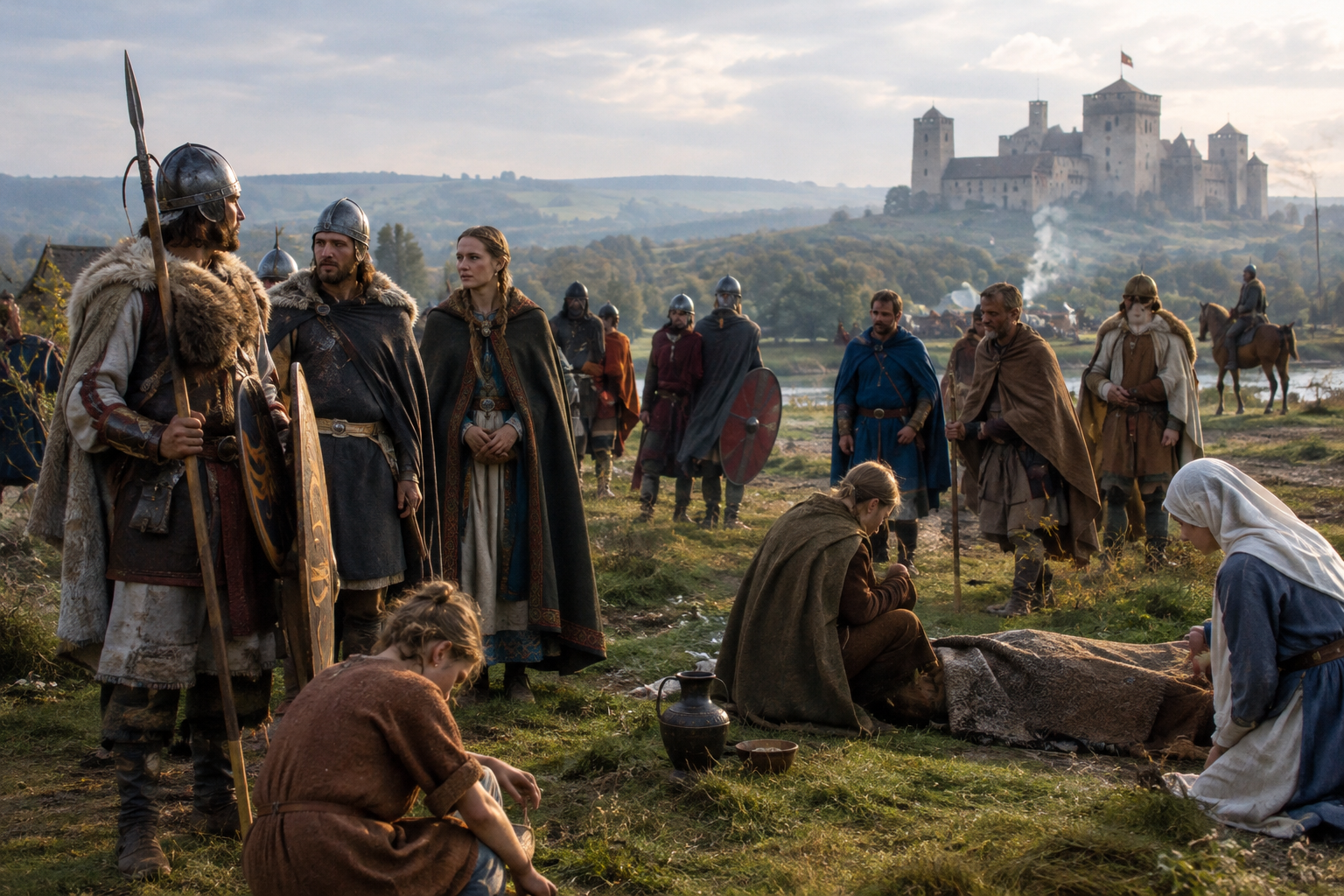
Some Y-chromosome lineages are easy to place in the public imagination. Others are more interesting precisely because they force us to look at history sideways. Haplogroup R1b1a1b1a1a1c2f belongs to that second category: a very specific paternal branch, narrow in name but broad in what it can tell us about movement across northern and western Europe, from Bronze Age communities to Iron Age tribes, early medieval war bands, and the guarded frontier society of the Scottish Borders.
It is worth saying at once what a Y-DNA haplogroup can and cannot do. A Y-line traces one direct paternal line only: father to father to father. It does not describe all of a person's ancestry, culture, language, or identity. Still, these paternal branches can be remarkably useful historical markers. When a lineage appears in burials from different centuries and regions, ancient DNA lets us watch the long career of a male line in a way that written history almost never can.
This haplogroup sits inside the wider R1b family, one of the major Y-chromosome groupings found across much of western Europe. For a branch as specific as R1b1a1b1a1a1c2f, caution matters. We should not simply pour the entire grand history of R1b into this one twig of the tree as though nothing changed along the way. But the samples supplied here do suggest a historical pattern worth noticing: this paternal line, or very close branches around it, appears in a corridor running through the Low Countries, northern France, parts of Germany, and into early medieval England and Italy.
That is already a revealing map. It points us toward the North Sea world, the lower Rhine region, and the connected landscapes that fed later Celtic, Germanic, and post-Roman populations. In other words, this is not a story confined to one kingdom or one "people," but to a zone where communities mixed, moved, fought, traded, and sometimes reinvented themselves.
Explore Bell Beaker ancestry in the Low Countries
The earliest supplied clues come from the Low Countries. At De Tuithoorn in North Holland, the Bell Beaker individual I4070, dated to 2080 BC, places this paternal line in a region central to later debates about Beaker-era mobility and the reshaping of northwest European populations. One sample never stands for an entire culture, of course, but it does show that a lineage connected with this haplogroup was already present in a landscape tied to major Bronze Age change.
Another useful waypoint is I11972 from Westwoud-Binnenwijzend, Netherlands, dated to 1410 BC. Now we are in the Middle Bronze Age, and the picture begins to look less like a passing episode and more like continuity within the wider North Sea and lower Rhine sphere. The point is not that one family sat still for centuries, but that related paternal lines were established in this region long before Roman authors began naming tribes.
By the Iron Age, the trail reaches northern France. At Bucy-le-Long we find CGG022425, a Belgic Suessiones Tribe France Bucy-le-Long individual dated to 500 BC, CGG022419, a Gallic France Bucy-le-Long sample dated to 457 BC, and CGG022456, a Belgic Suessiones Iron Age France Bucy-le-Long individual dated to 365 BC. That cluster is especially interesting because it places the lineage in a historically charged region associated with Belgic and Gallic populations before Rome's conquest. It reminds us that paternal lines do not obey the neat labels later historians prefer. "Belgic" and "Gallic" are useful categories, but the men buried in these cemeteries belonged to networks of kinship and mobility far older than Caesar's vocabulary.
Read about ancient DNA and Celtic expansions
The early medieval evidence is where this lineage becomes particularly vivid. In Haeven, Mecklenburg-Vorpommern, the Longobard sample HVN005 dated to 250 AD suggests the branch was present in a northern continental setting linked, at least archaeologically, to populations later associated with the Lombards or Longobards. That matters because the Lombard story is one of movement: not a simple tribal march, but a complicated reassembly of groups across central Europe.
That movement is clearer still in northern Italy. At Collegno, near Turin, three individuals from 580 AD appear in the supplied data: COL_069, described as a Lombard Warrior Elite Collegno Northern Italy; COL_069b, a Lombard Era Collegno Northern Italy individual; and COL_069x, again described as a Lombard Warrior Elite Collegno Northern Italy. Here archaeology and DNA meet in one of the most fascinating post-Roman settings in Europe: cemeteries where status, migration, and local interaction can all be studied together. The important point is not to claim these men were founders of later dynasties. It is that this paternal line was part of the human reality of the Lombard world in Italy.
England offers another strand of the story. At West Heslerton, Yorkshire, the early Anglo-Saxon cemetery produced I20644, I20671, and I20677, all dated to 550 AD. Add SED003 from Sedgeford, England Norfolk, dated to 600 AD, and the branch appears firmly within early Anglo-Saxon England. Again, one must not leap from haplogroup to ethnicity as if DNA settles every old argument. But these burials do show that the paternal line was moving within, or persisting across, the North Sea zone that linked continental Europe with eastern England in the centuries after Roman rule.
Discover the Anglo-Saxon migration story
The later samples show that the line did not vanish into antiquarian mist. S3044 from Norman Invasion Medieval Lincolnshire Lincoln Castle, dated to 1100 AD, places it in a fortress setting tied to the Norman world in England. That does not make it a "Norman haplogroup" in any exclusive sense. Rather, it shows how a paternal lineage already established in northwestern Europe could pass into yet another political order, one created by conquest but populated by people of mixed local and continental backgrounds.
Two German samples extend the line into the high and later medieval world: Petersberg from Medieval Upper Bavaria Germany, dated to 1068 AD, and ELW003, a Post Medieval Plague Victim Ellwangen Germany individual dated to 1550 AD. These are modest but important reminders that haplogroups are not only about dramatic migrations. They are also about persistence: ordinary men living through the routines and disasters of medieval and early modern Europe.
If you want a broader sense of how ancient DNA illuminates these transitional centuries, the MyTrueAncestry community article on Roman and early medieval blending along the frontier is a useful companion.
Explore frontier mixing after Rome
So how does all this connect to later historical families? Carefully. The supplied noble association is Clan Pringle and Smailholm Tower in the Scottish Borders. That is not proof that every Pringle, still less every Border family, carried this exact Y-line. Nor does the presence of ancient samples in England, France, Germany, or Italy prove direct descent from any one of them. But the historical setting is suggestive in a broader way.
Smailholm Tower was built around the fifteenth century by the Pringles of Smailholm, in a part of Britain where life was shaped by raids, feuds, and constant vigilance. This was frontier country, and the tower was a peel tower: a hard, practical stone house made for survival as much as status. Later it passed through several hands, including the Scotts, and by the seventeenth century its military purpose had faded as Border warfare quieted. In the nineteenth century it entered another sort of afterlife through the childhood memories of Sir Walter Scott, who helped turn it into one of the emblematic sites of Border romance. Today, preserved as a historic monument, it still gives that unforgettable impression of a community living armed and watchful on a ridge above disputed ground.
That matters for a haplogroup article because castles and towers preserve historical memory in a way genetics cannot. DNA can show that a paternal line had deep roots in the kinds of northwestern European populations that fed into Britain over many centuries. A place like Smailholm shows what happened much later when those populations became named families, local powers, and keepers of territory. The documents speak one language, the stones another, and genetics a third.
Readers interested in the family itself may want to continue with the related MyTrueAncestry feature on the clan.
What makes R1b1a1b1a1a1c2f so interesting is not that it can be pinned to one dramatic origin myth. Quite the opposite. Its value lies in showing how one paternal branch can appear in Bell Beaker North Holland, Bronze Age Netherlands, Iron Age northern France, Longobard-associated contexts in Mecklenburg-Vorpommern and northern Italy, early Anglo-Saxon cemeteries in Yorkshire and Norfolk, Norman-era Lincolnshire, and later medieval Germany. That is a serious historical spread.
Ancient DNA does not replace genealogy, heraldry, or written history. It complicates them, often for the better. It reminds us that the men who later stood in towers like Smailholm belonged to lineages older than surnames, older than kingdoms, older even than the languages their descendants would speak. But it also reminds us to be modest. Shared haplogroups are not proof of direct descent, and they are certainly not proof of noble identity.
What they offer is something subtler and, in many ways, more exciting: a glimpse of deep paternal continuity across the crowded, violent, mobile history of Europe.
If this haplogroup appears in your own results, MyTrueAncestry can help place it in that wider human story by comparing your DNA with ancient individuals, archaeological cultures, and historical populations. Those comparisons may reveal striking connections to the past, while still falling short of proving direct descent from any particular warrior, tribe, or noble family.






Comments