Haplogroup R1b1a1b1a1a1c2b2a1b1a4a1a

– 5 min read


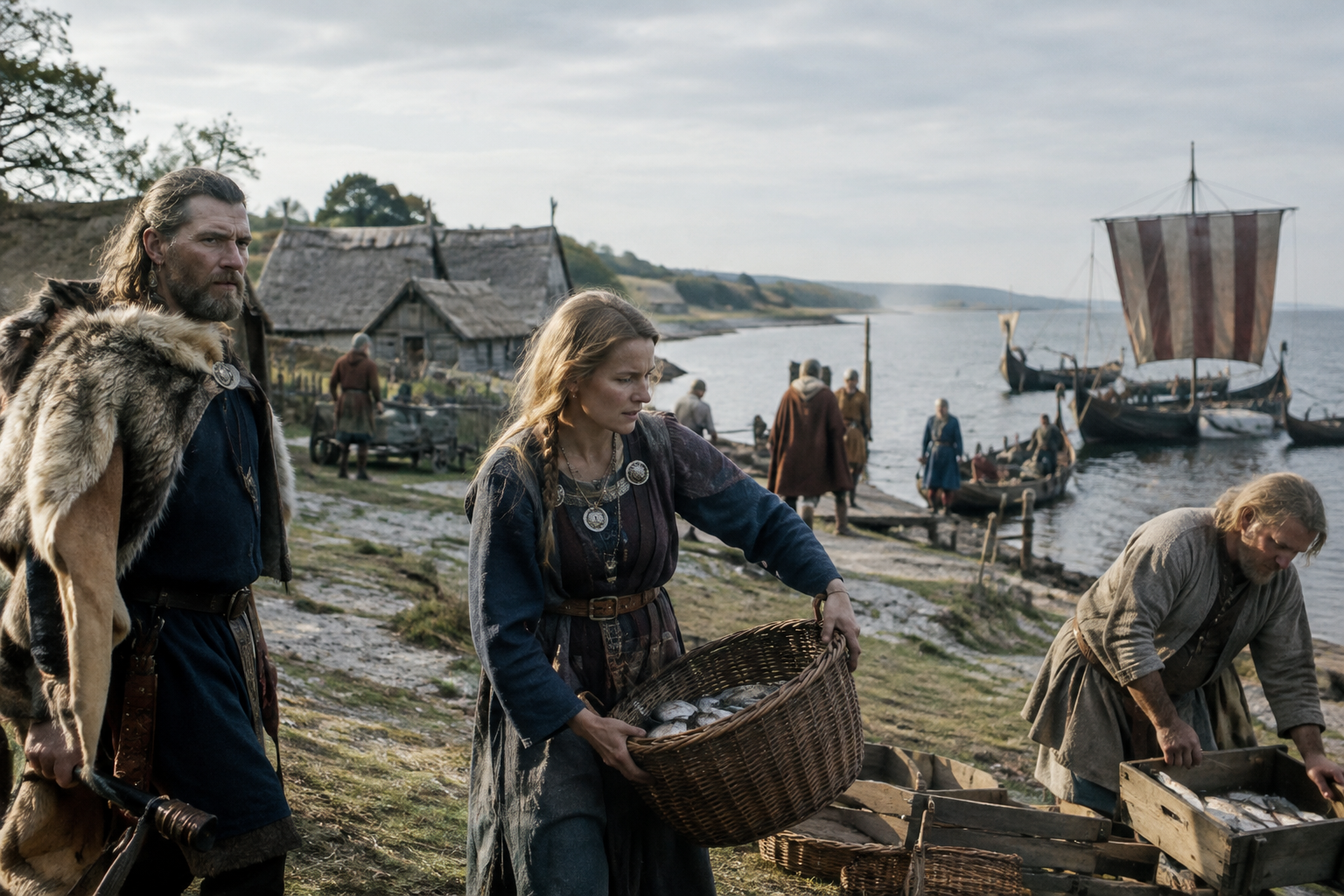
At Kopparsvik on Gotland, one Viking Age man has become a surprisingly useful guide to a very narrow paternal line. The individual known as VK469, dated to about AD 975, carries the Y-DNA haplogroup R1b1a1b1a1a1c2b2a1b1a4a1a in the MyTrueAncestry classification. That is a very precise branch name, and the value of a find like this is not that it tells us everything about Vikings, but that it pins one paternal line to one real person in one real place at the end of the Viking Age.
Gotland is an excellent place to start because it was never an isolated backwater. This Baltic island sat in the middle of movement: trade, travel, raiding, craft production, conversion, and contact across Scandinavia and beyond. A direct paternal lineage found here around AD 975 belongs, therefore, to a world of connections rather than to a sealed ethnic box. Y-DNA traces one father's father's line, not a person's entire ancestry, but that single line can still anchor family history in a very specific historical landscape.
Kopparsvik, near Visby, is one of the important burial areas for understanding Viking Age Gotland. By the late 10th century, the island was deeply involved in Baltic exchange networks, and its communities were participating in the wider Scandinavian world while also keeping local habits and identities of their own. A man such as VK469 lived in that in-between moment when older pagan-era traditions, expanding trade circuits, and the spread of Christianity all overlapped.
That matters for interpreting a haplogroup like R1b1a1b1a1a1c2b2a1b1a4a1a. The branch is very narrow, but its ancient appearance in Viking Age Gotland shows that even finely resolved paternal lines were present within the mixed and mobile societies of the Baltic. It would be a mistake to turn one lineage into a synonym for "the Vikings." The more careful conclusion is better: this branch was part of the male-line diversity of a Scandinavian island society at a time of intense movement and exchange.
An ancient DNA study of Viking-period populations posted at https://www.biorxiv.org/content/10.1101/703405v1 helped frame exactly this larger question: how diverse were the people moving through the Viking world, and how often do archaeology's cultural labels hide biological variety? Finds like VK469 are useful because they bring the answer down to ground level, to one excavated individual rather than to a vague idea of population history.
Anyone researching this haplogroup will notice immediately how long the label is. That is because it sits far downstream inside the huge western Eurasian Y-chromosome family commonly called R1b. The broad parent branch has a very deep and wide history across Europe, but that does not mean every tiny descendant branch shares the same story in every period. A narrow subclade such as R1b1a1b1a1a1c2b2a1b1a4a1a represents a much more recent slice of that history.
In practical terms, the Kopparsvik sample shows that this line had reached, or was already established on, Gotland by the late 10th century. That does not tell us where the branch first formed, and it does not by itself prove whether VK469's paternal ancestors had been on the island for generations or had arrived more recently through trade, marriage, or migration. What it does provide is a secure historical waypoint: this lineage was present in a documented Viking Age Baltic setting.
This is one of the quiet strengths of ancient DNA. Modern testers often want an origin story with a single homeland and a clean migration arrow. Archaeology usually gives us something messier, and more interesting: men carrying related paternal lines could belong to communities that were linguistically, culturally, and socially entangled across the North Sea and Baltic worlds.
To understand why VK469 is historically useful, it helps to remember what Gotland was in the Viking Age. The island occupied a strategic position in the Baltic Sea, linking Scandinavia to eastern trade routes, river systems leading into eastern Europe, and markets where silver, furs, textiles, and people all moved. A paternal lineage found on Gotland therefore sits in a setting shaped by commerce as much as by conquest.
That broader context has been increasingly reinforced by archaeological science on the island itself. MyTrueAncestry readers who want a longer background on Gotland's deep population history can compare this Viking Age evidence with much older island data in the post below.
The contrast is instructive. Gotland had already seen major demographic and cultural changes long before VK469 was buried there. By the Viking Age, the island was not preserving some untouched ancient population. It was participating in the continual reshaping of northern Europe, where local continuity and incoming connections existed side by side.
Because Gotland was part of the Scandinavian world, it naturally enters discussions about the spread of Germanic languages. But language, ancestry, and Y-DNA are not interchangeable. A man carrying R1b1a1b1a1a1c2b2a1b1a4a1a on Gotland around AD 975 may well have lived in a Norse-speaking environment, yet that does not mean the branch itself can simply be labeled "Germanic" as though lineages spoke languages on their own.
Still, ancient genomics has shown that the spread of historically Germanic-speaking populations involved both continuity and mixture. The Viking world was full of local populations with overlapping ancestries rather than one uniform biological type. That is exactly why a single sample like VK469 matters: it adds one definite paternal thread to a much larger woven fabric.
For descendants or testers today, the lesson is a useful one. If your paternal line falls within this branch, the Viking Age appearance on Gotland does not prove that your surname line came from Gotland, nor that every ancestor was Scandinavian. But it does show that the branch belonged to the sort of northern European population networks that were active in the Baltic during the 10th century.
Ancient DNA articles often focus on kings, mass migrations, or dramatic population replacements. Yet much of the real work of reconstructing the past comes from ordinary individuals in ordinary cemeteries. VK469 is important for precisely that reason. He is not useful because he can be turned into a legend, but because he fixes a narrow male line within a known archaeological time and place.
Scandinavian islands are especially revealing in this respect. They tend to preserve both local habits and the traces of long-distance contact. Comparing Gotland with places such as Finland or other Baltic-connected regions helps show that the northern world of the early Middle Ages was not neatly divided into static peoples. It was a corridor of interaction.
Baltic connections in early medieval Finland
That is the right scale on which to think about this haplogroup. Not as a badge of a tribe, and not as a shortcut to a saga hero, but as one paternal branch carried by a real man on an island tied into the commercial and cultural traffic of the Baltic Sea.
The clearest evidence for R1b1a1b1a1a1c2b2a1b1a4a1a here is its appearance in VK469 from Viking Age Kopparsvik, Gotland, around AD 975. That makes this branch historically visible in a Scandinavian Baltic context at the end of the Viking Age. For someone exploring their paternal ancestry today, that is not a complete biography of the line, but it is a solid historical foothold: your direct male line belongs to a branch that was present in one of the most connected regions of the Viking world.





Comments