Haplogroup R1b1a1b1a1a1c2b2a1b1a1a1

– 6 min read


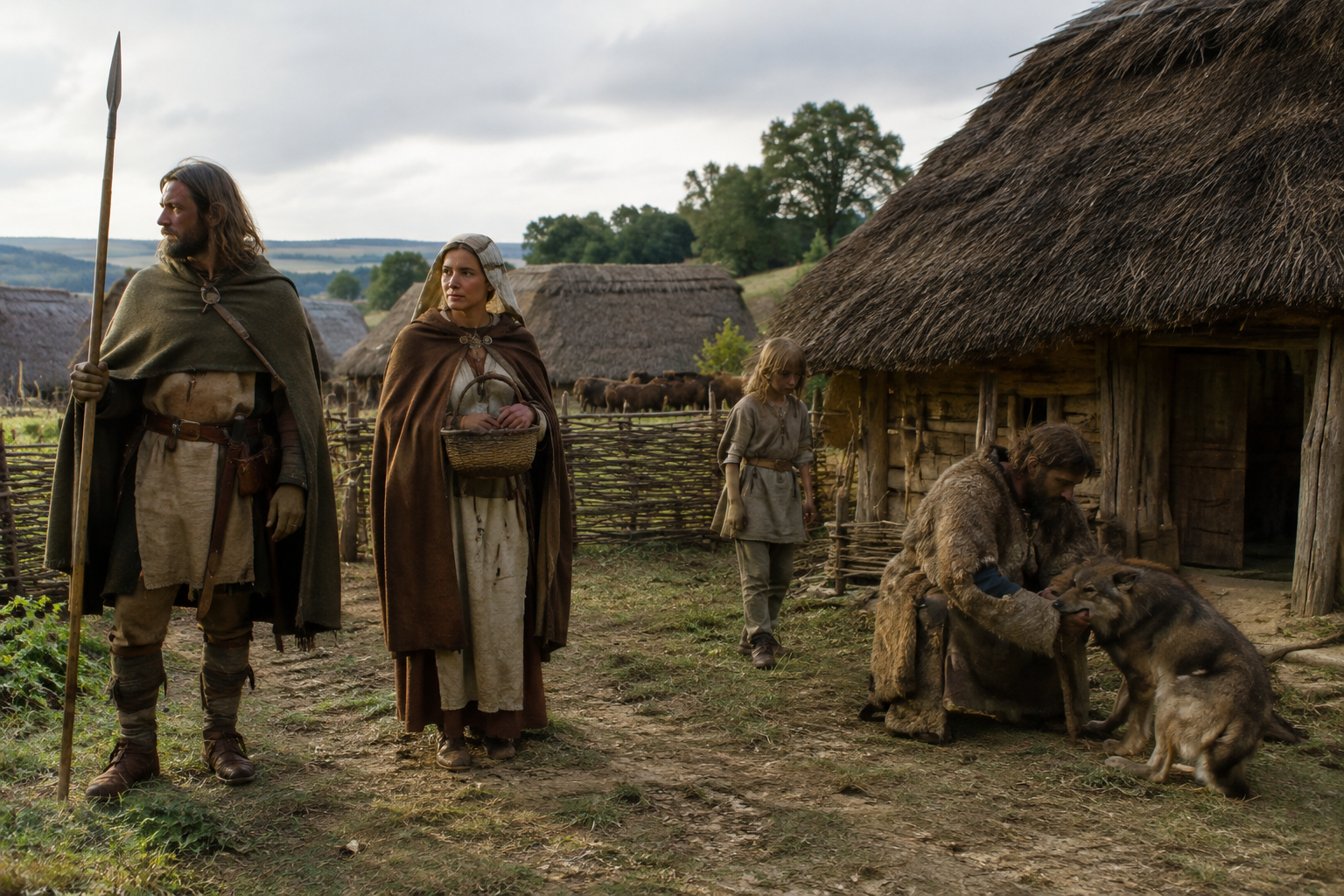
Some Y-chromosome lineages arrive in history with trumpets and banners. Others come to us more quietly: from a burial in early medieval Germany, from a ruined Border tower in Scotland, from the stubborn survival of a paternal branch through centuries of war, migration, and social change. Haplogroup R1b1a1b1a1a1c2b2a1b1a1a1 belongs to one of those stories where the evidence is intriguing, but where the historian and the geneticist both have to keep their feet on the ground.
This is a very specific subclade within the vast Y-DNA family of R1b, one of the major paternal lineages found across much of western Eurasia. That broader R1b story stretches back deep into prehistory and is often discussed in connection with later Bronze Age and post-Bronze Age population changes in Europe. But we must be careful: a narrow subclade is not the same thing as the whole parent branch. What matters here is not a grand claim that explains all of Europe, but the more interesting question of how one small paternal line appears within later historical landscapes.
Y-DNA traces a direct paternal line: father to son to son. It is powerful for studying one thread of ancestry, but it is only one thread. It does not represent a person's full ancestry, culture, language, or identity. Nor does sharing a haplogroup prove close kinship. Still, when ancient DNA, archaeology, and regional history begin to overlap, even a narrow lineage can illuminate a surprisingly large world.
The wider R1b tree has long been central to debates about European prehistory, especially questions of population movement after the Neolithic and during the Bronze Age. Many branches of R1b became widespread across western and central Europe over time, but the exact pathways taken by any one downstream lineage can be much harder to pin down. For a subclade as specific as R1b1a1b1a1a1c2b2a1b1a1a1, caution is not just sensible, it is essential.
What can be said responsibly is that this haplogroup sits within a paternal family whose deeper history is bound up with the making of Europe after prehistory: the mixing of older Neolithic farming communities, steppe-derived ancestry, and later regional populations. By the early medieval period, such paternal lines were being carried by men living in societies we would recognize from written history: post-Roman kingdoms, frontier communities, and tribal confederations rather than anonymous prehistoric horizons.
That is one reason this lineage is historically interesting. It draws our eye away from the rather lazy habit of saying "R1b equals X people" and toward a more useful question: how did specific paternal branches survive into the fluid world of late antiquity and the early Middle Ages?
Explore Central European DNA History
The clearest anchor supplied here is an ancient individual from Germany: DRH010, identified as Thuringii Tribe Germany Deersheim Saxony-Anhalt Year:500 AD. That single line of evidence is worth lingering over, because it places this paternal branch in a highly charged historical setting.
Around 500 AD, Saxony-Anhalt sat in a world reshaped by the collapse of Roman power in the West. Old imperial structures had weakened or vanished, while new political identities were forming among groups later described in written sources as Thuringians, Saxons, Franks, Goths, and others. These were not sealed biological tribes marching about with neat genetic labels. They were political and social communities, often mixed, mobile, and adaptive. Ancient DNA has been particularly good at reminding us of that awkward truth.
In that setting, DRH010 matters because he gives us a real man in a real region at a real historical moment. He is not "the origin" of the haplogroup, nor proof that all Thuringians carried it, nor the ancestor of any later family we can name. But he does show that this paternal line, or a very close related branch within the supplied classification, was present in central Germany in the early medieval period.
That is a valuable historical foothold. It places the lineage not in myth, but in the broken and reassembled political geography of post-Roman Europe. It also fits a broader archaeological picture in which central Germany was a corridor of continuity and movement, where older local populations and newer political formations met.
Read About Post-Roman Central Europe
It is tempting to make too much of a single sample, especially when the haplogroup label is so precise. But one of the virtues of archaeogenetics is that it disciplines the imagination. DRH010 does not prove direct descent to any medieval dynasty, clan, or modern tester. He does not stand for every man in Deersheim, and certainly not for every Thuringian. What he offers is context: this paternal branch was part of the human material of early medieval central Europe.
That context matters when we think about how lineages persist. Paternal branches can survive dramatic changes in language, lordship, religion, and identity. A line present in one post-Roman community may later appear, centuries on, in quite different social worlds. Written genealogy usually cannot follow that deep continuity. Ancient DNA sometimes can glimpse it, though only in fragments.
Readers interested in that broader frontier world may enjoy related work on late antique mobility and mixture, especially where the old Roman frontier dissolved into something far less tidy than schoolbook history suggests.
Discover the German Frontier World
The supplied family material shifts us from burial grounds to built landscapes, and from early medieval Germany to later Scotland. That jump is precisely the kind of leap that needs careful handling. We do not have evidence here that Clan Bell, Clan Marjoribanks, or Clan Moffat descend directly from DRH010. We do not even have proof that every paternal line within those families belonged to this haplogroup. Medieval and early modern families were never genetically uniform in the way romantic clan histories sometimes suggest.
What we do have is a historical association worth exploring. Clan Bell is linked here to The Black Tower, also called Blacket House, near Berwick in the Scottish Borders. This was a region made by insecurity: raids, feuds, divided loyalties, and constant negotiation between Scotland and England. Border towers were not simply picturesque little castles. They were practical answers to danger, places of refuge as much as status.
There is something rather fitting in placing a paternal lineage beside such a structure. Y-DNA often gives us not a royal palace but a watchtower view of history: narrow, local, stubbornly surviving. The Black Tower survives mainly in memory and historical notes, which in itself says much about Border life. Grand dynasties leave archives. Frontier families often leave fragments.
Clan Marjoribanks, by contrast, is linked to Balbardie House in West Lothian. Here the story is slightly different. Balbardie began as a 16th-century tower house for the Mure family, later expanding into a laird's residence and then a country house. That layered architecture is almost a perfect metaphor for genetic history. Beneath later comfort and status lie older fortified bones. Beneath modern surnames and family traditions lie older paternal branches, inherited almost invisibly across generations.
The Clan Moffat entry is more elusive, since the supplied text simply says, "Please share the location you want described." That absence is instructive too. Historical memory is uneven. Some families are attached to named houses and documented sites; others remain harder to place within this specific dataset. Genetics can sometimes fill gaps, but only when evidence is actually there.
It would be quite wrong to say that a ruined tower proves a haplogroup. Stones do not yield pedigrees by themselves. But castles, tower houses, and ancestral seats preserve something else: geography. They tell us where families held ground, where memory settled, and where later genealogical traditions took shape.
That geographical memory is where ancient DNA and medieval history begin to speak to one another. A lineage present in early medieval central Europe and later found in families of the British Isles would not be surprising in broad historical terms. Europe between late antiquity and the later Middle Ages was full of movement, settlement, service, marriage, and reinvention. But broad plausibility is not the same as documented descent. The honest historian keeps those categories separate.
Still, there is a real thrill in seeing how these different records complement one another. Ancient DNA gives us men like DRH010, otherwise silent. Historical architecture gives us Black Tower and Balbardie House, otherwise detached from deep prehistory. Together, they remind us that paternal ancestry is not only about names on a pedigree chart. It is about the long survival of male lines through tribal worlds, frontier violence, estate society, and the accidents of archival preservation.
Readers drawn to the Scottish side of this story may also want to look at broader work on Scotland's own deep kinship landscapes, where archaeology and DNA often complicate later clan legend in fascinating ways.
Haplogroup R1b1a1b1a1a1c2b2a1b1a1a1 is a reminder that the most useful genetic stories are often the most restrained. Its broader ancestry belongs within the immense and complicated history of R1b in Europe, but its specific importance lies in documented appearances and historical context, not sweeping claims. The sample DRH010 places this lineage in early medieval Saxony-Anhalt among the shifting societies of post-Roman Europe. The associated clan and castle material places our attention on later historical regions where paternal identity, family memory, and local strongholds mattered deeply.
That does not produce a straight line from Deersheim to a Scottish tower house. History is rarely so neat. But it does show how one paternal branch can become a useful thread for thinking about continuity, migration, and survival across a millennium of European change.
If you carry this haplogroup, or a nearby branch, MyTrueAncestry can help you explore where your paternal line may fit into the bigger archaeological picture. Ancient DNA matches can offer striking historical context, even when they do not prove direct descent from a named individual or noble family.
Upload your DNA to MyTrueAncestry and see whether your results connect you with ancient populations, early medieval individuals, and the historical landscapes discussed here.






Comments