Haplogroup R1b1a1b1a1a1c2b2a
– 7 min read


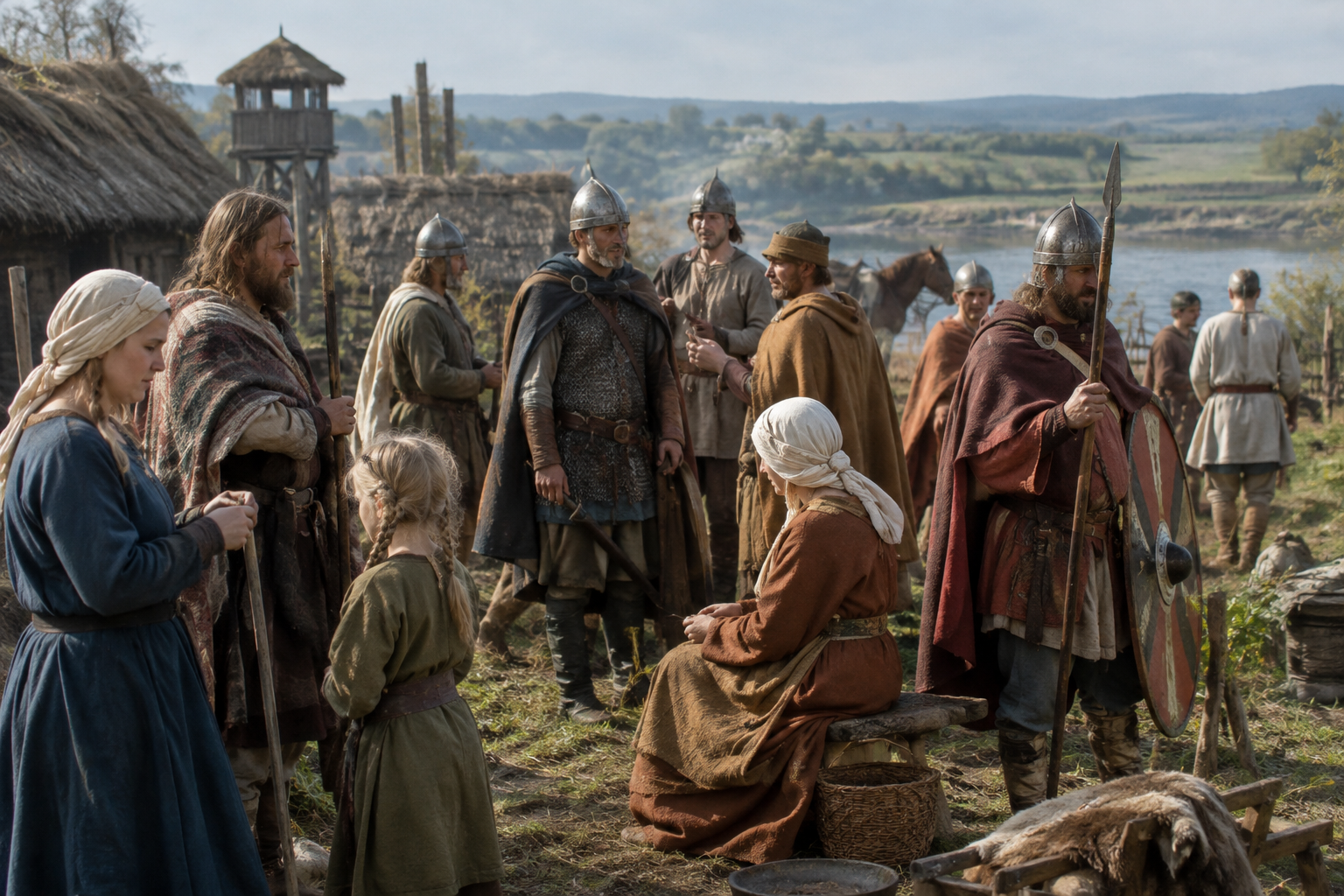
Some Y-DNA haplogroups announce themselves with royal drama or vast prehistoric fame. Others are more interesting precisely because they have to be reconstructed from scattered clues: a burial in Iron Age Yorkshire, a Jutland bog, Merovingian cemeteries in Germany, a Norman-period man at Lincoln Castle, and much later the memory of an old Welsh landed house at Tredegar. Haplogroup R1b1a1b1a1a1c2b2a belongs to that second category. It is not a complete story in itself, but a narrow paternal thread that can be followed through several of the most important population zones of northwestern Europe.
As ever with Y-DNA, a small note of caution is essential. A Y-chromosome haplogroup traces only one direct paternal line: father to father to father. It does not describe a person's whole ancestry, culture, language, or identity. Nor does sharing a haplogroup prove close relationship. But when a lineage appears in ancient burials across different centuries and regions, it becomes a useful historical instrument. It helps us ask where paternal continuity may have existed, where mobility was common, and how archaeology and genetics can illuminate one another.
R1b1a1b1a1a1c2b2a sits deep within the broad R1b family, one of the major Y-chromosome groupings in western Europe. For a very specific subclade like this, it is important not to lazily assign to it the whole grand history of every R1b branch. The broad parent lineage is found across large parts of Europe, but a narrow downstream branch has its own, much more local story. The evidence supplied here suggests that this particular paternal line, or closely related lines around it, was present in a northwestern European world that included Iron Age Britain, southern Scandinavia, the lower North Sea zone, and early medieval Germanic and post-Roman communities.
That does not mean the branch "belonged" to Celts, Jutes, Franks, Vikings, or Normans in any exclusive sense. Quite the reverse. What is striking is how one paternal thread can turn up in several historically distinct settings. That is exactly why ancient DNA matters: it complicates tidy ethnic labels.
Explore Celtic DNA and language spread
The earliest samples in this group already point to an intriguing western and northern European distribution. At Pocklington in East Yorkshire, two Iron Age men carry this paternal signature: I21639, described as a Celtic Parisi individual from 275 BC, and I21952, a Celtic Briton from 225 BC. East Yorkshire in the Iron Age was no isolated backwater. It faced the North Sea and the continental world beyond it. The Parisi of the region have long attracted interest because of their burial traditions and their links, whether close or distant, with continental cultural currents.
Then there is CLR23, from Le Cailar in southern France, dated to 350 BC and described as an Iron Age severed head burial. It is a reminder that related paternal lines could appear far from Britain, in the wider Celtic and post-Hallstatt world of Iron Age Europe. One should not leap from that fact to a simple migration map. But it does suggest that this branch, or close relatives, belonged to a broader western European landscape rather than to one tiny and sealed-off population.
The northward side of the picture appears in CGG019215, a Jute-associated individual from Alken Enge in Jutland, Denmark, dated to 191 AD. Alken Enge is one of those archaeological sites that pull the rug from beneath tidy textbook history: a wetland deposit preserving the dead of conflict, a reminder that the Roman-era north was violent, mobile, and interconnected. If a related paternal line appears both in Iron Age Britain and in Jutland, we are looking at a North Sea zone in which male lineages could circulate long before the better-documented Anglo-Saxon centuries.
That becomes still more suggestive with the early medieval burials in Kent: BUK040, a Jute Early Anglo Saxon individual from Buckland Dover dated to 400 AD; BUK011, BUK001, and BUK006 from the same general Buckland Dover context; and POH001, a Jute Early Medieval burial from Polhill, Kent, dated to 600 AD. Kent has always been one of the most revealing parts of England for the study of movement across the Channel. These burials do not prove a single family saga stretching from Yorkshire to Jutland to Dover. But together they make the point that this paternal lineage had a real place in the migration-period North Sea world.
Read about Anglo-Saxon migration DNA
By the fifth to seventh centuries, this haplogroup appears in a string of early medieval continental contexts. ADN014 comes from a Frankish grave at Hannover-Anderten in Lower Saxony, dated to 400 AD. OBM054 belongs to the Thuringii sphere at Obermoellern in Germany, dated to 500 AD. SZL070 and MFC016 come from Longobard-period contexts in Pannonia, at Savaria Szeleste and Arrabona Menfocsanak in present-day Hungary, dated to 525 AD and 550 AD. Then there are Merovingian-associated burials such as Alh_268 from Altheim in Bavaria, dated to 600 AD, Mln14 from Frankish Moemlingen, dated to 650 AD, and G63 from Lauchheim Mittelhofen in Germany, dated to 700 AD.
That list matters because it shows this lineage in exactly the sort of mixed and shifting political environments that followed the end of Roman imperial power in the West. Franks, Thuringians, Bavarians, and Longobards were not biological tribes in the crude old-fashioned sense. They were political and social formations, often absorbing people of varied origins. A paternal line found across such contexts does not identify an ethnicity. It reveals participation in that post-Roman world of alliance, mobility, military service, and settlement.
The Longobard-period samples are especially useful because Pannonia was a hinge region between central Europe, the Danube, and Italy. The Merovingian and Frankish burials, meanwhile, place the lineage firmly in the societies that would shape the medieval map of western Europe. A line that turns up from Kent to Bavaria to Pannonia is not the signature of stasis. It belongs to movement.
Explore the German frontier after Rome
Later appearances show that the story did not end with migration-period cemeteries. I3044, from Lincoln Castle in Lincolnshire and dated to 1090 AD, places the lineage in Norman dynasty England. Lincoln Castle was one of the great instruments of conquest and administration after 1066, a fortress planted into an already ancient urban landscape. A man buried in that milieu may have had paternal roots that were local, continental, Scandinavian, or some combination shaped by earlier centuries. That is precisely the point: Y-DNA can show continuity of male lines across political ruptures that written history presents as sharp breaks.
Two further samples widen the medieval geography. ST1237, from Sint-Truiden Onze-Lieve-Vrouwekerk in Belgium dated to 900 AD, shows the branch in the Low Countries, while ATP_PSN_127 from St John's Hospital, Cambridge, dated to 1209 AD, shows it in high medieval England. CGG106775, a Viking Age Denmark sample from Bogovej dated to 975 AD, fits neatly into the same northern European zone. By now one can see the shape of the evidence: not one dynasty, not one tribe, but a durable paternal presence around the North Sea, the Low Countries, England, Denmark, and early medieval German-speaking regions.
This is where the later historical setting comes in. Tredegar House, near Newport in south Wales, became the seat of the powerful House Morgan, later the Lords Tredegar. For centuries it stood at the center of one of the great landed estates of the region. Rebuilt largely in the late seventeenth century in red brick, with ambitious interiors and formal rooms, it projected exactly the kind of authority that old families liked to present as timeless: rooted in land, service, patronage, and memory.
But houses such as Tredegar are useful not because they prove a haplogroup. They do not. Rather, they remind us what written genealogy preserves and what it leaves out. Aristocratic houses preserve names, marriages, inheritances, and architecture. Y-DNA preserves only a narrow paternal thread. The two kinds of evidence intersect only cautiously. A historical association between a lineage and a family is not proof that every Morgan male carried the same branch, nor that an ancient man from Yorkshire or Kent was an ancestor of the Morgans of Tredegar.
Still, there is a broader geographical resonance worth noting. Wales sits beside the same western British and North Sea historical theatre in which several of the ancient samples occur. The Iron Age men of East Yorkshire, the Kentish early medieval burials, the Norman-period individual at Lincoln Castle, and the later Welsh noble setting all belong to a long-connected British story shaped by migration, conquest, continuity, and regional adaptation. Tredegar House today survives as one of the finest historic houses in Wales, not as a genetic document, but as a place where that later chapter of elite regional history can still be seen.
Discover the history of the Morgan family
R1b1a1b1a1a1c2b2a is a good example of why ancient DNA is most interesting when it resists easy slogans. The evidence provided here links the lineage with Iron Age Britain, Iron Age southern France, Roman-era Jutland, early Anglo-Saxon Kent, Frankish and Merovingian Germany, Longobard Pannonia, Viking Age Denmark, Norman England, medieval Belgium, and medieval Cambridge. That is not a neat ethnic badge. It is a map of persistence and movement in western and central Europe.
For family historians, that matters. Traditional genealogy usually reaches back only so far, and mostly through documents. Ancient DNA adds a different sort of depth. It can show that a paternal line existed in a region more than a thousand years ago, or that it was present in several neighboring historical populations. What it cannot do, without much more specific evidence, is prove descent from a named noble house or a single famous warrior in a cemetery.
If your own Y-DNA belongs somewhere near this branch, the excitement lies in context. Your direct paternal line may be part of a story that touched Iron Age Britain, the North Sea world, and the societies that emerged after Rome. That is already quite enough to be getting on with.
If you want to explore whether your DNA shows links to ancient individuals like I21639, I21952, BUK040, G63, or I3044, MyTrueAncestry lets you compare your results with archaeological discoveries from across the ancient world. These matches can offer remarkable historical perspective, even when they do not prove direct descent from any particular person, dynasty, or noble family.






Comments