Haplogroup R1b1a1b1a1a1c2b1b4
– 5 min read


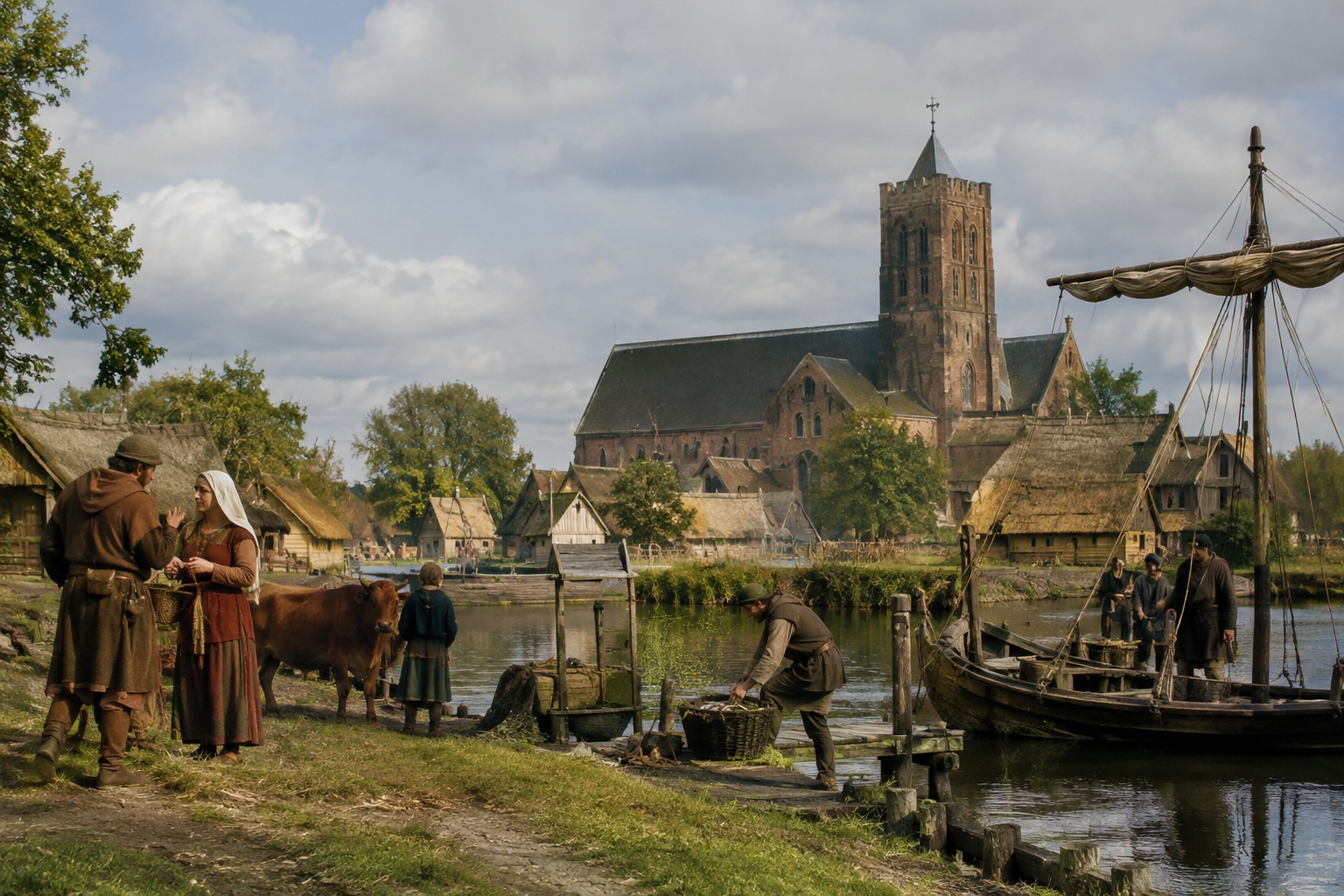
In around AD 1090, a man now identified as GRO023 was living in or near Groningen in the northern Netherlands, in a landscape of marshes, terp settlements, church foundations, and busy North Sea contacts. He belongs to the long Y-chromosome line labeled R1b1a1b1a1a1c2b1b4, a very precise paternal branch reported for this Carolingian-era to post-Carolingian context. That may look forbiddingly technical, but the historical interest is simple enough: one medieval man can anchor a paternal lineage in a region where language, power, and population were still being reshaped after the Roman world had gone.
GRO023 matters not because one skeleton can stand for all of Groningen, still less for all medieval Dutch men, but because he places this paternal line in a specific time and place. Y-DNA follows only the direct male line, so it is not the whole story of a person's ancestry. Even so, when a branch appears in a securely dated early medieval setting, it gives us a rare fixed point from which to think about continuity, migration, and local society.
The label "Carolingian Era Groningen Netherlands" immediately places GRO023 in a world shaped by the long afterlife of the Frankish empire. By about AD 1090, the Carolingian dynasty itself was long gone, but its political and religious framework still mattered. Parish organization, lordship, monastic influence, and the habits of written administration all survived in one form or another, even in regions at the northern edge of older Frankish control.
Groningen was no backwater. Northern coastal communities were tied into North Sea movement, with links that could run west toward the British Isles, east along the Frisian and Saxon coast, and south into the river systems of the Low Countries and the Rhineland. A paternal branch found here should therefore be understood within a connected maritime and riverine zone, not as an isolated local curiosity.
That wider setting makes GRO023 more interesting than the bare sample label first suggests. He lived in a region where older Frisian traditions, neighboring Saxon influences, Christian institutions, and seaborne exchange overlapped. A lineage found in such a setting may reflect deep local roots, movement across the North Sea world, or both.
Germanic languages and genomes
The important thing is to keep the scales straight. R1b1a1b1a1a1c2b1b4 is not the same as R1b in general. R1b is a very broad and widespread West Eurasian paternal haplogroup with a long and complicated history; this article's lineage is one tiny twig on that great branching tree.
Because the branch named here is so specific, caution is essential. We should not automatically project onto it every large narrative ever told about R1b, whether Bell Beaker expansions, Celtic speech, Atlantic Europe, or later medieval dynasties. What GRO023 securely offers is a medieval datapoint in the northern Netherlands. The deeper history of this exact subclade needs multiple ancient and modern comparisons before any more ambitious claim becomes safe.
That said, the context is suggestive. Northern medieval Europe often shows a complicated blend of local continuity and incoming paternal lines, especially in regions tied to migration-period and Viking-age networks. In that sense, a precise R1b branch in Groningen fits a historical world in which male-line ancestry could persist for generations while cultures, loyalties, and languages around it shifted.
It is tempting to imagine medieval Groningen as merely Dutch in a modern sense, but that would flatten the evidence. Around the 11th century, this was part of a broader coastal zone where Frisian, Saxon, Scandinavian, and Frankish connections all mattered. Men moved as traders, sailors, clerics, farmers, retainers, and settlers, and their descendants could end up genetically local within a few generations while still carrying lineages that had traveled.
That is one reason ancient DNA from the wider North Sea basin has proved so valuable. Research on early medieval populations in England, for example, has helped clarify how migration and mixture actually worked on the ground, often revealing substantial continental North Sea input alongside local ancestry rather than a simple tale of replacement. A useful point of comparison is this ancient DNA study of migration and population formation in early medieval England, which speaks to the same connected seaway world in which Groningen participated.
GRO023 does not prove that his paternal line arrived in one particular migration episode, nor that he or his father crossed the sea themselves. But he belongs to a region where such movements were historically normal, and that makes his lineage part of a much larger northern European story: not a march of neat tribes, but a mesh of neighboring communities linked by water, trade, marriage, and power.
One of the common traps in discussing early medieval DNA is to slide too quickly from genetics to ethnic naming. Groningen sits close to areas historically associated with Frisians, while also lying in reach of Saxon political and cultural influence. Those labels come from language, law, written sources, and later identity; a Y-chromosome lineage does not by itself choose between them.
That is worth dwelling on because the period is often described in tribal shorthand. Yet the archaeology and history of the Low Countries show communities that were neither sealed off nor static. The same paternal lineage could appear in men who spoke related but different dialects, lived under different lords, or identified with changing regional loyalties over time.
So if you carry this branch today, the medieval clue is best read geographically and historically before it is read ethnically. GRO023 points toward the northern Low Countries and the wider North Sea zone as a meaningful arena for this lineage in the late first millennium and early second millennium AD. That is already a substantial insight.
Readers sometimes assume that one sample is too little to say anything useful. In one sense that is true: a single man cannot define a population. But ancient DNA is often most valuable precisely when it gives us one securely placed individual, because it prevents speculation from floating free of time and place.
With GRO023, we are not dealing with an abstract modern distribution map or a surname tradition reconstructed backwards. We have a man from a real medieval landscape in the Netherlands, dated to around AD 1090, attached to a very specific paternal branch. That is the sort of evidence that can later be compared against other burials from the Low Countries, coastal Germany, Britain, or Scandinavia as the ancient record grows.
The Lower Rhine-Meuse and northern coastal regions have become increasingly important in archaeogenetics because they sit at the meeting point of deep prehistoric population change and historically documented medieval mobility. For broader regional background, the MyTrueAncestry piece on persistent forager ancestry and the Bell Beaker expansion in the Lower Rhine-Meuse region is a good reminder that these landscapes had already seen major demographic shifts long before GRO023's lifetime.
Lower Rhine-Meuse deep history
The distinctive value of haplogroup R1b1a1b1a1a1c2b1b4 here is not that it unlocks a royal pedigree or a grand tribal legend. It is that it is anchored, however modestly, in a real man from medieval Groningen. GRO023 places this paternal line within the northern Low Countries at a time when coastal Europe was stitched together by trade, lordship, Christianity, and the long legacy of migration.
For someone researching this branch today, that is the responsible takeaway. Your direct paternal line may have meaningful roots in the North Sea world of the early medieval Netherlands, but its full story will emerge only by comparing this medieval evidence with other ancient samples and with modern family-line testing.






Comments