Haplogroup R1b1a1b1a1a1a1b

– 6 min read


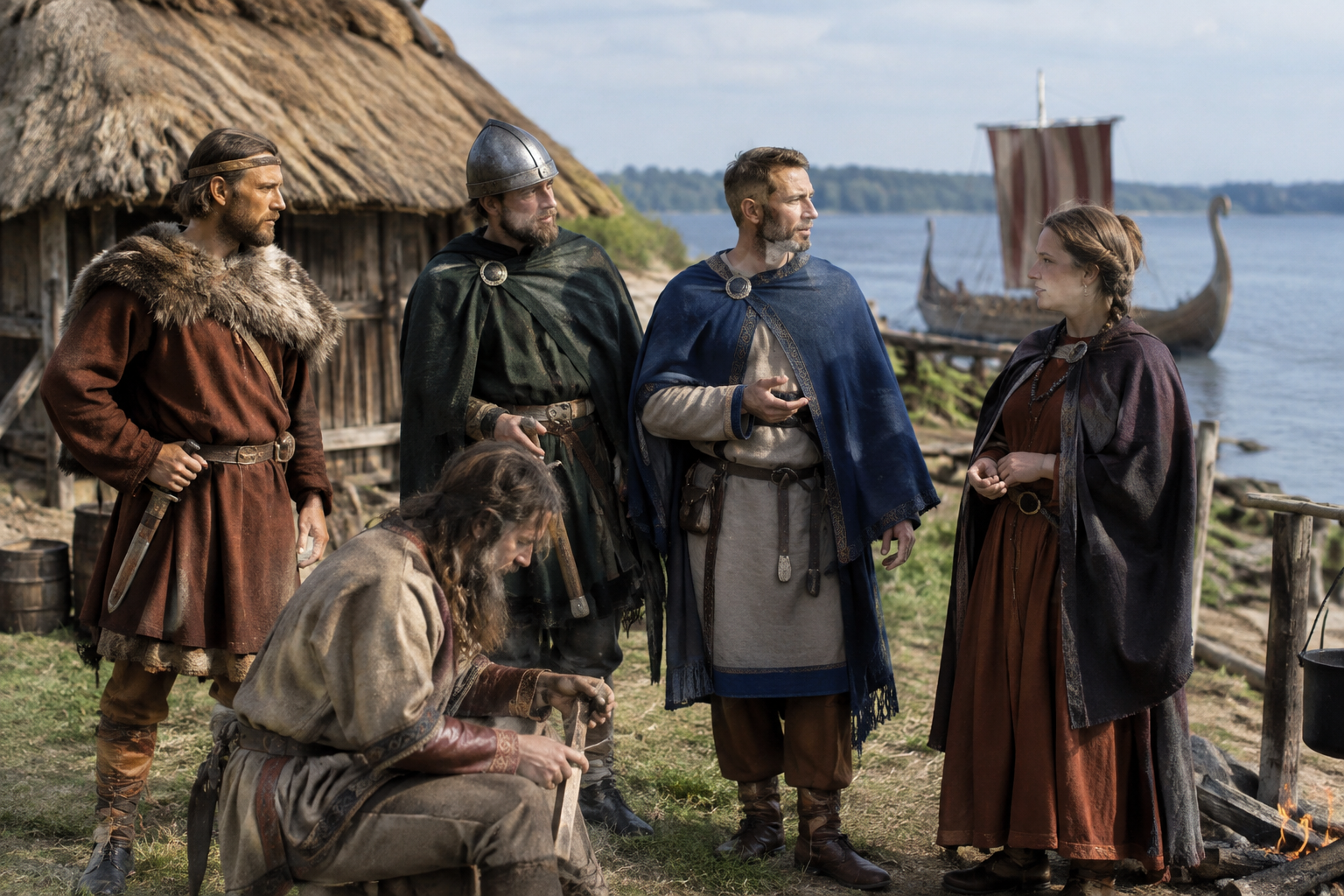
Some Y-chromosome lineages are easy to place in the big set-piece stories of European prehistory. Others are more elusive. Haplogroup R1b1a1b1a1a1a1b belongs to that second category: a very specific paternal branch whose interest lies not in grand claims, but in how it appears across a wide northern European arc, from Gothic-era Pomerania to Viking and post-Viking Scandinavia, and into the medieval Low Countries. That is already a good historical puzzle.
Y-DNA haplogroups trace one narrow line of ancestry: the direct paternal line, father to son to son. They do not represent a person's whole ancestry, culture, or identity. But they are exceptionally useful for asking a particular kind of question: how did male-line branches move, persist, and sometimes reappear in new historical settings? In the case of R1b1a1b1a1a1a1b, the evidence supplied here points us toward the North Sea and Baltic worlds, where migration, trade, warfare, and lordship repeatedly brought people together.
This haplogroup sits inside the much larger Y-DNA family known as R1b, one of the major paternal lineages in western Eurasia and especially well known in parts of Europe. That broader family has a deep and complicated history, but caution matters here: we should not simply pour the entire story of R1b into one very specific downstream branch. A narrow subclade such as R1b1a1b1a1a1a1b may represent only one later twig within that much larger paternal tree.
What can responsibly be said is that the supplied ancient evidence places this branch, or a very closely related paternal signature, in historically connected regions around the southern Baltic, Denmark, and the Low Countries. That geographical spread suggests movement within the northern European world rather than an isolated local lineage. Whether that movement reflects migration, military mobility, trade networks, elite contacts, or simple long-term regional continuity will vary from case to case.
That is one of the pleasures of ancient DNA: it makes us look again at familiar maps. Coastlines, estuaries, river routes, and fortified high places begin to matter just as much as modern borders.
Learn How Ancient DNA Reconstructs History
The earliest supplied anchor is PCA0479, listed as Ancient Individual:Gothic Wielbark Poland Pommerania Gdansk Year:200 AD ID:PCA0479. Even in that brief description, there is a lot to work with. Pomerania and the Gdansk region sit on one of the great contact zones of northern Europe, a meeting place of Baltic shores, river access, and long-distance exchange. The Wielbark cultural horizon has long attracted attention in discussions of the Gothic world, though archaeologists and geneticists alike are careful not to reduce complex communities to a single ethnic label.
Still, PCA0479 is important. It places this paternal signal in a second-century setting tied to the southern Baltic coast, a region often associated with mobility and shifting cultural affiliations. This does not prove that later bearers of the haplogroup descended directly from that one man. But it does show that this male line, or a line extremely close to it, was present in a part of Europe central to late Iron Age and Roman-era northern networks.
Several centuries later, the branch appears again in Scandinavia. VK289, listed as Ancient Individual:Viking Age Bodkergarden Grav Denmark Year:850 AD ID:VK289, belongs to the Viking Age world. By this period Denmark was not a fringe zone but a hub: ships, war bands, traders, and dynastic ambitions all moved through its coasts and islands. A paternal lineage appearing here after an earlier appearance in Baltic Pomerania fits, at the very least, a world in which the Baltic and North Sea were linked rather than separate.
Then there is CGG101864, listed as Ancient Individual:Post Viking Denmark Ahlgade Holbaek Year:1325 AD ID:CGG101864. The date matters. This is not a Viking raider in the old dramatic mould, but a man from post-Viking medieval Denmark, a Christian kingdom with towns, parishes, and written administration. If VK289 shows the lineage in the age of longships, CGG101864 shows that such paternal lines did not vanish with the sagas. They continued into settled medieval society.
Seen together, PCA0479, VK289, and CGG101864 suggest something more interesting than a single migration event. They suggest recurrence across centuries in the Baltic-North Sea zone.
Explore Ancient DNA and the Gothic World
A fourth sample helps widen the frame. GRO012, listed as Ancient Individual:Carolingian Era Groningen Netherlands Year:910 AD ID:GRO012, places the lineage in the medieval Netherlands during or just after the Carolingian age. Groningen sits in a landscape of marsh, coast, terp settlements, and sea-facing exchange. It is also part of a region where the Frankish world, the North Sea world, and Scandinavian influence could all intersect.
This matters because it stops the story becoming too narrowly Scandinavian. The presence of GRO012 in the Netherlands suggests that the paternal branch belonged to a broader northwestern European setting. Medieval Groningen was not isolated from Denmark, the Frisian coast, or the wider political orbit of the Carolingians. A haplogroup appearing in both Denmark and the Low Countries across the early medieval centuries fits the historical reality of movement around the North Sea rim.
It also reminds us that ancient DNA is often most revealing when it punctures tidy categories. A paternal line may appear in a "Gothic" context in one century, a "Viking Age" context in another, and a Carolingian or post-Carolingian Christian context in a third. The lineage itself is not Gothic, Viking, or Carolingian. Men carrying it lived within those worlds.
By the time we reach the high Middle Ages, the evidence changes in character. Ancient DNA gives us burials and biological lineages; medieval history gives us named families, fortresses, and landscapes of power. The supplied noble associations do not prove that every member of those houses carried haplogroup R1b1a1b1a1a1a1b. That would be far too strong. But they do help us place the haplogroup in the sort of regions where these paternal lines continued to circulate and endure.
The House of Ardenne-Verdun brings us to Bouillon Castle in southern Belgium. Bouillon stands above the Semois and carries the layered history of the Ardennes in stone. It is best known as the seat of Godfrey of Bouillon, who sold it in 1096 to help fund the First Crusade, but the fortress is older than that celebrity moment and later than it too. Enlarged, battered, rebuilt, and reshaped for artillery warfare in the sixteenth and seventeenth centuries, Bouillon is really a history of adaptation. That is perhaps a fitting parallel for a haplogroup that appears across changing historical worlds: what lasts is not one fixed identity, but continuity through change.
The House de Havilland offers quite a different kind of site in Abilant Castle in west Cornwall. Here the interest lies precisely in uncertainty. Abilant is less a towering ruin than a historical puzzle, reconstructed from place names, field boundaries, old maps, and stray records. That makes it unexpectedly relevant. Not all ancestry survives as a grand pedigree. Some of it survives as fragments in the landscape, just as some paternal lines survive in DNA long after walls and earthworks have faded.
West Cornwall, with its routeways and crossings, also reminds us that medieval Britain was tied into the same wider seaways that linked the Channel, the North Sea, and the Atlantic facade. A haplogroup found in Denmark and the Low Countries belongs in a historical conversation that can include such western outposts, though not as proof of direct descent from any one noble house.
Read About the House of Ardenne-Verdun
So what can we fairly say about R1b1a1b1a1a1a1b? The safest conclusion is also the most interesting. This is a paternal branch attested in multiple northern European contexts: PCA0479 in Gothic-era Pomerania around 200 AD, VK289 in Viking Age Denmark around 850 AD, GRO012 in Carolingian-era Groningen around 910 AD, and CGG101864 in post-Viking Denmark around 1325 AD. That spread suggests long-term presence within interconnected Baltic and North Sea worlds.
It does not prove one continuous named dynasty, one ethnicity, or one simple migration route. Shared haplogroups do not automatically mean close kinship, and a noble association does not equal documented biological descent. But ancient DNA and medieval history work beautifully together when used with care. DNA reveals lines of paternal continuity invisible in chronicles. Castles and family records show the political and social landscapes through which those lines passed.
If this corner of the Y-chromosome tree interests you, you might also enjoy looking at broader regional studies of movement and continuity in the Rhine-Meuse and North Sea worlds.
Explore the Lower Rhine-Meuse Story
That, in the end, is the real fascination of a lineage like R1b1a1b1a1a1a1b. It is not a shortcut to aristocratic fantasy. It is something better: a way of seeing how one paternal thread can appear in different archaeological settings, endure through the end of the ancient world, and remain present in the medieval societies that later built castles, founded houses, and left records.
Upload your DNA to MyTrueAncestry to explore how your own ancestry may compare with ancient individuals like PCA0479, VK289, GRO012, and CGG101864, and to discover the deeper historical settings behind your results. Ancient DNA matches can open remarkable windows onto the past, even when they do not prove direct descent from any specific historical family.






Comments