Haplogroup R1a2b

– 5 min read


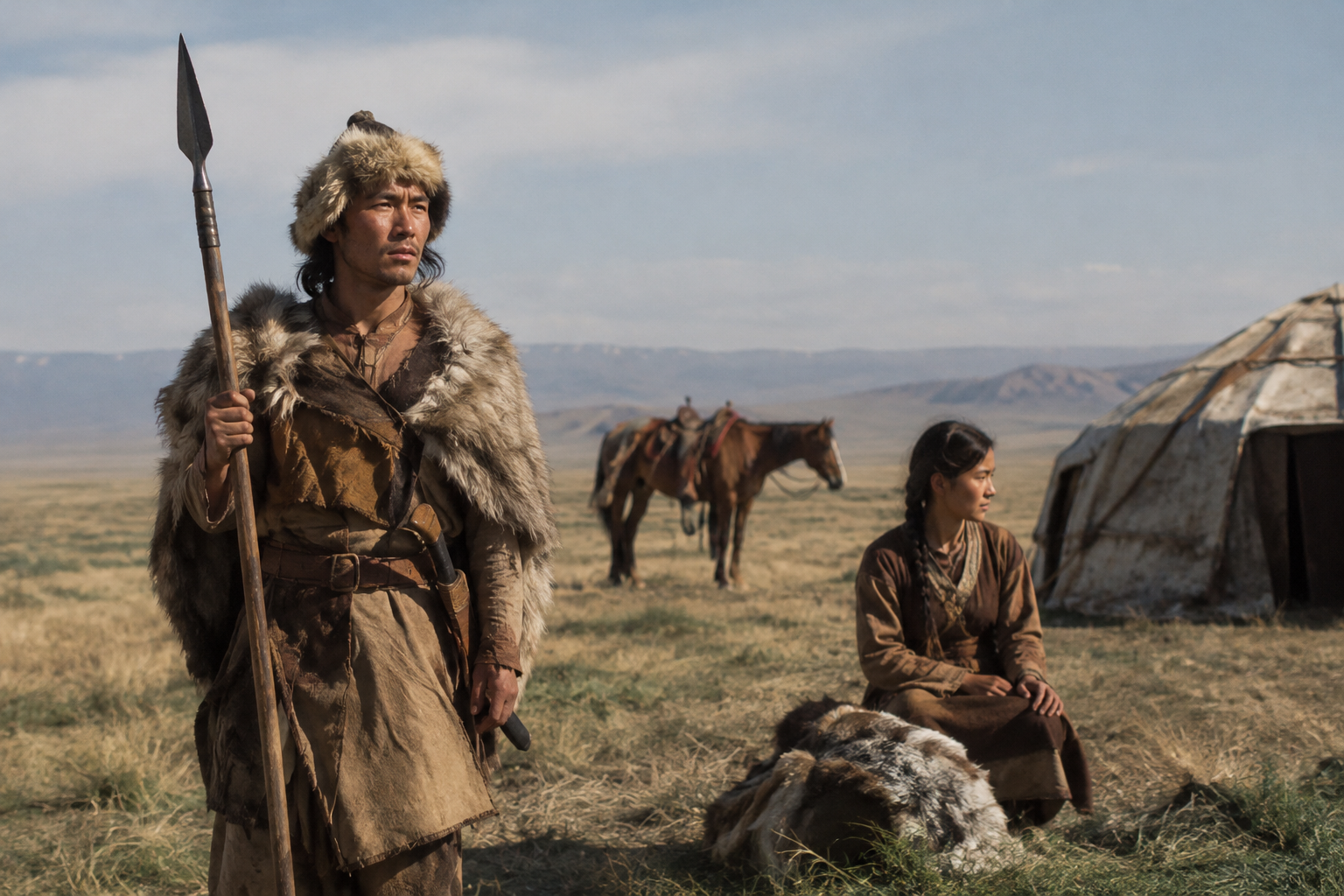
In the Bronze Age landscape of eastern Kazakhstan, one ancient man has become a useful anchor point for understanding the Y-DNA haplogroup R1a2b. He is sample I4773, dated to around 1560 BC from Aktogai, Kazakhstan. That is not much information on its own, but in ancient DNA even a single securely placed paternal lineage can matter a great deal, especially in a region that sat between the Inner Asian steppe, the mountain corridors of Central Asia, and the long networks of Bronze Age exchange.
The significance of I4773 lies in the setting as much as the label. A paternal line assigned here to R1a2b places this branch within a part of the world where male lineages connected to the wider R1a family are often discussed in relation to mobile pastoralists, expanding Bronze Age communities, and the reshaping of Eurasian populations. But one must be careful: R1a2b is a specific branch, while the broader R1a family is much older and much more widespread. Y-DNA traces one direct paternal line only; it is powerful for lineage history, but it is not the same thing as a person's whole ancestry.
Aktogai sits in a part of Kazakhstan that belongs to one of the great archaeological crossroads of Eurasia. By the middle of the second millennium BC, this was not an isolated frontier. It was a zone shaped by movement: herders, traders, metalworkers, and communities linked across open steppe and mountain edge. A sample like I4773 matters because it gives us a fixed paternal signal in a region where cultural labels and population histories were rarely simple.
Bronze Age Kazakhstan is often discussed in sweeping terms, yet the reality on the ground was patchier and more local. Different valleys and steppe zones could show continuity in some practices and change in others. That is why a lineage result such as R1a2b should not be turned into a grand slogan about one people replacing another. What it does show is that this paternal branch had reached, or was present within, the eastern Kazakh steppe by about 1560 BC.
Ancient DNA research across the broader steppe has repeatedly shown that male-line patterns can spread efficiently through mobile societies. That is one reason lineages related to R1a appear so often in discussions of Bronze Age Eurasia. But the article's branch, R1a2b, should be kept at the scale the evidence allows: not as a synonym for all steppe populations, but as one attested paternal thread within that wider world.
It is tempting to think of Bronze Age paternal lineages as if they map neatly onto language, ethnicity, or tribe. Archaeology is rarely so obliging. What a sample like I4773 gives us is something both narrower and more solid: evidence that one direct male line associated with R1a2b was present in Bronze Age Aktogai. That matters because eastern Kazakhstan stood near later corridors connecting the steppe to the Altai, Xinjiang, and farther west into the central Eurasian grasslands.
In practical historical terms, this means R1a2b belongs to the story of populations who lived in the circulation zone of animals, metals, technologies, and marriage networks stretching across enormous distances. Some lineages endured locally; others arrived, branched, or disappeared. The ancient DNA record is still uneven, and a single sample cannot tell us whether I4773 belonged to a local long-established community or to a lineage more recently introduced into that district. Yet it clearly shows that this branch was part of the male-line landscape there in the later Bronze Age.
That, in turn, is why Kazakhstan so often appears in broader discussions of Eurasian prehistory. The region is less a blank middle than a working engine room of movement. Even when details are sparse, a sample from Aktogai helps pin an abstract haplogroup to a real time and place.
The wider R1a family is famous in archaeogenetics because it appears across large parts of Eurasia and in many different historical settings. But fame is not precision. An article about R1a2b needs to resist the old bad habit of letting the parent branch do all the storytelling. We should not assume that every migration or every cultural horizon associated with broader R1a automatically explains this narrower lineage.
Still, the broader context helps. In Bronze Age Eurasia, paternal lineages in the R1a family are often found among populations linked to steppe-derived ancestry and to the social transformations of the third and second millennia BC. Eastern Kazakhstan is one of the places where those histories overlapped with local developments rather than arriving as a single tidy package. A genetic study of ancient Eurasian populations published in Nature helped establish just how important these large-scale movements and mixtures were, even if each individual branch must still be assessed cautiously.
So the useful conclusion is not that R1a2b "was the Bronze Age steppe," which would be far too broad. It is that R1a2b appears to have been one of the paternal branches participating in that world, and I4773 gives us one concrete example from Kazakhstan.
One of the most interesting things about Central Asian and steppe archaeology is that mobility does not erase locality. People moved, certainly, but they also stayed, adapted, intermarried, and built regional traditions. In that respect, Aktogai is valuable not because it confirms a romantic vision of endless riders crossing the grasslands, but because it reminds us that every grand Eurasian pattern had to be lived out in specific communities.
Bronze Age sites in Kazakhstan often sit within networks that connected pastoral economies, mining zones, and transport routes. Male-line evidence can therefore illuminate how certain paternal branches persisted or spread within these systems. The presence of R1a2b in I4773 fits comfortably into a historical picture in which eastern Kazakhstan was open to interaction without losing its regional character.
This is also why comparisons with other steppe and Inner Asian studies are useful. Research on nearby and connected regions keeps showing that ancient populations were mixtures of ancestry streams rather than sealed biological blocs. If you want a broader sense of how these eastern steppe and frontier populations changed through time, MyTrueAncestry's discussion of population continuity and change in the Altai region gives a helpful neighboring perspective.
For someone who carries R1a2b today, the ancient individual from Aktogai offers something quite tangible: a documented instance of that paternal branch in Bronze Age Kazakhstan around 1560 BC. That does not mean every modern carrier descends from this man in any recent genealogical sense, nor that the lineage belongs to one language or one named people. But it does place the branch in a historically important zone of Bronze Age Eurasia where steppe mobility and regional settlement met.
That is, in fact, the most interesting point. R1a2b is not just a code in a haplotree. In the case of I4773, it is a paternal line attached to a real human being who lived in a Central Asian world already shaped by movement, exchange, and deep regional history. For modern family historians, that is often where the past becomes most vivid: not in sweeping claims, but in one ancient life, one site, and one lineage securely standing in place.
East-West mixing in Inner Asia
The clearest lesson of R1a2b, as far as the current evidence here goes, is that this paternal branch was present in the Bronze Age societies of eastern Kazakhstan. Sample I4773 from Aktogai does not solve the whole history of the lineage, but it places it in one of Eurasia's most important contact zones at a formative period. If you belong to R1a2b today, that ancient connection responsibly suggests a paternal history tied, at least in part, to the mobile and interconnected world of Bronze Age Central Asia.






Comments