Haplogroup R1a1a1b2a2b2b3a

– 5 min read


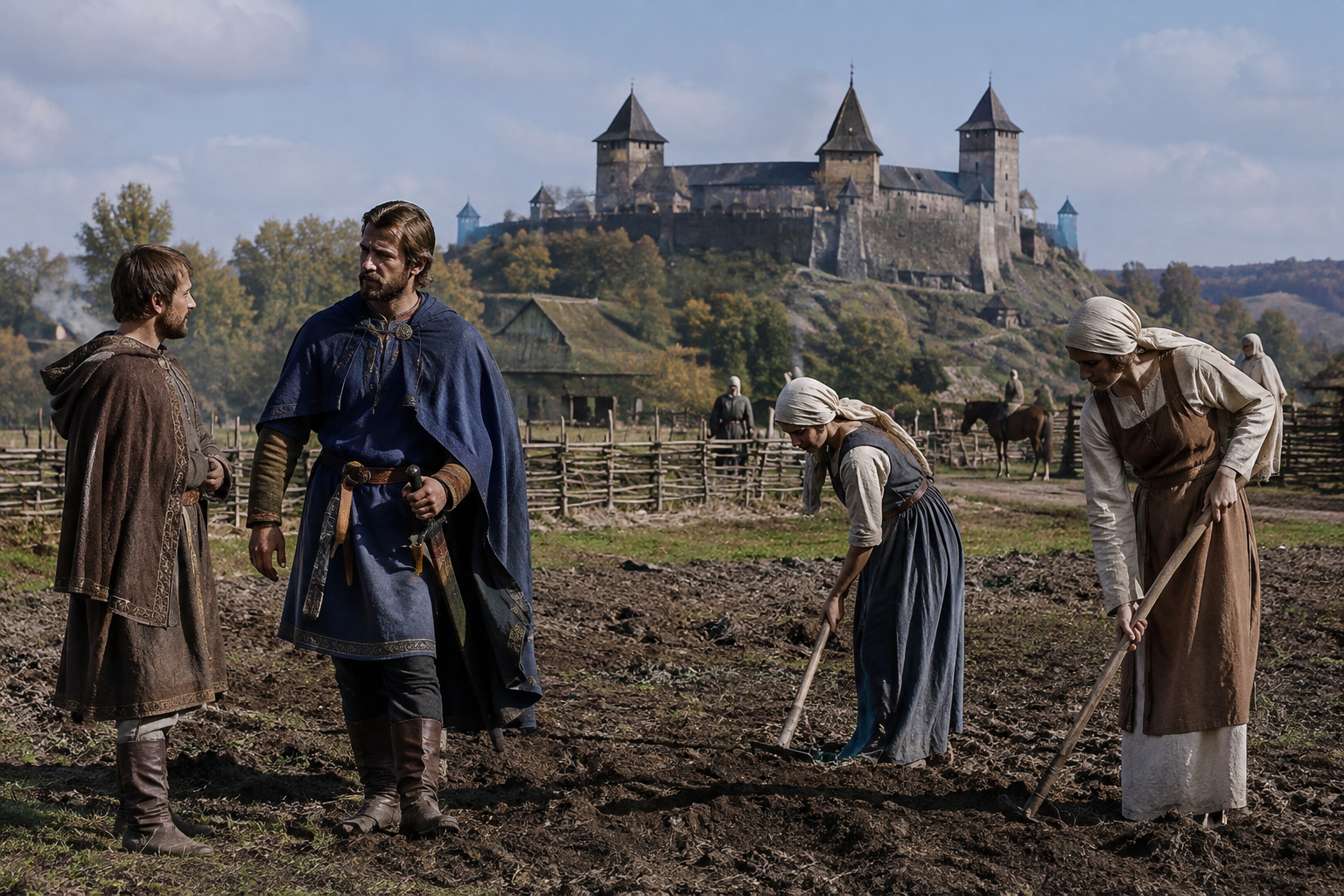
At Vors-Papkert in medieval Hungary, one excavated man from around AD 850 has become a useful marker for a much larger story. The individual known as VPB-279, recovered from a cemetery in the western Carpathian Basin, is associated in MyTrueAncestry with the Y-DNA haplogroup R1a1a1b2a2b2b3a. That may look forbiddingly technical, but the historical setting is wonderfully concrete: this was a man living in a frontier world shaped by the fading Carolingian order, local communities in the Little Hungarian Plain, and the approach of the political changes that would soon remake the region.
The interest here is not that one grave somehow "explains" a people. It does not. The point is that a direct paternal line found in a real burial from ninth-century Hungary lets us place this branch inside a specific archaeological landscape. Y-DNA follows one line of descent through fathers and sons, so it tells us something narrow but valuable: one thread in the making of post-Roman and early medieval Europe.
Vors-Papkert belongs to the dense and complicated history of western Hungary after Rome. By AD 850 this was no empty land waiting for newcomers. It had already seen Roman administration, late antique reorganisation, and centuries of movement involving groups linked in different ways to Germanic, steppe, Slavic, and Avar-period histories. Cemeteries in the region show that the Carpathian Basin was not a sealed ethnic box, but a contact zone.
That is why VPB-279 matters. A lineage assigned here to R1a1a1b2a2b2b3a appears in a place where identities were political and local as much as they were biological. The burial does not make this man a spokesperson for all medieval Hungarians, still less for every carrier of R1a. But it does anchor this paternal branch in a documented early medieval community west of the Danube, in the Carolingian period rather than the later high medieval kingdom.
A broader ancient DNA study of this region helped show how mixed these post-Roman communities could be, and how continuity and mobility sat side by side in the Little Hungarian Plain. That wider context is the real historical value of the sample: not an isolated genetic label, but a lineage found in a borderland where several older populations and newer political structures overlapped.
The long name matters because it keeps us honest. R1a1a1b2a2b2b3a is a very narrow twig on the much larger R1a tree. R1a as a whole has a deep and wide history across Eurasia, turning up in many ancient and modern populations. But it would be a serious mistake to pour all of that enormous history into one medieval burial from Hungary.
So the safest way to read this evidence is as follows: VPB-279 represents one direct paternal branch within a region where R1a-lineages were part of the broader genetic landscape. The precise subclade tells genealogists that this was not just "some R1a," but a finer paternal signature. Archaeologically, though, its significance comes from place and date: a Carolingian-era cemetery in the Carpathian Basin.
That distinction between broad haplogroup and narrow subclade is especially important in central Europe, where similar top-level Y-DNA labels can appear in people with rather different cultural affiliations. A lineage is not a language, not a kingdom, and not an ethnicity. What it gives us is a line of male descent that can sometimes be followed across time if enough ancient samples accumulate.
There is a persistent temptation to look at ninth-century Hungary and ask which later nation or famous dynasty a burial "really" belonged to. The archaeology resists that sort of neat answer. Around AD 850, the western Carpathian Basin sat within the orbit of the Carolingian world, but older local traditions and neighbouring influences remained visible. Communities buried their dead in landscapes already layered with Roman and post-Roman memory.
In that sense, VPB-279 belongs to a historical moment before the full crystallisation of the medieval Hungarian kingdom. He lived in the era just before the Magyar conquest transformed the political map. For anyone carrying R1a1a1b2a2b2b3a today, that is the intriguing point: this lineage was present in the basin before the classic royal and national narratives of later centuries had settled into place.
Research on ancient populations in this period has repeatedly underlined diversity rather than simplicity. The western Hungarian cemeteries do not present one uniform biological profile marching under a single label. They show local communities with varied ancestries and ties, shaped by both continuity and movement. That makes the survival of a specific paternal line all the more interesting.
The mention of the Carolingian Empire in connection with Vors-Papkert is historically useful, provided we keep it in proportion. It does not mean every buried person was a Frank, nor that political allegiance can be read straight off the Y chromosome. What it does mean is that the cemetery belonged to a period when Carolingian influence reached into the region through power, church structures, military organisation, and frontier management.
That broader setting may help explain why western Hungary in the ninth century looks so layered in the archaeological record. Borderlands gather people: farmers, retainers, craft workers, migrants, and families whose ancestors may have arrived in earlier centuries. A paternal branch like R1a1a1b2a2b2b3a could persist through such changes precisely because local populations do not vanish every time political masters change.
One of the useful scientific entry points for this landscape is the research associated with these burials in a study of post-Roman and early medieval communities in the region. Even without inflating what one paper can prove about one individual, the broader lesson is clear enough: western Hungary was a zone of interaction, and ancient DNA helps map that interaction at human scale.
With only one directly named ancient individual here, the job is not to invent a dynasty out of thin air. It is to ask what sort of evidence a single burial can genuinely offer. In this case, VPB-279 shows that the branch linked on MyTrueAncestry to R1a1a1b2a2b2b3a was present in a real early medieval cemetery in Hungary at about AD 850. That is modest, but not trivial.
For family historians, such samples are most helpful when they narrow the historical backdrop of a paternal line. Instead of floating in a vague "eastern European" cloud, this branch can be discussed in relation to a known place and period: the Little Hungarian Plain in the late first millennium, at the edge of Carolingian power and on the eve of major change in the Carpathian Basin.
It also fits a wider pattern seen across Europe, where Y-DNA lineages often persist through striking cultural shifts. Empires collapse, burial customs change, languages spread, and new elites appear, yet some paternal lines remain rooted in the same broad regions for centuries. Ancient DNA is at its best when it captures that tension between continuity and upheaval.
The strongest supported insight from R1a1a1b2a2b2b3a, as represented by VPB-279, is not a dramatic tale of kingship or conquest. It is something subtler and, in its way, more revealing: this paternal branch appears in ninth-century western Hungary, in a community living through the unstable, mixed, and politically charged world of the post-Roman Carpathian Basin. If this is your Y-line, the ancient evidence points toward a history tied to real medieval populations on that frontier, where continuity survived amid repeated historical change.






Comments