Haplogroup R1a1a1b2a2b2b2
– 4 min read


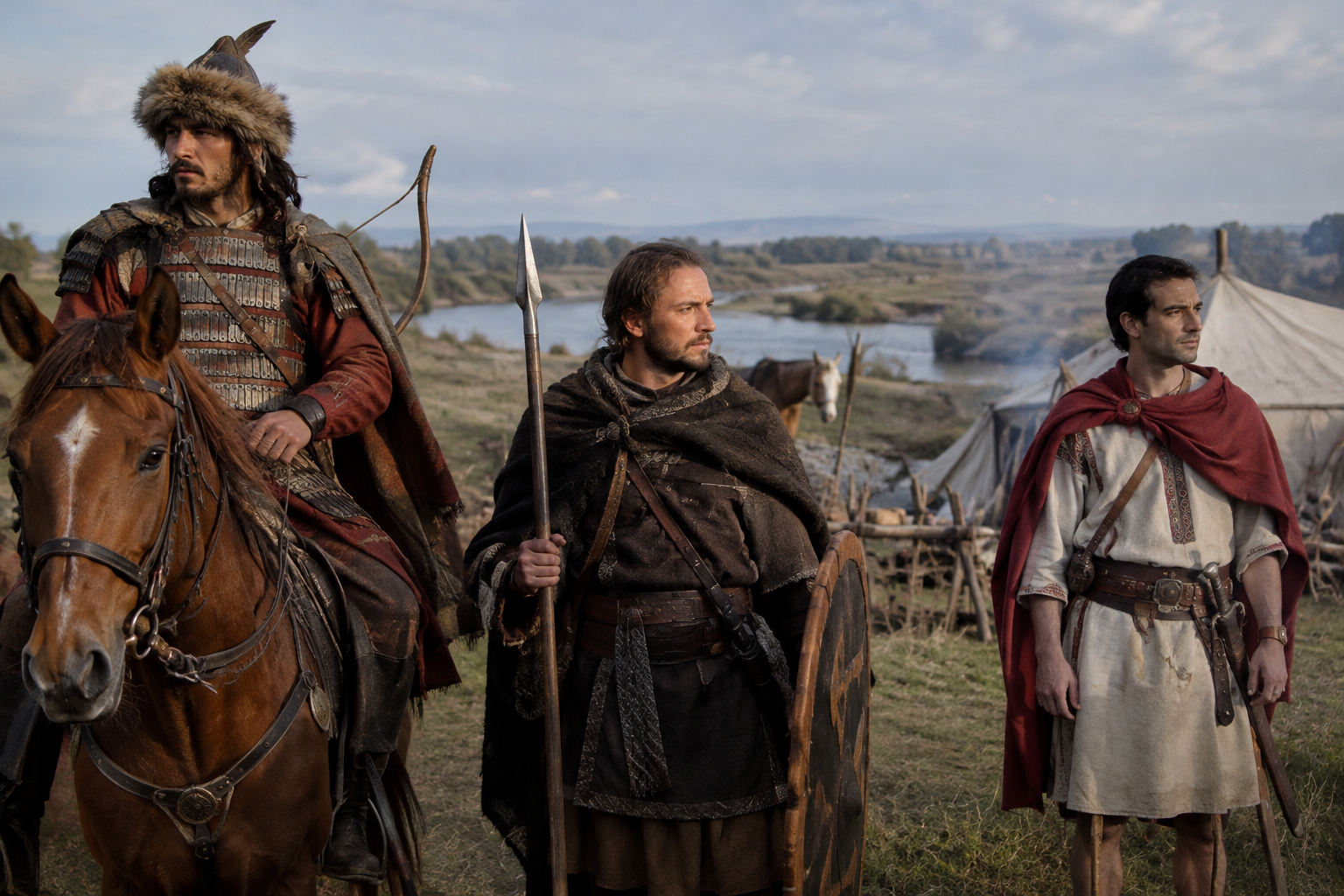
At Kiskundorozsma in Roman-era Pannonia, one ancient male dated to around AD 216, sample CGG021922, offers a neat reminder that frontiers were never tidy edges on a map. This was a world of Roman power, Sarmatian mobility, and constant movement across the Carpathian Basin. The reported association of this man with the Y-DNA branch R1a1a1b2a2b2b2 places a very specific paternal line inside that mixed borderland.
What makes this branch interesting is not that it can be turned into a grand single-origin legend, but that it appears here in several different settings stretching from Roman Pannonia to the Black Sea and into the late Roman to Migration-period lands north of the Danube. Y-DNA tracks one direct paternal line only, not a person's whole ancestry, yet even that narrow line can be historically revealing when the archaeological contexts are this varied.
The Kiskundorozsma individual sits in a region that was one of late antiquity's great contact zones. Pannonia was a Roman province, but it was also a place where imperial soldiers, traders, settlers, and steppe-connected groups met, fought, intermarried, and buried their dead. A Sarmatian-context male in this landscape is therefore not an exotic exception. He belongs to a long story of Iranian-speaking steppe peoples interacting with Rome along the middle Danube.
That matters for understanding R1a1a1b2a2b2b2. The branch is a narrow twig within the much larger R1a family, which has a broad and complicated history across Eurasia. The Kiskundorozsma case does not prove where this exact subclade first arose, but it does show that by the Roman period a paternal line linked to this branch was present among people identified archaeologically with the Sarmatian horizon in Hungary.
A recent ancient DNA study of post-Roman and late antique populations in the Carpathian Basin has helped sharpen this wider picture of mobility and mixture in the region, even when individual lineages must be treated cautiously at fine resolution: research on ancient populations of the Carpathian Basin.
The second sample, CGG017682, comes from Suvlu-Khaye in Crimea and is dated to around AD 625. By then the Roman Empire in the west had fallen, the eastern empire still mattered around the Black Sea, and Crimea had become one of those places where Goths, Alans, steppe groups, and imperial interests overlapped in ways that often frustrate simple labels.
This is exactly why the find is useful. If a paternal line associated with R1a1a1b2a2b2b2 turns up both in Roman-era Pannonia and later in Crimea, the important point is not that we can draw a straight arrow from one grave to the other. It is that the same narrow male-line branch appears within a wider zone of steppe and frontier interaction extending from the Danube to the northern Black Sea.
Crimea in the 6th and 7th centuries was not a sealed ethnic enclave. It was a maritime and overland crossroads, connected to the Caucasus, the Pontic steppe, and the Byzantine world. A male line found there may have arrived through local continuity, regional mobility, or the reshuffling of communities characteristic of the Migration Period and its aftermath. The archaeology and genetics together suggest a branch at home in frontier societies rather than in any single neatly bounded people.
The third sample, R2211, comes from Tes Mlynany in Slovakia and is dated to about AD 450, in the Late Roman Period. This is a fascinating date. Around the mid-5th century, old Roman structures in central Europe were under pressure, the Hunnic Empire had altered political life across the region, and older provincial and barbarian distinctions were breaking down fast.
Slovakia, like western Hungary, sat close to the old Roman frontier but was not merely peripheral to it. It was part of a larger north Danube zone where local communities, incomers, federate groups, and post-imperial successor societies all left traces. A man carrying a paternal line associated with R1a1a1b2a2b2b2 in this setting fits the broader pattern seen in the other two samples: not a royal dynasty, not a single migrating tribe proven by DNA alone, but a recurring male line moving through the disturbed landscapes of late antiquity.
One reason this is worth stressing is that AD 450 is a moment historians often dramatize with names like Huns, Goths, and collapsing empires. Ancient DNA tends to complicate that drama. It shows that many burial grounds in this world were populated by people whose identities were created locally, through alliance, marriage, military service, and generations of movement. A Y-line can persist through all of that while the cultural label around it changes.
Set side by side, these three samples form a modest but suggestive cluster. One appears in Sarmatian Roman-era Hungary, one in late Roman Slovakia, and one in 7th-century Crimea. That distribution points toward a paternal line circulating in the connected worlds of the Carpathian Basin and the northern Black Sea, especially in settings shaped by steppe contacts and the political upheavals of late antiquity.
That does not mean every man of this branch was Sarmatian, Alan, Gothic, or anything else in a simple ethnic sense. Archaeological identities are built from burial practice, material culture, historical setting, and sometimes texts; haplogroups are inherited male-line markers. Still, when the same narrow branch recurs in steppe-adjacent and frontier contexts, it becomes easier to see why descendants today may find echoes of eastern-central European or Pontic-zone history in their paternal results.
Research on ancient individuals from the northern Black Sea and surrounding migration-period contexts has increasingly shown how mixed these communities were, genetically and historically. For readers interested in that broader setting, the pattern fits well with discussions of frontier diversity in posts on Khazar and Saltovo-Mayaki era burials, Gothic communities, and Black Sea mobility.
The most distinctive thing about R1a1a1b2a2b2b2 in the present evidence is its appearance across a chain of historically connected frontier regions rather than in one isolated prestige burial or one named dynasty. Kiskundorozsma, Tes Mlynany, and Suvlu-Khaye belong to different centuries and different political worlds, yet all sit within the broad belt where Rome, post-Roman societies, and steppe-linked populations met.
For someone researching this paternal haplogroup today, that is the responsible historical takeaway. This branch seems to have been part of the male-line diversity of late antique eastern-central Europe and the Black Sea world, especially in communities shaped by mobility and contact. It is a clue to one strand of ancestry running through turbulent borderlands, where identities shifted faster than Y-chromosomes did.






Comments