Haplogroup R1a1a1b1a3a2e

– 5 min read


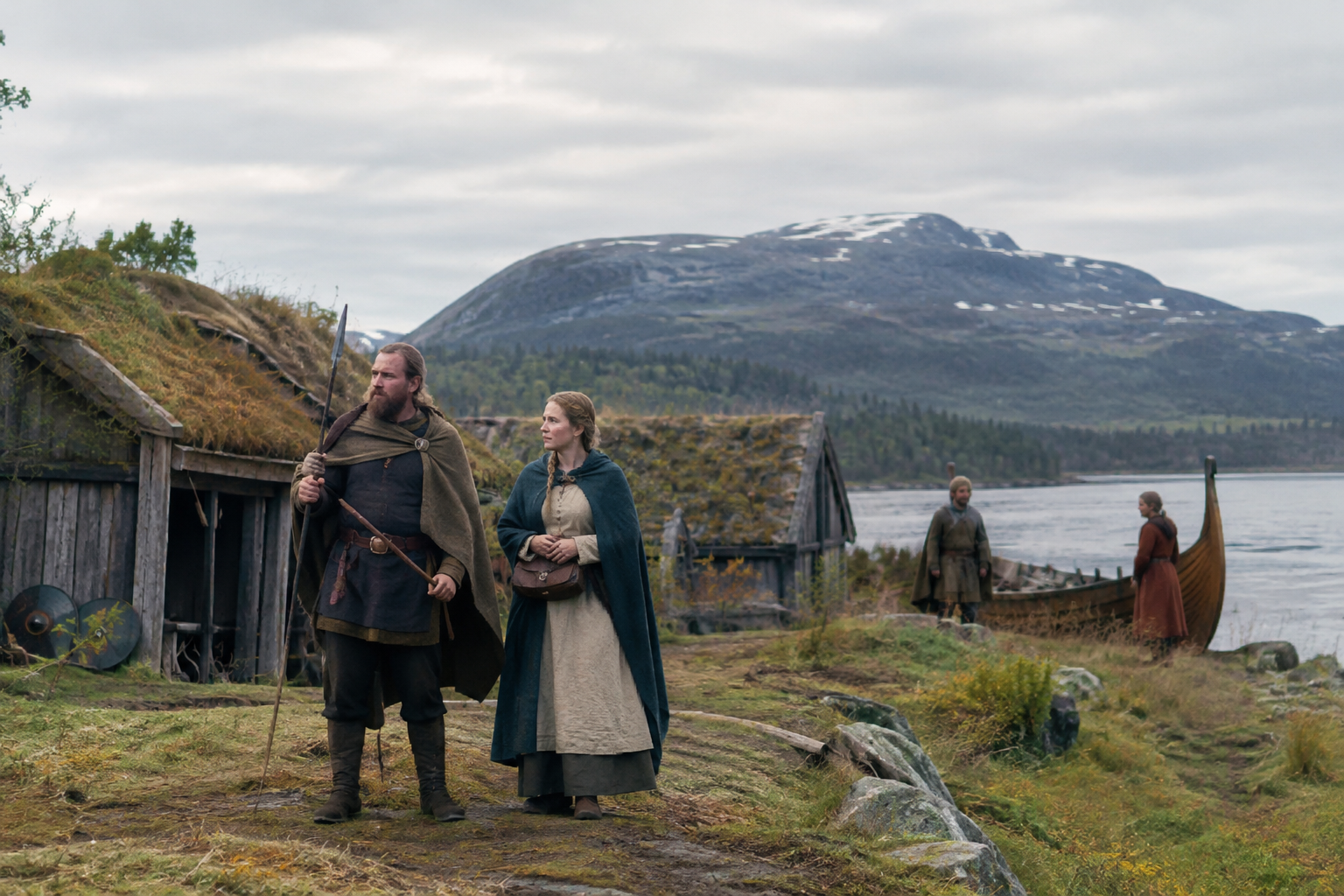
At Vasterhus in Jamtland, central Sweden, archaeologists uncovered a churchyard that belongs to the long afterlife of the Viking world rather than to the Viking Age itself. One of the men buried there, sample wes007, dates to around 1213 AD. He is interesting not because he was a king or saga hero, but because he offers something rarer in ancient DNA: a firmly placed ordinary medieval individual whose paternal line is associated here with R1a1a1b1a3a2e.
That matters because Jamtland in the early 13th century sat in a historical borderland. It was tied to the Scandinavian world, yet also shaped by older inland routes, regional loyalties, and the gradual consolidation of Christian institutions. A Y-chromosome result from a burial like wes007 does not tell us his whole ancestry, language, or identity. What it does give us is one direct paternal thread, preserved in a man buried in a rural Swedish church community at a moment when old Norse society had already been transformed.
Vasterhus is not the sort of site that owes its fame to glittering grave goods. Its importance is almost the opposite. This is a cemetery of a Christian community, and that changes the historical mood at once. By the early 1200s, burial in consecrated ground tells us we are dealing with a settled medieval society in which parish life, not ship-borne raiding, structured death and remembrance.
Sample wes007 belongs to that world. The date around 1213 AD places him in a period when Jamtland was connected to wider Scandinavian political and ecclesiastical systems, even if it still retained a strong regional character. The association of this burial with haplogroup R1a1a1b1a3a2e shows that this paternal line was present in inland Sweden in the centuries after the classic Viking Age had ended.
The most useful point here is a historical one. We are not looking at some remote prehistoric abstraction, but at a named archaeological context: a medieval burial ground, a specific individual, and a paternal lineage carried by a man who lived in a recognizably Christian Scandinavian society.
The long label R1a1a1b1a3a2e is a very narrow paternal branch within the much broader haplogroup R1a. That broader family of lineages has a deep and complicated history across Eurasia, and it turns up in many different ancient and modern populations. But one of the common mistakes in popular DNA storytelling is to drag the whole immense history of R1a into every tiny downstream branch as if all its carriers shared one simple story. They do not.
For wes007, the responsible statement is narrower. This branch, or an assignment associated with this branch, appears in a medieval Scandinavian burial from Jamtland. That anchors the lineage in one documented place and period. It does not by itself prove descent from any named Viking, Norse chieftain, Slavic founder, or steppe warlord, however tempting those grand narratives may be.
That modesty is not a weakness. It is what makes archaeogenetics useful. Once a lineage is tied to a real burial context, we can begin asking better questions about regional continuity, mobility, and the social worlds in which paternal lines were carried forward.
Jamtland is especially interesting because its history is awkward in the best possible way: it does not fit neat modern categories. In the Middle Ages it stood between larger kingdoms, with strong links westward toward Norway and clear participation in the wider Scandinavian sphere. A man buried at Vasterhus around 1213 AD was therefore living in a region where political allegiance, trade routes, and local identity did not always line up tidily.
That makes a Y-line result from this cemetery more than a technical footnote. It helps place R1a1a1b1a3a2e in a frontier-like inland setting rather than only in the coastal Viking imagination that dominates popular history. Medieval Scandinavia was not made solely by famous seafarers. It was also made by farmers, parish communities, and regional populations whose lives are far less dramatic in the written sources and often much clearer in the cemetery.
A major ancient DNA study of Scandinavian populations, published in Cell, helped underline just how varied the genetic background of Scandinavia could be across time and region. Even when a site seems culturally straightforward, the people buried there may reflect layers of older movement and mixture rather than a single simple ancestry block.
One of the most useful correctives provided by cemeteries like Vasterhus is chronological. Too often Scandinavian Y-DNA gets mentally frozen in the ninth or 10th century, as though all relevant history ended with longships. But wes007 belongs to a later phase, when Christianity had reorganized burial custom and when local communities were being drawn more tightly into church structures and royal power.
That later date matters for paternal history. A Y-line that appears in the Viking Age and disappears immediately would tell one kind of story. A Y-line still present in a churchyard around 1213 AD tells another: survival through social change. In other words, whatever older background ultimately fed into this branch, it was not merely passing through. It had become part of the population that inhabited and reproduced medieval Scandinavian society.
This is precisely why post-Viking cemeteries are so valuable. They show which paternal lines made the transition from the looser political world of the earlier Iron Age and Viking Age into the more organized medieval order. That transition is one of the great historical shifts of northern Europe, and DNA lets us watch it not through kings' chronicles but through actual bodies in the ground.
There is only one ancient sample listed here, and that may sound thin. In fact, single well-placed burials can be extremely informative. A securely dated medieval individual from a named Swedish site gives us a point of contact between a modern tester's paternal haplogroup and an excavated human life.
That does not turn wes007 into an ancestor for everyone with R1a1a1b1a3a2e. Nor does it make Vasterhus the birthplace of the branch. But it does provide a documented medieval appearance of this paternal line in inland Scandinavia. For family historians and deep ancestry researchers alike, that is a useful sort of evidence: concrete, limited, and real.
Germanic Languages and Genomics
The strongest insight from R1a1a1b1a3a2e in this case is not grandeur but placement. Through wes007 at Vasterhus, the lineage is visible in a post-Viking, early 13th-century churchyard in Jamtland: a real community in a real medieval landscape. For someone researching this paternal branch today, that is a valuable clue toward the northern European and specifically Scandinavian worlds in which at least one bearer of the line lived.
And perhaps that is the proper pleasure of ancient DNA. Not that it turns every lineage into a royal saga, but that it restores ordinary men like wes007 to history - one burial, one region, one father's line at a time.






Comments