Haplogroup R1a1a1b1a3a2a

– 6 min read


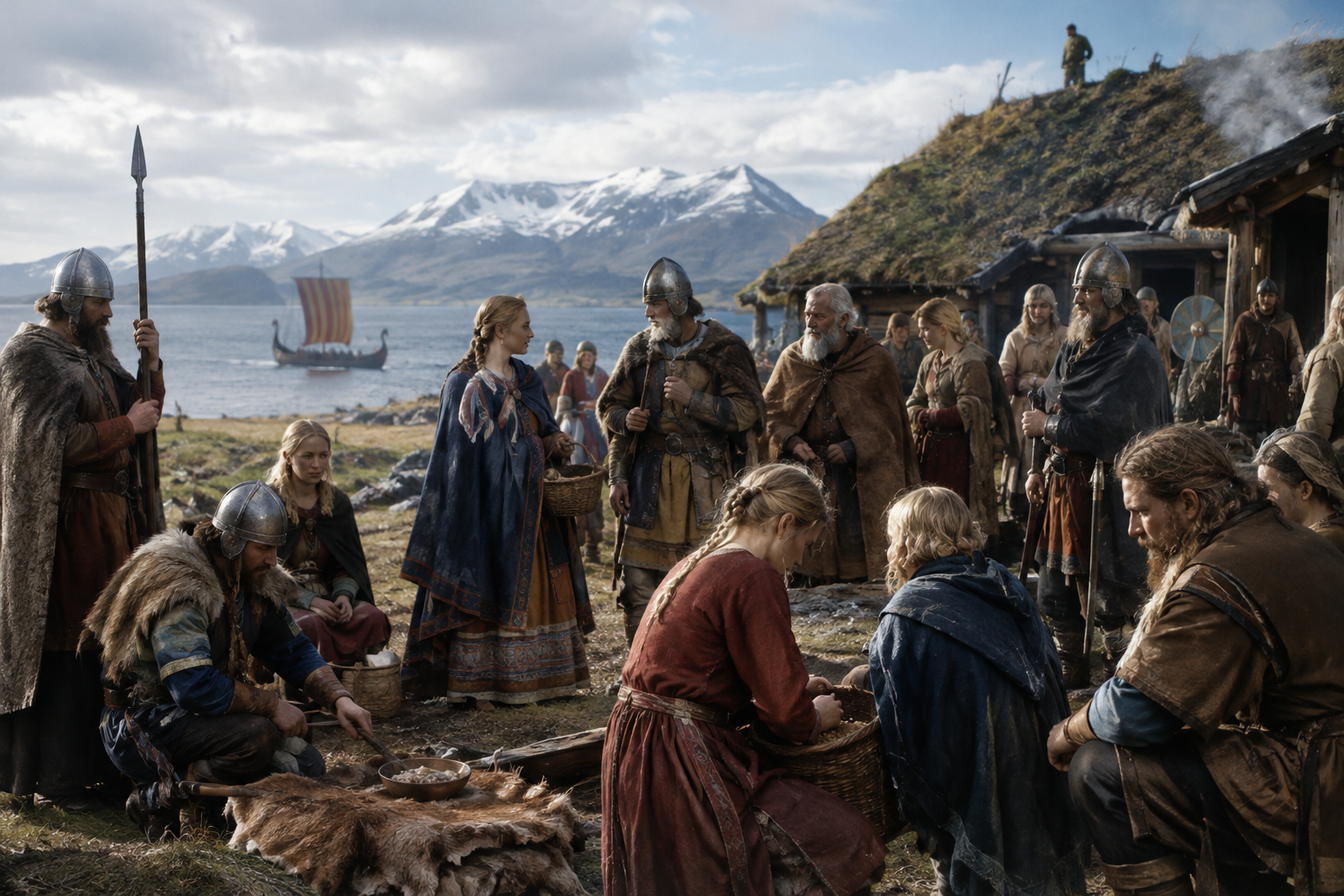
Some Y-DNA haplogroups announce themselves with trumpets: they are common, broad, and easy to place in the grand sketch of Eurasian prehistory. R1a1a1b1a3a2a is more like a detail in the corner of a manuscript. Small perhaps, very specific certainly, but all the more interesting for that. It sits within the wider world of haplogroup R1a, one of the major paternal lineages of Eurasia, yet this narrow branch has to be handled carefully. We cannot simply pour the whole history of R1a into it and declare the matter settled.
That caution is part of the fascination. Y-DNA haplogroups trace one direct paternal line only: father to father to father across the centuries. They do not describe a person's entire ancestry, culture, language, or identity. But when ancient DNA begins to place related paternal lines in real burials, real ships, real massacre sites, and real medieval communities, that single line becomes an extraordinary historical instrument. In the case of R1a1a1b1a3a2a, the supplied evidence points us above all toward northern and northeastern Europe, especially the Scandinavian and North Sea world, with intriguing appearances further south and east.
In phylogenetic terms, R1a1a1b1a3a2a is a downstream branch of R1a. Broadly speaking, R1a has deep importance in the study of Eurasian paternal ancestry and has often been discussed in connection with prehistoric and later movements across the steppe, central Europe, and northern Europe. But that broader story is only the backdrop. A specific subclade such as this one may have had a much narrower historical distribution, and its documented appearance in ancient individuals matters more than any sweeping generalization.
The ancient samples supplied here suggest that lineages close to, or associated with, this branch were present in Scandinavia from at least the Bronze Age onward and remained visible through the Iron Age, Viking Age, medieval period, and even into the early modern world. That is already quite striking. It suggests not a fleeting episode, but a long northern history.
For readers interested in the bigger methodological picture, MyTrueAncestry's article on archaeogenetics is a useful companion to this kind of evidence.
One of the most revealing early data points is CGG105636_CGG105637, from Bronze Age Norway Skjeggesnes, dated to 1125 BC. Even without forcing too much out of a single sample, it places this paternal line's wider family in Scandinavia remarkably early. That matters because it gives us a chronological anchor long before sagas, kingdoms, or surnames. We are not dealing only with medieval movement; there is evidence for substantial depth in the north.
By the Iron Age, the picture gains texture. CGG107490 from Iron Age Denmark Sjaelland Mosede Mose, dated to 175 AD, and CGG105327 from the Danii Tribe Sjaelland Roskilde Iron Age Denmark, dated to 313 AD, place related paternal ancestry in Zealand during the centuries when the Roman Empire still dominated the south but the north was developing its own political and military worlds. These are especially valuable because they suggest continuity in the Danish islands across time rather than a purely Viking Age phenomenon.
Then there is PL067, from the Gothic Tribe Poland Maslomecz Wielbark, dated to 250 AD. This is precisely the sort of sample that makes ancient DNA so useful and so awkward in equal measure. Useful, because it shows that a paternal line connected to this haplogroup's sphere was present in a Gothic-associated context beyond Scandinavia. Awkward, because one must resist the temptation to turn that into a simple ethnic label. Gothic archaeological communities were not genetically uniform, and one lineage does not define an entire people.
Still, the geography is suggestive: Denmark, Norway, and a Gothic-context burial in Poland hint at links across the Baltic world. If you want to follow that Gothic dimension further, the Maslomecz material has its own excellent MyTrueAncestry context.
By the Viking Age, the evidence becomes wonderfully concrete. We are no longer speaking only of regions but of men caught in movement. CGG107016 from Viking Age Northern Norway Ytre Kvaroy Luroy, dated to 725 AD, and VK498 from Vendel Age Saaremaa Salme II-XXXII, also dated to 725 AD, place this paternal thread in the martial and maritime world of the Baltic and Norwegian coasts.
The famous overseas expansions are represented too. NNM-A1 from Viking Norse Iceland, dated to 935 AD, shows this northern paternal ancestry in the settlement world of the North Atlantic. VK344 and VK354, both from Viking Age Oland Sweden and dated to 950 AD and 986 AD, keep the line firmly within eastern Scandinavian settings. VK397 from Viking Age Skara Varnhem Sweden, dated to 1050 AD, belongs to the era when Scandinavian society was changing fast, with Christianity, kingdom-building, and older local identities overlapping rather than neatly replacing one another.
Perhaps most vivid of all are the samples that turn up in England. VK145 from the Viking St. Brice Massacre Oxford, dated to 1002 AD, and VK264 from the Viking Invader Ridgeway Hill England, dated to 998 AD, are reminders that Scandinavian paternal lines were not confined to the fjords. They arrived in Britain through raiding, migration, military service, settlement, and all the messy human business that lies behind those labels.
That broader Scandinavian-British connection is worth exploring in its own right.
The later medieval samples show that this was not a lineage that simply burned brightly in the Viking Age and vanished. In England, ATP_PSN_943 from Medieval England Cherry Hinton, dated to 1055 AD, and ATP_PSN_916 from the same site, dated to 1120 AD, place related paternal ancestry in an ordinary medieval setting rather than an exotic one. That is important. Ancient DNA is most powerful when it moves from famous warriors to everyday communities.
There is also I4803 from Early Medieval Slovakia Bratislava, dated to 1250 AD, which broadens the picture into central Europe. Again, caution first: this does not mean the entire history of this subclade belongs to Slovakia, nor that the Bratislava man was in any meaningful genealogical sense connected to the Scandinavian samples we have named. But it does remind us that medieval Europe was highly mobile, and paternal lineages could travel in ways that written records barely catch.
Further north and west, CGG101808 from Medieval Denmark Zeeland Ahlgade Holbaek, dated to 1375 AD, and VK238 from Medieval Age Faroe Islands Sandoy Church, dated to 1600 AD, reinforce the longstanding North Atlantic and Danish presence. The same is true of the early modern Swedish naval world represented by kro010 and kro012 from the Stora Kronan Shipwreck Battle of Oland Sweden, both dated to 1676 AD. These are not "Vikings" in the usual sense at all, but sailors of a gunpowder kingdom. Yet the paternal line persists.
For readers who want more on those North Atlantic islands, the Faroese angle is particularly rewarding.
How does all this connect with a Scottish noble house? Carefully, and through historical context rather than overconfident genealogy.
The supplied family association is Clan Spalding, linked with Ashintully Castle in Perthshire, Scotland. Ashintully began as a 16th century tower house built for the Spalding family. Later it passed through marriage to the Murray family, becoming a lairdly residence beside the River Tay. In the 18th and 19th centuries it was enlarged and altered into a baronial style country house, though it kept its older core. That is a very Scottish story: medieval defensibility, early modern estate ambition, and the long social afterlife of landed families.
The later history is even more telling. A serious fire in 1928 damaged the building; after decline it fell into ruin; and restoration in the late 20th century brought it back into use. During the Second World War it housed evacuee schoolchildren from Dundee, which rather wonderfully reminds us that old aristocratic buildings do not remain frozen in heraldic dignity. They acquire new lives.
Genetically, one should not claim that Ashintully Castle proves anything about the Y-DNA of every Spalding or Murray. It does not. Nor can a broad or even fairly specific haplogroup on its own demonstrate direct descent from a castle-owning line. What the connection does provide is regional and historical context. Perthshire sits within a northern British landscape long shaped by movements across the North Sea and the Scandinavian world. The ancient samples from England, Denmark, Norway, Sweden, Iceland, and the Faroes show that paternal lines connected with this haplogroup circulated across exactly the maritime zone that helped shape medieval and later Scotland.
Readers interested in the family context can continue with the clan material itself.
R1a1a1b1a3a2a is historically interesting not because it gives a single tidy origin story, but because it refuses to. The evidence supplied here suggests a paternal lineage with deep roots in northern Europe, visible in Bronze Age Norway, Iron Age Denmark, Baltic-connected Gothic settings, Viking Age Scandinavia, North Atlantic settlements, medieval England, and later Scandinavian worlds. That is a real pattern.
What it does not do is prove that any modern carrier descends from a particular Viking raider, a Gothic warrior, a laird at Ashintully, or a crewman on the Stora Kronan. Ancient DNA works best as context, comparison, and historical illumination. It shows where related paternal lines appeared, how long they persisted, and which regions repeatedly mattered.
And that, in truth, is exciting enough. A single paternal branch can lead us from Bronze Age Norway to a Scottish tower house by way of Denmark, Poland, Oxford, Iceland, Oland, and the Faroe Islands. Not because one man founded them all, but because history is made from continuities, dispersals, accidents, and survivals.
If your own Y-DNA or autosomal results connect with lineages like R1a1a1b1a3a2a, MyTrueAncestry can help place them beside ancient individuals and historical populations. Those matches may offer remarkable clues about your deeper ancestry, even if they do not by themselves prove direct descent from any one ancient person or noble family.






Comments