Haplogroup R1a1a1b1a3a1a1a

– 6 min read


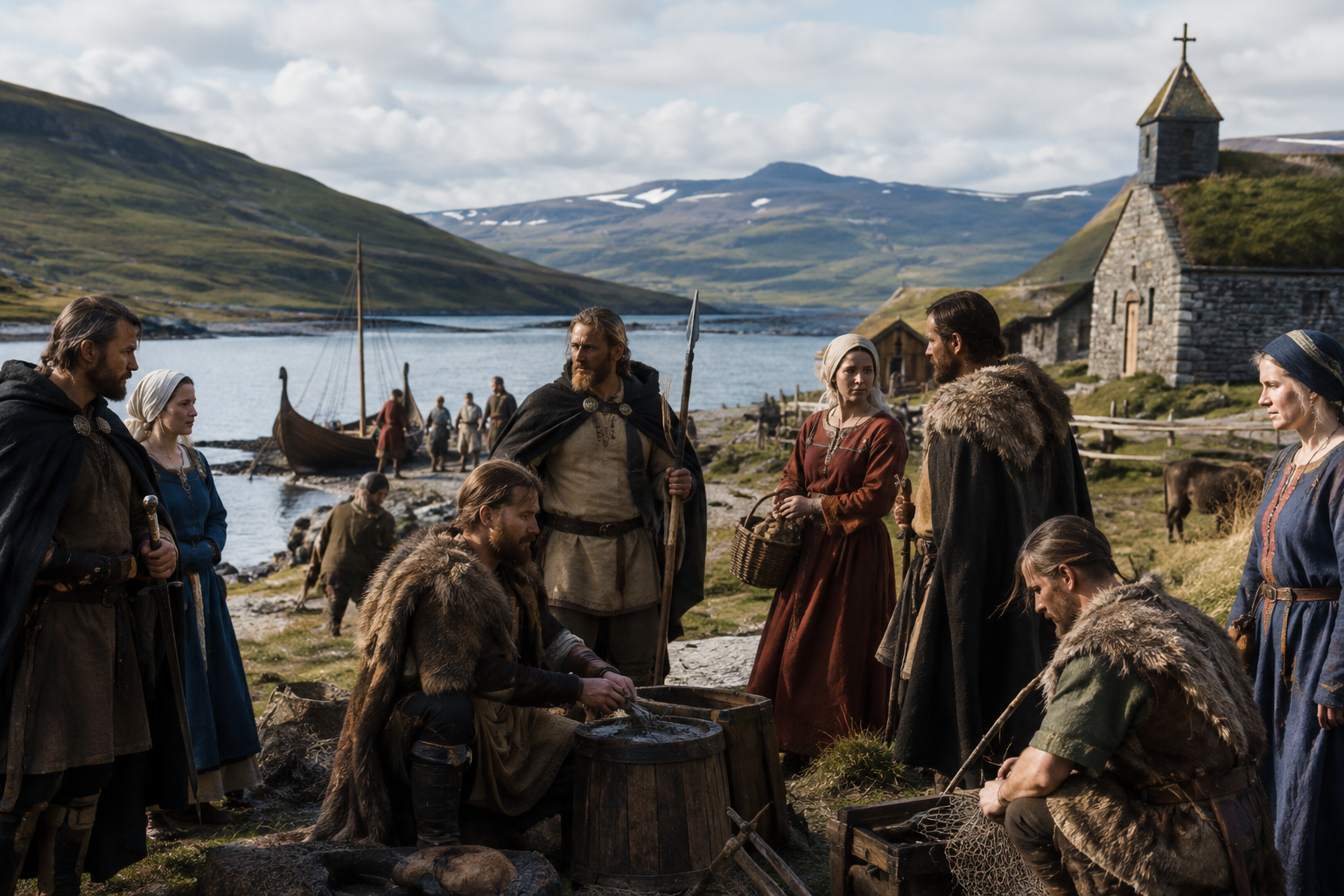
Some Y-chromosome lineages announce themselves with a great fanfare of royal claims, national myths, or sweeping migration stories. Haplogroup R1a1a1b1a3a1a1a is more interesting than that, and in some ways more revealing. It sits deep within the large and historically important R1a family, a branch of the Y-chromosome tree that has turned up across much of Eurasia in many different times and places. But this very specific subclade reminds us of something essential in archaeogenetics: the closer we zoom in, the less we should rely on broad stereotypes and the more we should pay attention to actual people, actual burials, and actual landscapes.
Y-DNA haplogroups trace one narrow line of descent: the direct paternal line, father to son across generations. They do not describe a person's whole ancestry, culture, language, or identity. Still, when ancient DNA places a paternal lineage in Viking Age Sweden, post-Viking Denmark, medieval Hungary, Iceland, Saaremaa, and the Faroe Islands, it gives us something wonderfully concrete. Not a fairy tale of pure bloodlines, but a set of clues about how male lineages moved through the North Sea, the Baltic, and parts of continental Europe over many centuries.
R1a is one of the best-known Y-DNA macro-lineages in Eurasian population history. Its broader branches are often discussed in connection with steppe-related expansions and later distributions in eastern, central, and northern Europe, as well as parts of Asia. But one must be careful here. The full history of broad R1a cannot simply be pasted onto the narrower branch R1a1a1b1a3a1a1a. A downstream lineage may represent only one later chapter of a much larger paternal family.
What the supplied ancient evidence does suggest is that this branch, or a very closely related part of the tree, was present in the medieval and late first-millennium world around the Baltic and North Atlantic. That matters because it places the lineage not in an abstract map of prehistoric arrows, but in the lived worlds of seafaring, warfare, trade, conversion, and settlement.
Take VK551, from Vendel Age Saaremaa Salme II-U, dated to 725 AD. Saaremaa, in the eastern Baltic, was no sleepy fringe. It lay in a maritime zone where raiding, exchange, and military ventures linked Scandinavia and the Baltic world. A lineage found here belongs to a period just before what we conventionally call the Viking Age, when the sea was already acting as a highway rather than a barrier.
Then there is VK48 from Viking Age Gotland Kopparsvik Sweden, dated to 975 AD. Gotland is one of those places that turns up again and again in discussions of Viking commerce, mobility, and contact. A paternal line found there tells us not who all Gotlanders were, but that this branch existed in one of the great nodal points of the Baltic trading world.
Sweden appears again with VK35 from Viking Age Skara Varnhem Sweden, dated to 1050 AD. By then Scandinavia was changing rapidly: kingdoms consolidating, Christianity spreading, burial customs shifting. The same broad paternal network that once moved through raiding fleets and trading ports now appears in a more settled medieval frame.
And in KPN002, from Post Viking Era Denmark St Clemen Zealand Denmark, dated to 1100 AD, we see this lineage still present after the classic Viking Age had ended. That is important. It suggests continuity beyond the age of longships in popular imagination. These male lines did not vanish when the sagas stopped sounding dramatic; they continued into the Christian medieval societies that followed.
The North Atlantic samples are perhaps the most evocative. VK129, from Viking Age Ingiridarstadir Iceland, dated to 1050 AD, places this lineage in the colony world created by Scandinavian expansion. So does GTE-A1, described as Viking Gaelic Mix Iceland and dated to 935 AD. That label is especially valuable, because it hints at the hybrid societies of the Viking Atlantic: Norse settlers, Gaelic connections, and communities that were never culturally simple.
By the time we reach VK244 from Medieval Age Faroe Islands Sandoy Church, dated to 1600 AD, the story has moved well into the post-medieval Christian North Atlantic. A Y-lineage appearing there does not prove unbroken descent from any one Viking founder, but it does show how paternal branches associated with the northern maritime world could persist for centuries in island communities shaped by settlement, kinship, and church life.
Seen together, these samples suggest that this branch belongs, at least in the evidence we have here, to a northern European and North Atlantic sphere of movement. That does not mean it was exclusive to "Vikings," nor that every carrier would have identified the same way. It means that this paternal line appears in regions bound together by sea-lanes, seasonal travel, and the surprisingly wide horizons of early medieval life.
One sample in the list widens the picture nicely. AHS18, from Medieval Hungary Carolingian Empire Zalavar Varsziget, dated to 850 AD, places the lineage in a very different setting: the frontier politics of central Europe in the Carolingian age. Zalavar was part of a region where imperial ambitions, Slavic populations, local elites, and shifting military control met in an often untidy fashion.
This matters because it warns us against turning the haplogroup into a purely Scandinavian badge. Medieval Europe was criss-crossed by mobile men, warrior retinues, merchants, settlers, clerics, and captives. A paternal lineage appearing in both the Baltic-North Atlantic world and in Carolingian Hungary need not imply one simple route. It may instead reflect the deeper and more tangled spread of related male lines across northern and central Europe before, during, and after the Viking Age.
In that sense, ancient DNA is at its most useful when it punctures easy assumptions. It does not hand us a tidy ethnic label. It gives us distribution through time, and asks us to think harder.
That brings us to Scotland, where genealogical memory is preserved not only in documents but in stone. The supplied family associations point to two very different, but equally suggestive, settings: royal Stewart power at Dundonald Castle in South Ayrshire, and west Highland clan lordship at Dunollie Castle near Oban.
Dundonald Castle was built in the late 1300s for Robert Stewart, later King Robert III of Scotland. The site had a much older history as an early royal centre, and the great tower house was both comfortable residence and public declaration of Stewart authority. In other words, this was not just a military shell. It was a place where kingship was staged. If a lineage such as R1a1a1b1a3a1a1a appears in the wider historical orbit of Scottish royalty, that should be understood as contextual rather than conclusive: a reminder that medieval royal houses were formed in a world of inherited male lines, alliances, adoptions of identity, and political continuity across generations.
Dunollie Castle speaks in a rather different accent. Its site reaches back to the early medieval kingdom of Dal Riata and may have been an important stronghold of the Cenel Loairn kindred. Later it became associated with the chiefs of Clan MacDougall, whose power in the 12th and 13th centuries depended on kinship, warfare, and command of sea routes along the Argyll coast. The ruined tower house visible today is largely 15th century, but it stands on older fortifications. That layering is the point. Western Highland power was built not in isolation, but in a maritime landscape where family, lordship, and movement by water mattered immensely.
Explore the Royal House of Stewart
It is tempting to look at a castle, a royal surname, and a Y-DNA branch and imagine a clean line back into the early Middle Ages. History is rarely so obliging. A noble family's association with a haplogroup does not prove that every historical member carried it, and a shared haplogroup does not prove close kinship. Two men can share a paternal branch while being separated by many centuries and countless collateral lines.
But that does not make the evidence disappointing. Quite the reverse. Haplogroup R1a1a1b1a3a1a1a, as seen through these samples, belongs to a world stretching from Saaremaa and Gotland to Denmark, Iceland, the Faroes, Hungary, and later Scottish historical memory. It is a good example of how paternal ancestry can persist across political transformations: pagan and Christian, Baltic and Atlantic, royal and clan-based, continental and insular.
If you want to keep following that Scottish dimension, the regional clan context is also worth exploring through MyTrueAncestry's article on Clan MacDougall, which complements the story of Dunollie and the west Highland seaways.
That, in the end, is what ancient DNA does best. It does not replace archaeology or written history. It sits beside them, sometimes confirming, sometimes complicating, often making the old stories larger and stranger than we expected.
If your own Y-DNA belongs somewhere in this broad northern and central European story, MyTrueAncestry can help you compare your results with ancient individuals such as VK551, VK48, VK35, VK129, KPN002, GTE-A1, VK244, and AHS18. Those matches do not prove direct descent from a Viking, a Stewart, or a MacDougall chief, but they can offer a fascinating window into the older populations that shaped your paternal line.






Comments