Haplogroup R1a1a1b1a2b3a3a2g2c1
– 5 min read


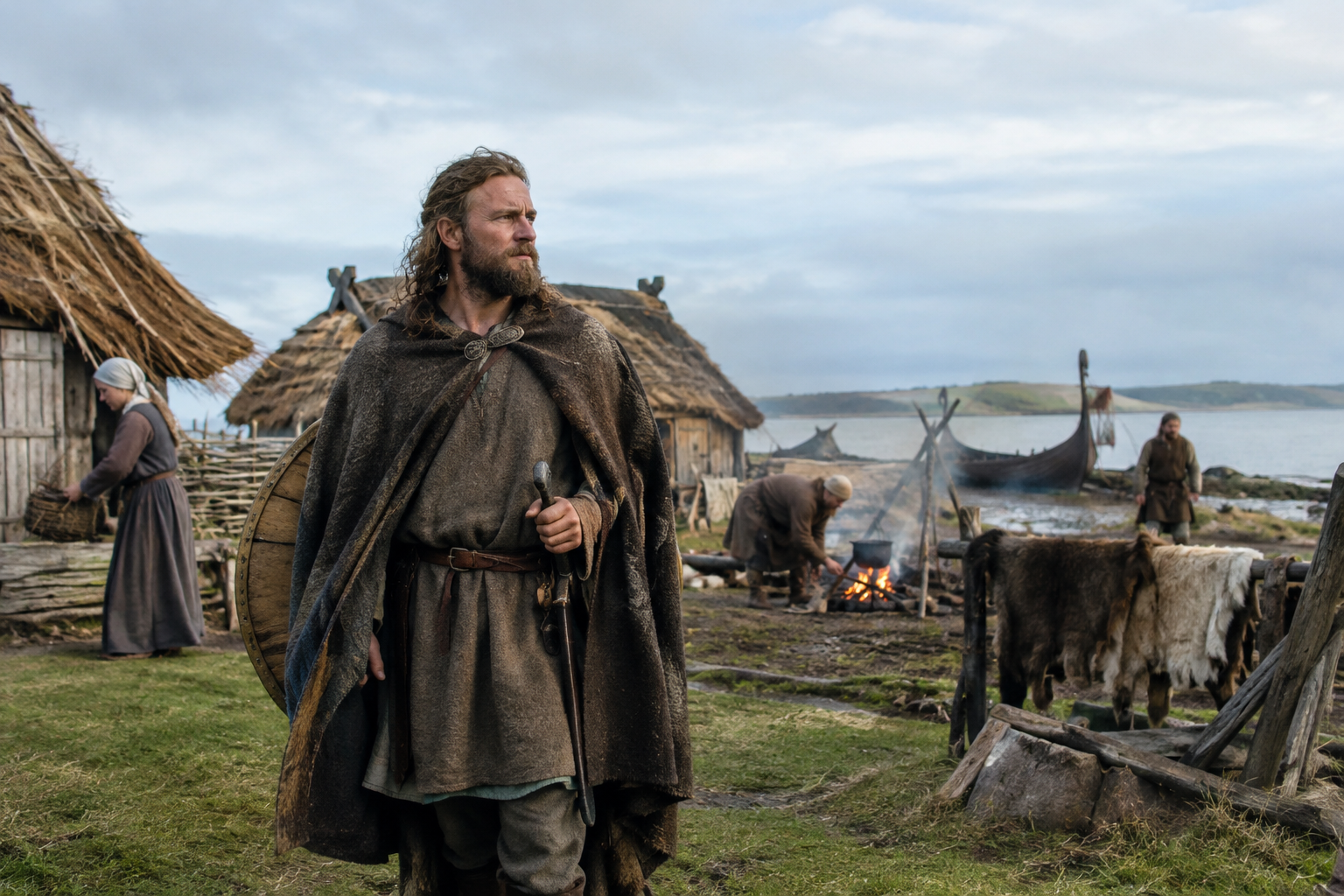
At Kaargarden in Denmark, one Viking Age man dated to about AD 950 survives in the ancient DNA record as sample VK274. That is not much to go on if one wants saga-like biography, and it is exactly why the case is so useful. With a single burial and a very narrow genetic clue, we are forced back onto the real business of archaeology: place, period, and the patient question of what one paternal line was doing in a world tied together by ships, trade, raiding, marriage, and migration.
The Y-DNA label associated here, R1a1a1b1a2b3a3a2g2c1, is an extremely specific paternal branch. Y-DNA follows one direct male line only, so it is not a summary of a person's whole ancestry, still less a shortcut to ethnicity. But when such a branch appears in a Viking Age Danish context, it becomes historically interesting because it sits inside the wider R1a family, a lineage with a long and complicated history across northern, eastern, and central Europe.
Kaargarden matters because Denmark in the 10th century was not a remote fringe. It was one of the key engines of the Viking world: a landscape of farms, landing places, market towns, royal ambitions, and sea-routes stretching into the Baltic, the North Sea, the British Isles, and beyond. A man buried there around AD 950 lived in the same broad age as Harald Bluetooth's consolidation of power and the gradual Christianization of parts of the Danish realm, though nothing in the short sample description lets us pin VK274 to those events personally.
What the sample does give us is a firmly Scandinavian archaeological setting for this paternal line. That alone is valuable. Haplogroups do not travel as abstract labels; they move because people move, settle, intermarry, and become local. In other words, by the time we meet this branch at Kaargarden, it is not floating over a map. It belongs to a real man in a real Viking Age community.
A broader ancient DNA study of Viking Age populations, available as research on ancient genomics in the Viking world, helped establish just how mobile and mixed Scandinavian societies could be. That wider context matters here even when the surviving details for VK274 are spare: a Danish Viking Age burial is part of a much larger North Sea and Baltic human story.
The first thing to say is that the full string R1a1a1b1a2b3a3a2g2c1 is much narrower than the better-known umbrella term R1a. It would be poor history to pour the entire prehistory of R1a into this one Viking Age Dane and call the matter settled. The wider parent haplogroup has deep roots in Eurasia and appears in many ancient and modern populations, but a fine-grained branch like this represents only one twig on that much larger tree.
That said, narrow branches are precisely what can make paternal history interesting. They may point to founder effects, regional clustering, or the survival of particular male lines within shifting political worlds. In the Viking Age, where identities were made through alliances and households as much as through ancestry, the persistence of a paternal branch in Denmark reminds us that Scandinavian communities were both local and connected.
So the responsible reading is modest but meaningful. This branch was present in Viking Age Denmark; it forms part of the male-line diversity of that period; and it sits within a larger pattern in which Scandinavian populations were not genetically uniform, even when they participated in a shared Norse cultural sphere.
For many readers, R1a immediately suggests eastern Europe, steppe-linked expansions, or later Slavic-speaking populations. That is one reason VK274 is so useful: he complicates any lazy one-to-one equation between a haplogroup and a people. By the Viking Age, Scandinavian societies had long been in contact with Baltic and eastern regions, and the movement was not one-way. Goods, captives, spouses, mercenaries, traders, and settlers crossed these zones for centuries.
In practice, that means a Danish bearer of a narrow R1a branch need not be treated as exotic, intrusive, or somehow less Scandinavian. Viking Age Scandinavia contained multiple paternal lineages, some commoner, some rarer, some perhaps recently arrived in a given region, others long established. Archaeogenetics has been steadily pushing us away from the old temptation to imagine neatly bounded "tribal" gene pools.
Germanic languages and genomics
This is especially important in Denmark, which sat at a maritime crossroads. The same coasts that launched Viking expeditions also received influences from abroad. A paternal lineage found there in AD 950 may reflect ancestry rooted in Scandinavia for many generations, or it may preserve older eastern or Baltic connections absorbed into Danish society well before this man was buried. With the present evidence, the honest answer is that both remain possible.
Archaeologists are often told, usually by people who prefer sweeping narratives, that one skeleton proves nothing. Well, quite. One skeleton does not prove everything. But one securely dated individual can still anchor a branch in time and place, and that is no small thing. VK274 shows that this paternal line was part of the lived population history of Viking Age Denmark, not merely a modern testing curiosity.
Single individuals become more useful when set against regional studies. Denmark has already transformed our understanding of population change across much longer periods, from the Mesolithic and Neolithic onward, showing that the peninsula and islands were repeatedly reshaped by migration and admixture. Seen against that deeper background, a Viking Age R1a branch in Denmark belongs to a landscape with a very long habit of absorbing newcomers and turning them into locals.
There is another point too. Late first-millennium Scandinavia was not simply exporting people westward to England, Ireland, and Iceland. It was also deeply entangled with the Baltic and river routes leading toward eastern Europe. The presence of an R1a branch in Denmark fits that bigger northern world of circulation remarkably well, even if VK274 himself cannot be assigned a personal travel itinerary.
One of the most useful lessons from recent ancient DNA work is that "Viking" is best understood first as a historical and cultural term, not a genetic type. Men who sailed under similar political loyalties, used related languages, or were buried in recognizably Scandinavian settings could still carry quite different paternal lineages. That is not a bug in the evidence; it is the evidence.
VK274 therefore works as a corrective to caricature. He was part of a Danish Viking Age setting, yet his direct paternal line falls within a branch many people might instinctively place elsewhere. The result is not confusion but clarity: Viking Age communities were formed from histories older and more tangled than their labels.
Readers interested in the wider northern picture may also want to compare Scandinavian evidence with findings from nearby regions around the Baltic, where early medieval mobility and contact networks show up repeatedly in both archaeology and genomics.
Baltic connections in the early medieval north
If your direct paternal line belongs to R1a1a1b1a2b3a3a2g2c1, the most defensible historical insight from the evidence here is a modest but solid one: this branch was present in Viking Age Denmark, represented by VK274 at Kaargarden around AD 950. That does not make every modern carrier "a Viking" in any simple sense, nor does it tie everyone with the branch to one burial or one nation. What it does offer is a real archaeological foothold in the Scandinavian world of the 10th century, where paternal lines, languages, and identities were already products of long movement across northern Europe.






Comments