Haplogroup R1a1a1b1a2b3a

– 7 min read


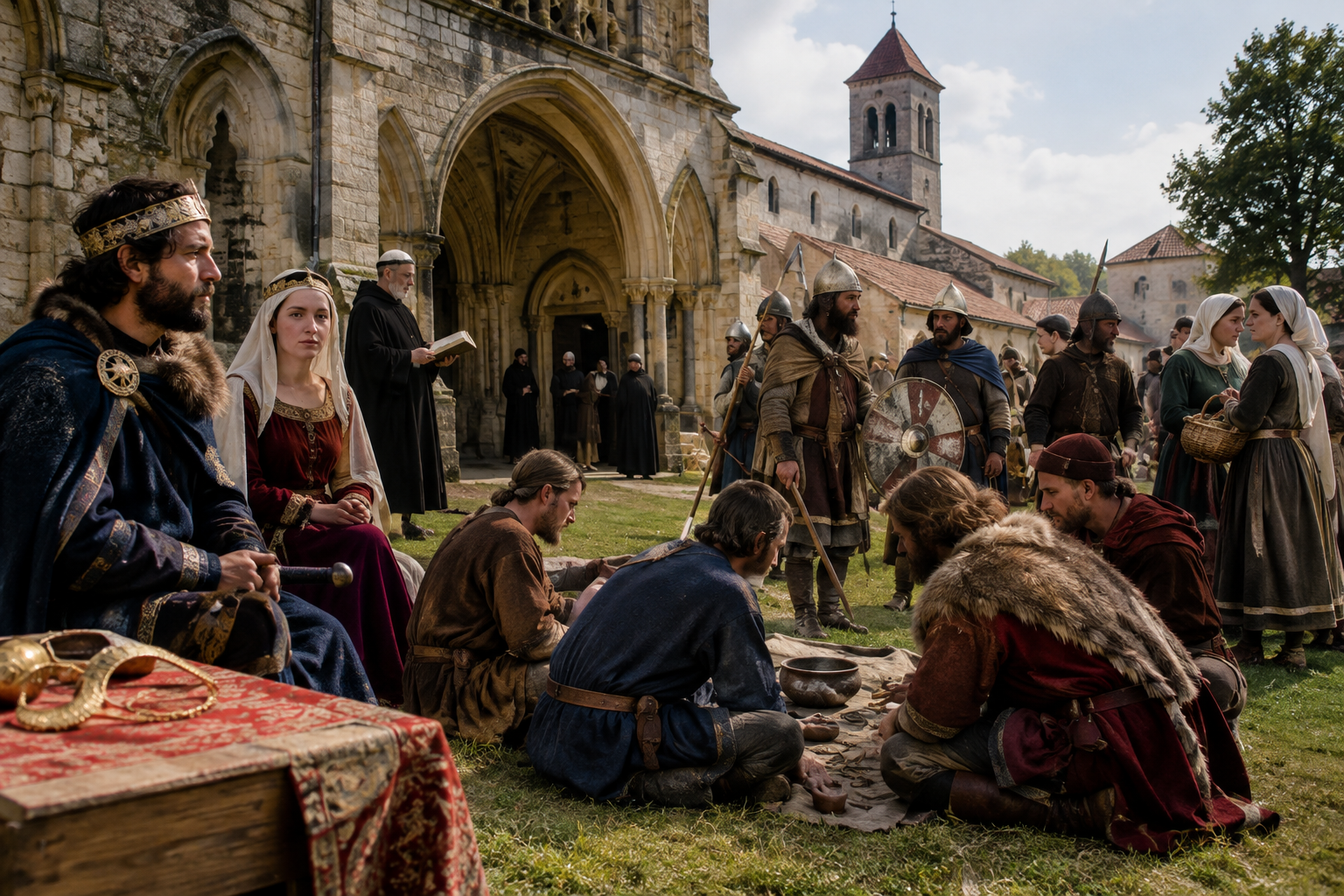
Some Y-chromosome lineages appear in history like brief cameos. Others keep turning up in awkwardly fascinating places: a Bronze Age burial in Hungary, Gothic-associated cemeteries in Poland, Avar-period elites in the Carpathian Basin, Piast-era Poland, Viking Age Gotland, and later the Baltic world of noble manors. Haplogroup R1a1a1b1a2b3a belongs to that second category. Not because a single straight line can be drawn from one skeleton to one dynasty, but because this branch sits inside one of the best-known paternal lineages in Eurasian history and appears across regions where migration, conquest, settlement, and local continuity repeatedly overlapped.
That is worth pausing over. A Y-DNA haplogroup traces one very specific line of inheritance: the direct paternal line, father to son to son again. It does not describe a person's whole ancestry, culture, language, or identity. Still, when ancient DNA places related paternal branches in graves spread across centuries and landscapes, it gives us something precious: not a fairy tale of pure descent, but a map of male-line history that written sources alone could never provide.
R1a1a1b1a2b3a is a highly specific branch within the wider haplogroup R1a tree. At that broad level, R1a is deeply associated with parts of Eurasia and is often discussed in connection with prehistoric and early historic movements across the steppe and into central, eastern, and northern Europe. But one must be careful here. The history of the broad parent haplogroup is not automatically the history of every narrow descendant branch. A subclade like R1a1a1b1a2b3a may have had a much more focused later distribution, and the evidence supplied here points especially toward central Europe, the Baltic region, and parts of the medieval north and east of Europe.
The sample spread suggests a lineage at home in zones of movement rather than isolation: the Carpathian Basin, Poland, Saxony-Anhalt, Croatia, the Baltic, southern Scandinavia, and Estonia. That does not prove a single migrating tribe carrying one neat genetic badge. Quite the reverse. It hints that related paternal lines were absorbed into several different historical worlds: Bronze Age communities, Iron Age groups, Gothic-associated populations, Avar and post-Roman elites, western Slavic settlers, Piast-linked medieval lineages, and Baltic-Scandinavian networks.
The oldest clues in this dataset come from Bronze Age central and eastern Europe. Sample S9, from the Balaton region of Hungary and associated with Somogyvar-Vinkovci, is dated to 2290 BC. Further west, SLB022 from Schleinbach in Austria dates to 1875 BC. There is also poz794 from Bronze Age Raciborowice near Krakow in Poland, dated to 1900 BC, and I6185 from Trestiana in Romania, dated to 1750 BC.
These burials do not let us pin down the exact birthplace of R1a1a1b1a2b3a. What they do show is that related paternal lines were already established across a broad swathe of central and eastern Europe during the Bronze Age. In other words, by the second millennium BC, this was not a tiny local curiosity. It belonged to a world of connected communities stretching from the Carpathian Basin toward the north and northeast.
The Baltic evidence sharpens that picture. Bronze and Late Bronze Age Estonia contributes several samples: V9 dated to 1110 BC, X15 dated to 1100 BC, X08 from a stone-cist burial dated to 870 BC, and later X17 at 660 BC and X14 at 600 BC. Latvia adds the hill-fort of Kivutkalns with Kivutkalns209 at 650 BC, Kivutkalns222 at 590 BC, and Kivutkalns19 and Kivutkalns25 both at 560 BC. These are not noble genealogies; they are better than that. They are ordinary and fortified communities showing that related male lines were present in the eastern Baltic long before medieval states or manor houses entered the story.
That Baltic depth makes later appearances in Estonia and Scandinavia more historically interesting, even if it does not prove direct descent from any one Bronze Age man.
Discover Late Bronze Age Central Europe
If the Bronze Age gives us depth, the first millennium AD gives us motion. The lineage appears in contexts associated with the world usually labelled Migration Period and early medieval Europe, that wonderfully untidy age when archaeologists, historians, and geneticists all have to work together because none of them can make full sense of it alone.
There are Gothic-associated samples in Poland such as PL052 from Grodek Wielbark and PL066 from Maslomecz Wielbark, both dated to 250 AD. Add GRK017 from Iron Age Grodek nad Bugiem, also 250 AD, and the picture is of related paternal branches present in the borderlands where material culture, mobility, and mixed communities complicate any simple ethnic label. The Gothic world was not genetically uniform, and these samples fit that broader lesson rather well.
By the fifth to seventh centuries the lineage is visible farther south in the Carpathian Basin. GYS058 from Late Antique Pannonia at Arrabona Szechenyi Square in Hungary is dated to 425 AD. The Dark Ages Hungarian Gothic-related samples SEI-1 and SEI-5 are both dated to 400 AD. Then come the Avar-period and elite burials: MGS005 from Moedling-An der Goldenen Stiege in the Vienna Basin, dated to 650 AD; RKC051 and RKC052 from Rakoczifalva in Hungary, also 650 AD; and KUP015, a Germanic Avar elite grave at Kunpeszer, dated to 609 AD.
What does that mean? Not that this was "the Avar haplogroup" or "the Gothic haplogroup." It means that a paternal branch within R1a could be carried by men buried in several overlapping social and political settings - some local, some migrant, some elite, some likely mixed by origin. This is exactly the sort of complexity that ancient DNA has been so good at restoring to early medieval history.
Read About Gothic Genetic Diversity
One of the most striking clusters in the dataset comes from medieval Poland and neighboring western Slavic territory. There are numerous samples from Santok and related Piast-era contexts: PCA0404, PCA0520, PCA0202, PCA0376, PCA0381, PCA0382, PCA0398, and PCA0342, mostly dated around 1100 AD, with PCA0198 from 950 AD and PCA0629 from 1150 AD. There is also PCA0562 from Milicz in Silesia, dated to 1100 AD, and samples PDH011 and PDH012 from Pidhirtsi in the Duchy of Sandomierz, both dated to 1150 AD.
Across the Elbe-Saale zone in present-day Germany, western Slavic settler contexts produce SDN028 and SDN029 from Steuden, both 900 AD, and a notable run of Niederwuensch individuals - NDW017, NDW025, NDW036, NDW038, NDW039, NDW043, and NDW071 - around 1100 AD.
This is where the lineage begins to look less like a scatter of isolated cases and more like a real medieval regional pattern. In the Piast sphere and adjoining western Slavic settlement zones, related paternal lines appear repeatedly. That is not proof that every Piast ruler or every western Slav carried the same branch. But it does suggest that this lineage was part of the male-line landscape of medieval central-eastern Europe, including politically important territories.
The northern story does not stop in medieval Poland. Sample R10840 from Bailuliai in Lithuania is dated to 340 AD, while VII15 from Iron Age Ingria is dated to 125 AD. In the Viking and Vendel Age material, the lineage also appears in maritime settings: VK487 from Salme II-I on Saaremaa, dated to 725 AD; VK475 from Kopparsvik on Gotland, 975 AD; VK463 and VK60 from Frojel on Gotland, both 975 AD; and VK282 from Stengade on Langeland in Denmark, dated to 950 AD.
Put bluntly, this is not the pattern of a lineage locked inside one inland peasant valley. It turns up in Baltic island warfare, trading worlds, Scandinavian-connected burials, and coastal exchange networks. It belongs to the same historical zone that tied Estonia, Gotland, Saaremaa, and the eastern Baltic into one restless sea-lane system.
That is what makes Riddarshuset Stiernhelm and Vihula Manor in northern Estonia such a pleasingly appropriate later setting for this haplogroup's story. The manor was first recorded in the early 16th century and passed through Baltic German noble hands over the centuries. It grew into a substantial landed estate, with main house, mills, barns, a vodka distillery, and parkland by the river: in other words, not just a residence, but a machine for organizing land, labor, status, and local authority.
Like many Baltic estates, Vihula stood at the intersection of several political orders. Its history runs through the old Teutonic and Livonian world, then Swedish rule, then the Russian Empire. By the 19th century it acquired much of the form visitors recognize today. The 20th century brought the violent dismantling of that older manor system through Estonian independence, war, Soviet occupation, and collectivisation. Its recent restoration means that Vihula now preserves, in wood, stone, and landscape, several layers of Estonian history at once.
Genetically, one should not leap from a manor house to a Y-chromosome claim. A noble family associated with a site does not prove that every male in that family carried R1a1a1b1a2b3a, or that a medieval or early modern lineage can be read directly off an ancient sample list. But geographically and historically, Vihula belongs to a region where this paternal branch had already been present for many centuries, perhaps millennia. That is the interesting connection: not a certificate of descent, but a continuity of place across very different social worlds.
Discover the Stiernhielm Family
R1a1a1b1a2b3a, as seen through these ancient samples, is a reminder that paternal ancestry is rarely tidy. This lineage appears in Bronze Age communities of Hungary, Austria, Poland, Romania, and the Baltic; in Gothic-associated and post-Roman contexts; among Avar-period elites; across western Slavic settlements; within Piast-era Poland; and in Viking Age Baltic-Scandinavian networks. It is a branch that seems to have persisted through change rather than belonging to one single people or kingdom.
That is why ancient DNA matters. Written genealogies begin late and usually favor the powerful. Archaeology gives us objects, graves, and landscapes. Genetics adds another layer: a way to trace one slender paternal thread through populations that rose, mixed, fought, married, traded, and vanished into later societies. It cannot tell you that an ancient man was your ancestor, or that sharing a haplogroup makes you a Piast prince or a Baltic noble. But it can place your direct paternal line inside a much larger human story.
If your own Y-DNA belongs somewhere near this branch, MyTrueAncestry can help you explore whether your results show links to ancient individuals from places like Santok, Rakoczifalva, Saaremaa, or Bronze Age Estonia. Those matches are not proofs of direct descent, but they can offer a remarkably vivid sense of where your paternal line has appeared in the historical record.






Comments