Haplogroup R1a1a1b1a2a3a1b1
– 5 min read


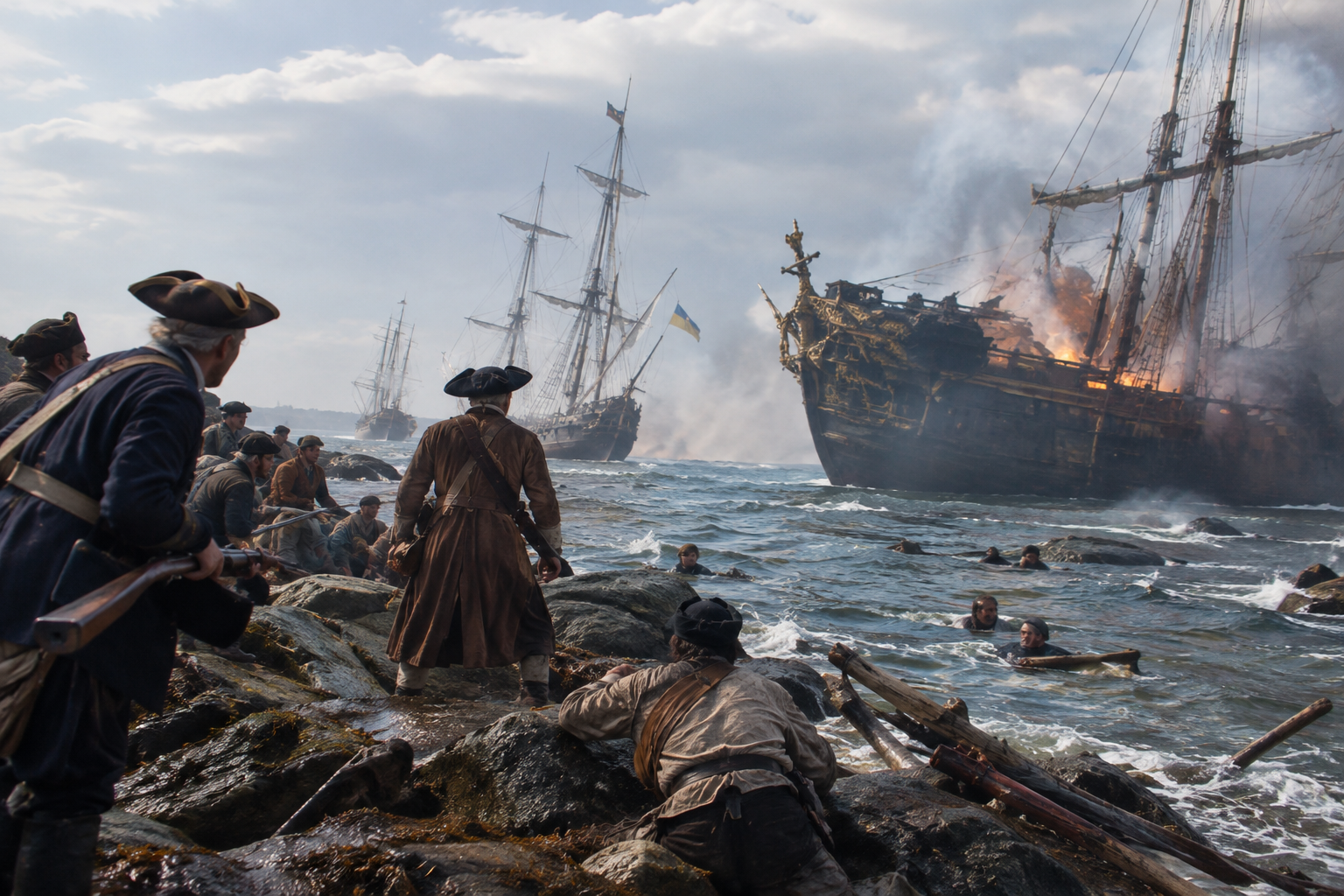
One of the clearest human faces attached to the Y-DNA haplogroup R1a1a1b1a2a3a1b1 comes not from a royal tomb or an early medieval cemetery, but from disaster at sea. The ancient individual kro009 was recovered from the wreck of Stora Kronan, the great Swedish warship lost in the Battle of Oland in 1676 AD. That already makes him historically vivid: not an abstract lineage on a chart, but a man caught in one of the Baltic world's most famous naval catastrophes.
For anyone tracing this paternal branch, that is a useful place to begin. Y-DNA follows one direct male line only, not a person's whole ancestry, but it can pin that line to a striking historical setting. In this case, the setting is late 17th-century Sweden at war, and a branch of the wider R1a family that has deep importance across northern and eastern Europe, yet appears here in a specifically Scandinavian context.
Stora Kronan was among the largest ships in the Swedish navy, and its loss off Oland during the Scanian War became one of the great maritime disasters in Swedish history. The sample kro009, dated to 1676 AD, belongs to that moment. Archaeologically, shipwreck victims are different from cemetery populations: they capture a crew assembled for war, not a community buried over generations in one parish.
That distinction matters. A naval crew can include men from different provinces, social backgrounds, and family histories, all compressed into one event. So kro009 is not "the Swedish population" in miniature. What he gives us instead is something more concrete: evidence that the paternal line represented by R1a1a1b1a2a3a1b1 was present among men serving aboard a major Swedish warship in the late 1600s.
The Kronan material has attracted wide public interest because it brings together archaeology, forensic reconstruction, and ancient DNA. MyTrueAncestry readers who want more on the ship itself may enjoy this related piece:
The long label R1a1a1b1a2a3a1b1 is a very narrow twig on the larger R1a tree. That larger haplogroup is well known in ancient and modern Eurasian genetics, especially in parts of eastern Europe, central Europe, and Scandinavia. But one of the easiest mistakes in popular DNA writing is to let the fame of the parent branch do all the work for the smaller one.
So it is worth being precise. The evidence here securely places this specific branch in a 17th-century Swedish individual from the Kronan wreck. It does not, by itself, prove where every earlier ancestor of that line lived, what language they spoke, or which migration first carried the branch into Scandinavia. The narrower the subclade, the more careful we have to be.
Even so, the broad setting is historically plausible and interesting. Sweden in the 17th century was not an isolated kingdom at the edge of Europe. It was a Baltic military power drawing manpower, wealth, and political ambition from a region knitted together by trade, war, and long earlier movements of people. A paternal branch like this could sit within that layered northern European story quite comfortably.
There is something almost wonderfully awkward, in the best historical sense, about using a warship casualty to think about haplogroups. We often imagine ancient DNA as belonging to prehistory, to barrows and stone chambers and the distant dark. But archaeology is not only about remote antiquity. A 17th-century wreck is archaeology too, and sometimes a very exacting kind of archaeology, because the historical framework is unusually tight.
With kro009, the date and event are unusually clear. We know the ship, the battle, and the year of loss. That allows the paternal lineage to be anchored to a specific political world: the age of the Swedish Empire, when the Baltic was a contested military zone rather than a quiet northern backwater.
Research on Scandinavian population history has increasingly shown how powerful ancient genomics can be when set beside archaeology and history rather than left to float on its own. A major ancient DNA study of the region, published in Cell, helped underline just how long and complicated the making of Scandinavian populations has been, from deep prehistory onward. That bigger background does not identify kro009's personal biography, but it does remind us that even a seemingly "local" Swedish sailor stood at the end of many older demographic layers.
The Battle of Oland took place in waters that had seen centuries of movement before Kronan exploded and sank. This was a maritime corridor joining Sweden, Denmark, the German coast, the eastern Baltic, and routes beyond. When we find a paternal branch like R1a1a1b1a2a3a1b1 in this setting, the right historical instinct is not to force a single origin tale, but to recognise the Baltic as a zone of repeated contact.
That matters especially for R1a lineages, which in broader form are spread widely across northern and eastern Europe. In different periods those lineages appear in contexts linked to steppe-derived Bronze Age expansions, later European regional histories, and medieval or early modern population structures. A late Swedish sample does not collapse all those episodes into one story. It shows only that one descendant line of that vast paternal history had reached, or remained in, Sweden by the later 1600s.
There is also a social point here. Warships were institutions of the state. Men aboard them were not chosen to preserve some ancient tribal identity; they were serving a navy. So the importance of kro009 lies precisely in the gap between genetics and identity. His Y-line belonged to one paternal branch, but his lived world was that of an early modern sailor in a heavily organised Scandinavian kingdom.
If we step back from the single individual, the broader Scandinavian record makes this find easier to place, even if not easier to oversimplify. Across Sweden and neighbouring regions, ancient DNA has revealed changing mixtures of forager, farmer, and steppe-related ancestry over millennia, as well as later reshaping through mobility in the Viking and post-Viking worlds. Paternal lines did not stand still while cultures changed around them.
That is one reason readers should resist the temptation to read a precise Y-branch as a ready-made ethnic badge. In Scandinavia, as elsewhere, language, kingdom, local community, and paternal descent could overlap, but they were never the same thing. The long history behind a branch like R1a1a1b1a2a3a1b1 is likely older and broader than any one Swedish political identity.
For readers interested in how genomics has been used to tackle language and population questions in the Germanic world, this article is a helpful companion:
Germanic Languages and Genomics
And for a later but still distinctly Scandinavian perspective on burial communities and DNA, this related study is also worth a look:
The most distinctive thing about this article's evidence is its sharpness of context. R1a1a1b1a2a3a1b1 is not represented here by a vague regional association but by a named ancient individual, kro009, from the Stora Kronan wreck off Sweden in 1676 AD. That does not make every modern carrier "Swedish," still less a descendant of one wreck victim, but it does place this paternal branch firmly within the documented human landscape of the Baltic north in the early modern period.
For family historians, that is often the real value of ancient DNA: not a fantasy pedigree, but a solid historical foothold. In kro009, this haplogroup appears not in legend, but in a man whose world was one of ships, empire, and war in the Baltic Sea.






Comments