Haplogroup R1a1a1b1a1a1c1d

– 5 min read


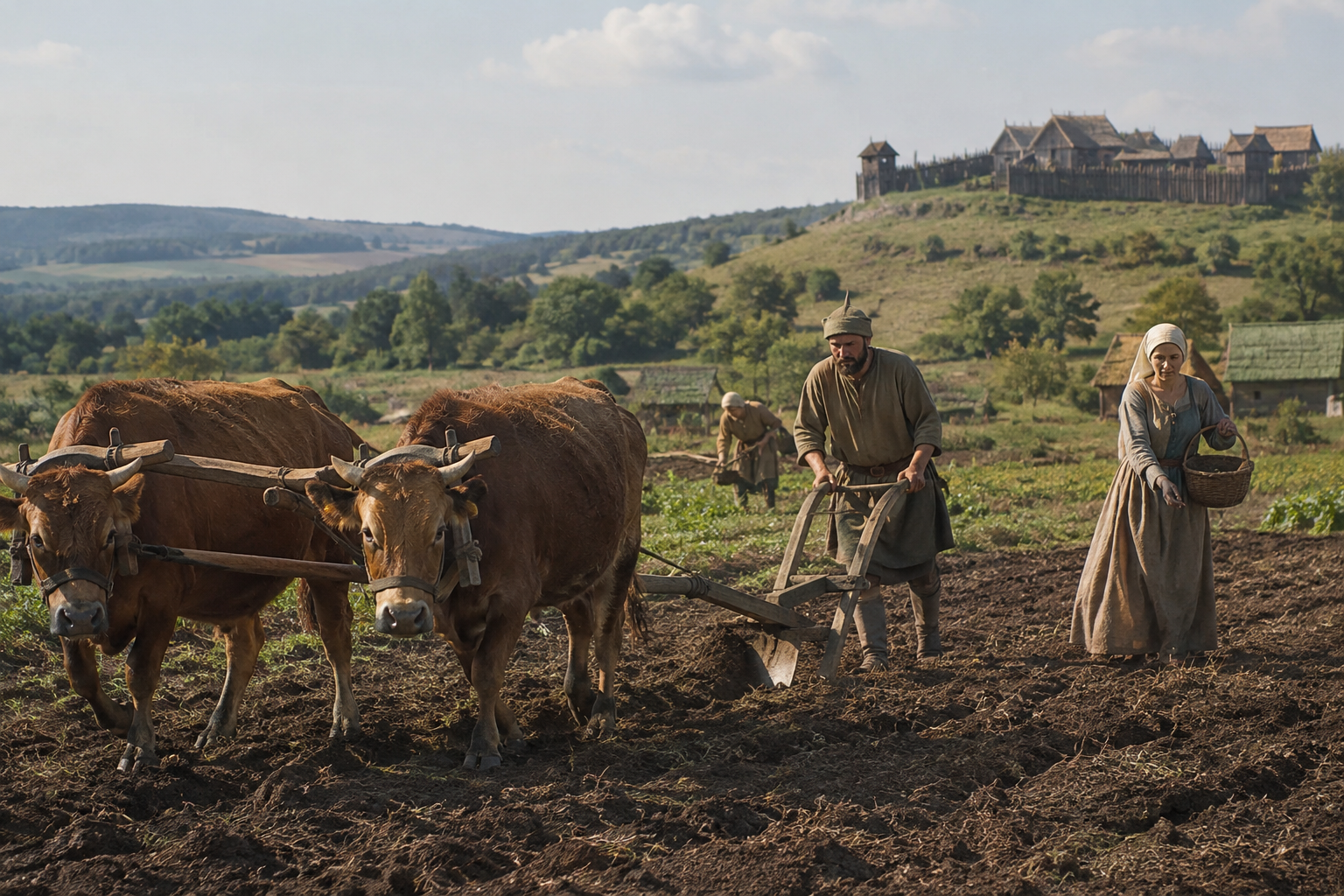
At Bodajk in Transdanubia, western Hungary, one man from around AD 950 has become a useful marker for a much larger story. He is identified as AHPS200W, from the site recorded as Medieval Hungary Transdanubia Bodajk Proletarfoldek. The interest here is not that a single burial can explain a whole people - it cannot - but that this individual has been associated with the Y-DNA lineage R1a1a1b1a1a1c1d, placing a very precise paternal branch inside the busy and mixed world of conquest-era and early medieval Hungary.
That makes Bodajk valuable precisely because it is so specific. A Y-chromosome lineage traces one direct paternal line only, not a person's total ancestry, language, or social identity. But when a branch like R1a1a1b1a1a1c1d appears in a documented early medieval burial from the Carpathian Basin, it gives us something tangible: a paternal thread tied to a real place, a real period, and a landscape where steppe-derived groups, local populations, and new elites were meeting, settling, and reshaping the region.
AD 950 sits in a crucial stretch of Hungarian history. The Carpathian Basin had already seen the arrival of the conquering Hungarians in the late 9th century, and by the mid-10th century their descendants were no longer simply mobile newcomers at the edge of Europe. They were becoming part of the political and social fabric of the basin itself, occupying old Roman landscapes, older Avar territories, and zones long connected to the wider steppe.
Bodajk lies in Transdanubia, west of the Danube, a region with deep archaeological layering. Roman rule, post-Roman rearrangements, Avar power, Frankish contact, and then the Hungarian conquest all left their mark here. So when AHPS200W turns up in this setting, the sample matters less as an isolated curiosity than as evidence from a frontier that had become a homeland.
An ancient DNA study of medieval Hungary published in Science Advances has helped frame this broader picture by examining elite and conquest-period ancestry in the region. Even without forcing every individual into a grand narrative, the research strengthens an important point: early medieval Hungary was not genetically uniform, and paternal lines associated with steppe-linked and eastern connections could persist alongside local and mixed ancestry profiles.
The long label matters. R1a1a1b1a1a1c1d is not the same thing as R1a in general, and it should not be flattened into a vague claim about "all eastern Europeans" or "all steppe peoples." R1a is a broad and widespread paternal macro-lineage with many branches that took very different routes through time. The branch in this article is a much narrower twig on that larger tree.
That distinction is essential in ancient DNA. A precise subclade can suggest a more focused paternal history, but only if supported by evidence from securely dated individuals and careful comparison across sites. With AHPS200W, the responsible claim is modest but meaningful: this branch was present in early medieval western Hungary, in a period when communities in the Carpathian Basin were still carrying traces of older steppe connections while also becoming increasingly local in their daily lives and burial landscapes.
In other words, the significance of this haplogroup here is contextual. It does not prove noble descent, tribal identity, or a single migration path. What it does do is place one direct paternal line inside one of the best documented zones of medieval population change in Europe.
The temptation with Hungary is always to tell a simple conquest story: riders arrive, a kingdom emerges, and modern identities naturally follow. Archaeology and genetics both make that version look far too tidy. The Carpathian Basin had already been a crossroads for centuries before the 10th century, and it remained one afterward.
Roman provincial populations, post-Roman communities, Avars, Slavic-speaking groups, incoming Hungarian groups, and other mobile networks all formed part of the region's human background. By the time of AHPS200W, western Hungary was not an untouched receiving zone but an inhabited and layered place where older populations and newer arrivals had already been interacting for generations.
That is why a lineage like R1a1a1b1a1a1c1d is interesting in Bodajk. Its presence fits a historical setting in which eastern and steppe-linked paternal lines could survive within mixed communities rather than existing in some neatly segregated "conqueror" block. Medieval cemeteries in Hungary increasingly show just this sort of complexity: burials tied to local landscapes but still carrying ancestry signals that reach beyond the basin.
Transdanubia is one of those regions where history accumulates rather than replacing itself cleanly. Roman towns and roads shaped movement long after imperial control was gone. Avar-period settlement and power left a major imprint. Frankish influence reached in from the west. Then the Hungarian conquest added another political layer without erasing the old terrain beneath it.
Seen in that light, Bodajk is not just "a Hungarian site." It belongs to a region where identities, loyalties, and family histories were already entangled. A 10th-century burial there may reflect a household or community participating in the new Hungarian order, but that does not mean every paternal line in the cemetery arrived at the same moment or came from the same source.
This is also where the power of archaeogenetics lies when used carefully. A single Y-line can sharpen the picture without overclaiming. AHPS200W tells us that the branch R1a1a1b1a1a1c1d had reached, or endured in, this western Hungarian setting by around AD 950. The wider historical meaning comes from the region's complexity: this was a world of incorporation, not simply invasion.
Readers sometimes expect ancient DNA to work like a census. It does not. One individual cannot stand for all medieval Hungarians, all conquerors, or even all men in one cemetery. But a well-placed individual can still be illuminating if the archaeological context is clear and the date sits in a historically active period.
AHPS200W is exactly that kind of sample. The burial comes from the century when the Hungarian polity was consolidating and when the memory of migration still sat close to lived experience. For people researching R1a1a1b1a1a1c1d today, that gives the lineage a concrete foothold in the medieval Carpathian Basin rather than leaving it floating as an abstract string of letters.
It also nudges us toward a better historical question. Instead of asking whether a lineage is "Hungarian" in some timeless sense, it is better to ask where and when that paternal branch is actually documented, and in what sort of archaeological world. Bodajk offers one answer: western Hungary, around AD 950, in a region shaped by conquest but already far beyond first arrival.
The clearest supported insight from R1a1a1b1a1a1c1d, as seen through AHPS200W of Bodajk, is that this direct male line belonged to the formative centuries of medieval Hungary's population history. It sits in a landscape where steppe-linked ancestry, local continuity, and political transformation overlapped rather than replacing one another in neat sequence.
For someone tracing this haplogroup today, that does not amount to a ready-made royal pedigree or a guaranteed ethnic label. It offers something better: a documented paternal presence in 10th-century Transdanubia, one of the key regions where medieval Hungary took shape.






Comments