Haplogroup Q1b2b1b2a

– 4 min read


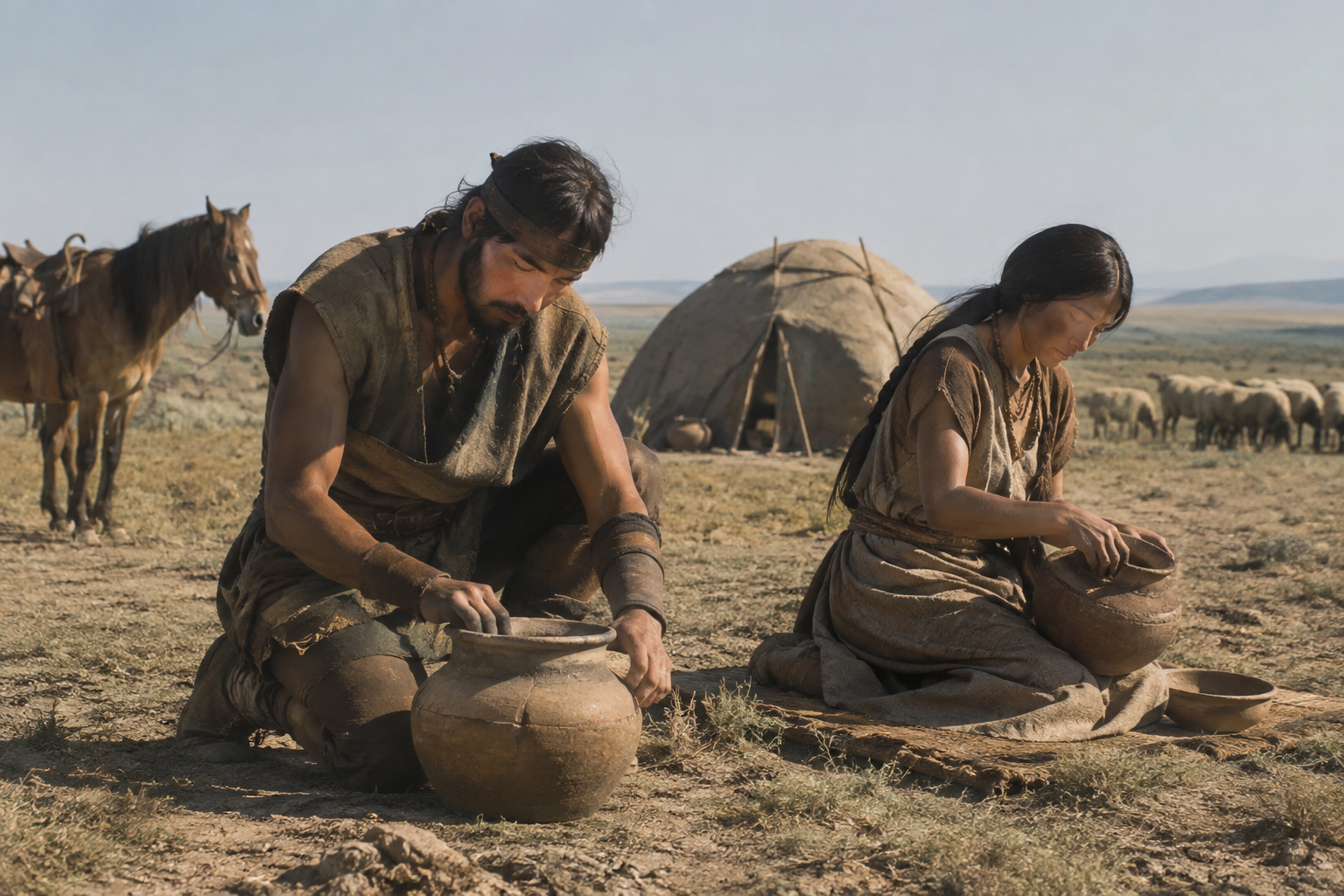
At Kyzul Bulak in Kazakhstan, one Bronze Age man known as I4784 offers a rare fixed point for thinking about the Y-DNA haplogroup Q1b2b1b2a. He is dated to around 1560 BC, which places him in the later Bronze Age of the eastern steppe zone, a world of mobile herders, regional exchange, and increasingly mixed communities stretching between Inner Asia and the wider Eurasian grasslands.
That matters because Q lineages are often discussed in very broad, sweeping terms, when the real historical interest usually lies in their smaller branches and their specific archaeological appearances. In this case, the evidence is spare but useful: one documented ancient individual from Bronze Age Kazakhstan associated with the branch Q1b2b1b2a. Y-DNA, of course, traces only one direct paternal line, not a person's whole ancestry, but even one well-placed paternal lineage can tell us something about where a male line was present and when.
The sample I4784 comes from Kyzul Bulak, in Kazakhstan, and its date of about 1560 BC places it in a period when the steppe was anything but static. By the middle and later Bronze Age, Kazakhstan sat inside a vast corridor of movement linking western steppe populations, Central Asian oases, and regions further east. A paternal lineage turning up here is not a curiosity at the edge of history; it sits right in one of Eurasia's great contact zones.
What makes this sample valuable is not royal glamour or an elaborate tomb narrative, but its position in time and space. Bronze Age Kazakhstan repeatedly appears in archaeogenetic research as a place where populations met, mixed, and sometimes moved on. A lineage associated with Q1b2b1b2a in this setting points to the presence of this paternal branch within that wider world of steppe interaction.
An ancient DNA study of Eurasian populations published in Nature is cited alongside this record, and while the sample summary here is limited, the broader research tradition around such sites has made one thing very clear: steppe ancestry histories are rarely simple one-direction migrations. They are layered histories of local continuity, incoming groups, and long-distance connections.
There is an old temptation in genetic storytelling to start with the largest label and treat everything beneath it as if it were the same thing. But Q1b2b1b2a is not interchangeable with all of haplogroup Q. The parent haplogroup has a very wide and complicated history across northern Eurasia and, in other branches, the Americas. That does not mean every subclade followed the same routes or belonged to the same historical populations.
So the sensible way to read I4784 is quite modest. We can say that a paternal line assigned to this branch, or closely associated with it in the sample record, was present in Bronze Age Kazakhstan around the mid-second millennium BC. We should not leap from that to grand claims about a single tribe, a single language, or a single migration event.
This caution is not a nuisance; it is where the history becomes more interesting. Bronze Age male lines on the steppe do not map neatly onto later ethnic names. Archaeological cultures, spoken languages, biological ancestry, and Y-chromosome descent overlap only partly. One paternal branch can persist through major cultural change, while an archaeological horizon can include several unrelated male lines.
If one imagines Bronze Age Kazakhstan merely as open grassland between more important civilizations, one misses the point entirely. It was a central arena in its own right. Herding economies, metal exchange, seasonal mobility, and inter-regional contact all made this landscape historically consequential long before written empires tried to define it.
The importance of a site like Kyzul Bulak lies partly in that geography. A paternal lineage found there belongs to a zone that connected the forest-steppe to the north, the Inner Asian mountain corridors to the east and southeast, and the settled regions of Central Asia to the south. In such a setting, male-line survival could reflect many kinds of history: local inheritance, incorporation into wider steppe networks, or the arrival of related men through marriage alliances and movement between communities.
That is why a single sample can still be historically meaningful. It anchors Q1b2b1b2a in a Bronze Age setting where interaction was the rule rather than the exception. For anyone carrying this lineage today, the ancient evidence does not point to a tidy badge of identity. It points instead to a frontierless world of mobility.
East-west mixing in Inner Asia
Although I4784 is the only ancient individual listed here, he fits a larger archaeological picture increasingly visible across Kazakhstan and neighboring regions. Bronze Age Inner Asia was marked by repeated episodes of population contact. Some communities show strong steppe-related ancestry, others more ties toward Central or East Asia, and many reveal combinations shaped over centuries rather than in one dramatic event.
This is precisely the sort of setting in which a lineage like Q1b2b1b2a may appear quietly but significantly. Not as the exclusive marker of an empire or a people, but as one thread among several paternal histories circulating through Bronze Age societies. In that sense, the real lesson of I4784 is not rarity for its own sake. It is that paternal diversity on the steppe had depth.
That broader point connects well with other MyTrueAncestry work on eastern Eurasia and frontier populations, especially where ancient DNA has complicated older stories of neatly bounded groups.
There is a pleasing austerity to this evidence. No grand dynasty. No castle pedigree. No medieval chronicler eager to tell us what the lineage meant. Just a man from Kyzul Bulak, dead by around 1560 BC, preserving a paternal signal that now turns up in a modern haplogroup assignment.
That austerity is useful, because it forces us back to the archaeology. The branch Q1b2b1b2a is, on present evidence here, part of the Bronze Age population history of Kazakhstan. It belongs in the conversation about Inner Asian mobility, steppe-era male lines, and the complex formation of Eurasian populations before the historically named confederations of the Iron Age.
For present-day testers, that means the strongest responsible claim is not a fantasy of direct descent from a famous ruler, but a connection to the deep paternal history of the Eurasian steppe and its borderlands. I4784 shows that this lineage, or a very close ancestral branch, was already established in Bronze Age Kazakhstan within a world of movement, exchange, and regional mixture that helped shape later Eurasian history.





Comments