Haplogroup Q1a2a1a4a

– 5 min read


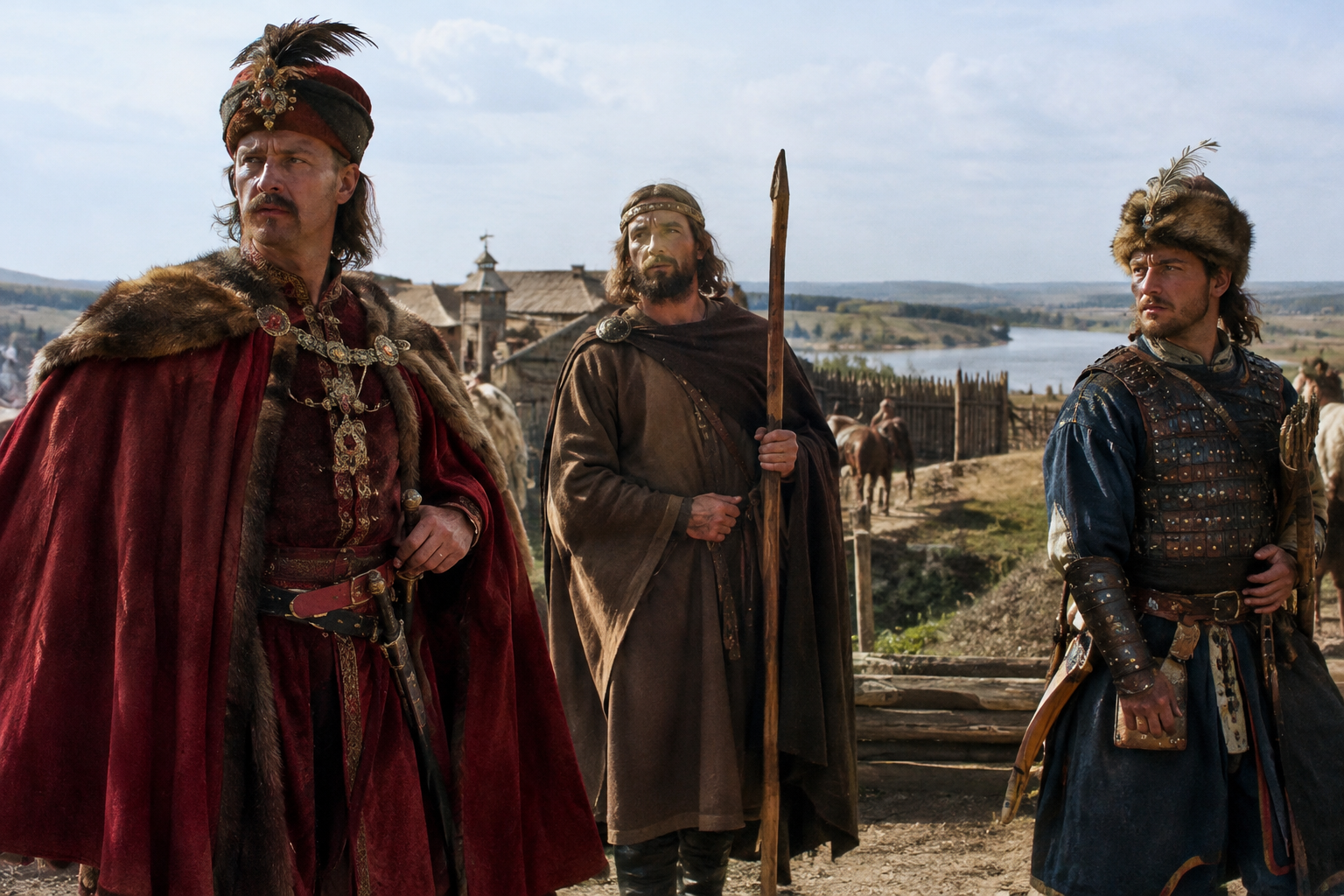
One of the more striking appearances of haplogroup Q1a2a1a4a in the medieval record comes from a noble burial in Hungary dated around AD 1500: sample PER10, identified as a Bathory male from Pericei. That is interesting not because one grave can explain a whole lineage, but because this is a branch of Y-DNA more often associated, in broad terms, with eastern Eurasian and steppe-linked paternal histories than with the standard story people usually tell about late medieval Central European nobility.
Set beside two earlier finds - A1804 from Early Avar-period Szarvas-Kovacs-halom in Hungary, dated around AD 650, and Alh_245 from Merovingian-period Altheim in Bavaria, dated around AD 600 - the picture becomes much more archaeological, and much more interesting. Q1a2a1a4a is not a label for an ethnicity or a complete ancestry. It marks one direct paternal line. But in these three men, that line appears in very different social and historical settings across the early and later medieval world of Central Europe.
Sample PER10 is the obvious place to begin because the context is unusually vivid: a male member of the Bathory nobility, dated to about AD 1500 in Pericei, in what was then part of the Kingdom of Hungary's political world. Here Q1a2a1a4a is not turning up in a frontier camp or an early migration-period cemetery, but in a late medieval elite context, where lineage, inheritance, and family memory mattered greatly.
That does not mean the entire Bathory family can be reduced to a single Y-DNA result, nor that one tested individual resolves every genealogical question. Still, a noble burial like PER10 matters because it shows this paternal branch persisting within the social fabric of medieval Hungary long after the great movement of steppe empires and post-Roman kingdoms. The line was not merely passing through; in this case, it had become part of the region's established aristocratic landscape.
There is also a wider historical backdrop here. Medieval Hungary was never a sealed box. Its ruling and noble strata emerged from centuries of mixture, conquest, alliance, and migration across the Carpathian Basin. A recent ancient DNA study on medieval Hungarian elites helps frame that setting, showing how conquest-period and steppe-linked ancestries could remain visible in later high-status groups without implying uniformity in every lineage or every family branch: research on medieval Hungary's elite population.
If PER10 shows survival into late medieval nobility, sample A1804 shows us an earlier and very different horizon. This man comes from Early Avar-period Szarvas-Kovacs-halom in Hungary, dated around AD 650. That places him in the centuries after the collapse of Roman authority in the region, when the Carpathian Basin was shaped by Avar power, local communities, and an ever-shifting balance between steppe traditions and European provincial realities.
The Avar period is exactly the sort of context in which a haplogroup like Q1a2a1a4a becomes historically suggestive. Not because the haplogroup can be equated with "the Avars" as a whole - it cannot - but because Avar-period cemeteries repeatedly remind us that the Carpathian Basin was connected to wider eastern networks. Some paternal lines, material styles, and biological ancestries point to those connections more clearly than others. A1804 belongs in that conversation.
An ancient DNA study of post-Roman populations in the Carpathian Basin has helped underline just how mixed and locally varied these communities were, rather than presenting them as a single incoming bloc. In that setting, a Q-lineage in an Early Avar burial is meaningful as evidence of one strand within a broader and more complicated population history: research on post-Roman communities in the Carpathian Basin.
What makes A1804 especially useful in this article is that it pushes the documented presence of this paternal line in Hungary centuries earlier than the Bathory nobleman. It suggests continuity of possibility, not proven descent. In other words, the same broad paternal branch can appear first in an early medieval steppe-era context and later in a Christian noble one, while the society around it changes almost beyond recognition.
The third sample, Alh_245, comes from Altheim in Bavaria and is dated to around AD 600, in the Merovingian period. This is a different political world again: not Avar-ruled Hungary and not late medieval noble Hungary, but the post-Roman west, where local populations, military service, migration, and frontier exchange all helped shape early medieval communities.
That matters because a Q1a2a1a4a assignment in Bavaria should not be treated as exotic decoration attached to a familiar Frankish story. Rather, it is a reminder that early medieval Europe was full of people whose paternal lines did not fit modern nationalist expectations. Merovingian Bavaria sat within zones of contact stretching eastward into the Danube basin and beyond. A single burial cannot map the exact route by which this lineage arrived there, but it does show that such eastern-associated paternal ancestry was not confined to one kingdom or one elite circle.
Alh_245 also helps prevent a common mistake in popular genetics: assuming that an unusual Y-line in one medieval country must represent a late, isolated arrival. In fact, when the same lineage appears in Bavaria around AD 600 and in Hungary around AD 650, the better historical question is not "why is this here at all?" but "what kinds of connections across Central Europe made this unsurprising to the people who lived through it?"
It is worth pausing over the level of resolution here. The article is about Q1a2a1a4a, a fairly specific branch of the wider haplogroup Q family. The wider parent haplogroup has a very large geographic and chronological story, ranging across northern Eurasia and into the Americas. But those broad patterns should not be lazily pasted onto this narrower medieval branch without specific evidence.
What the samples actually show is modest but solid. Men associated with this branch, or reported under it in the available material, appear in early medieval Bavaria, in Early Avar-period Hungary, and in a late medieval Hungarian noble context. That is enough to say the lineage had a real foothold in Central European history. It is not enough to claim that every carrier descends from one named people, one conquering army, or one ruling house.
That, in fact, is part of the fascination. Y-DNA often preserves a narrow line of transmission across enormous changes in language, faith, dress, and political allegiance. The man in an Avar-period burial and the Bathory nobleman inhabited worlds with very different institutions and identities, yet one paternal branch can connect those worlds without making them identical.
What makes Q1a2a1a4a distinctive in a MyTrueAncestry context is not simply rarity. It is the combination of settings in which it appears. Here we have a line turning up across three moments that historians usually keep in separate boxes: Merovingian Bavaria, the Avar Carpathian Basin, and late medieval Hungarian nobility. The archaeology does not collapse those boxes, but the genetics does force them into conversation.
For someone researching this paternal haplogroup today, the careful takeaway is that this branch can sit quite comfortably inside the history of Central Europe's borderlands, military societies, and elite formations. Its documented ancient appearances fit especially well with the long, complicated traffic between the eastern steppe and the Danube world. That is not a family tree, and it is not a guarantee of noble descent. But it is a historically rich setting in which this paternal line is genuinely at home.






Comments