Haplogroup Q1a1b1a
– 5 min read


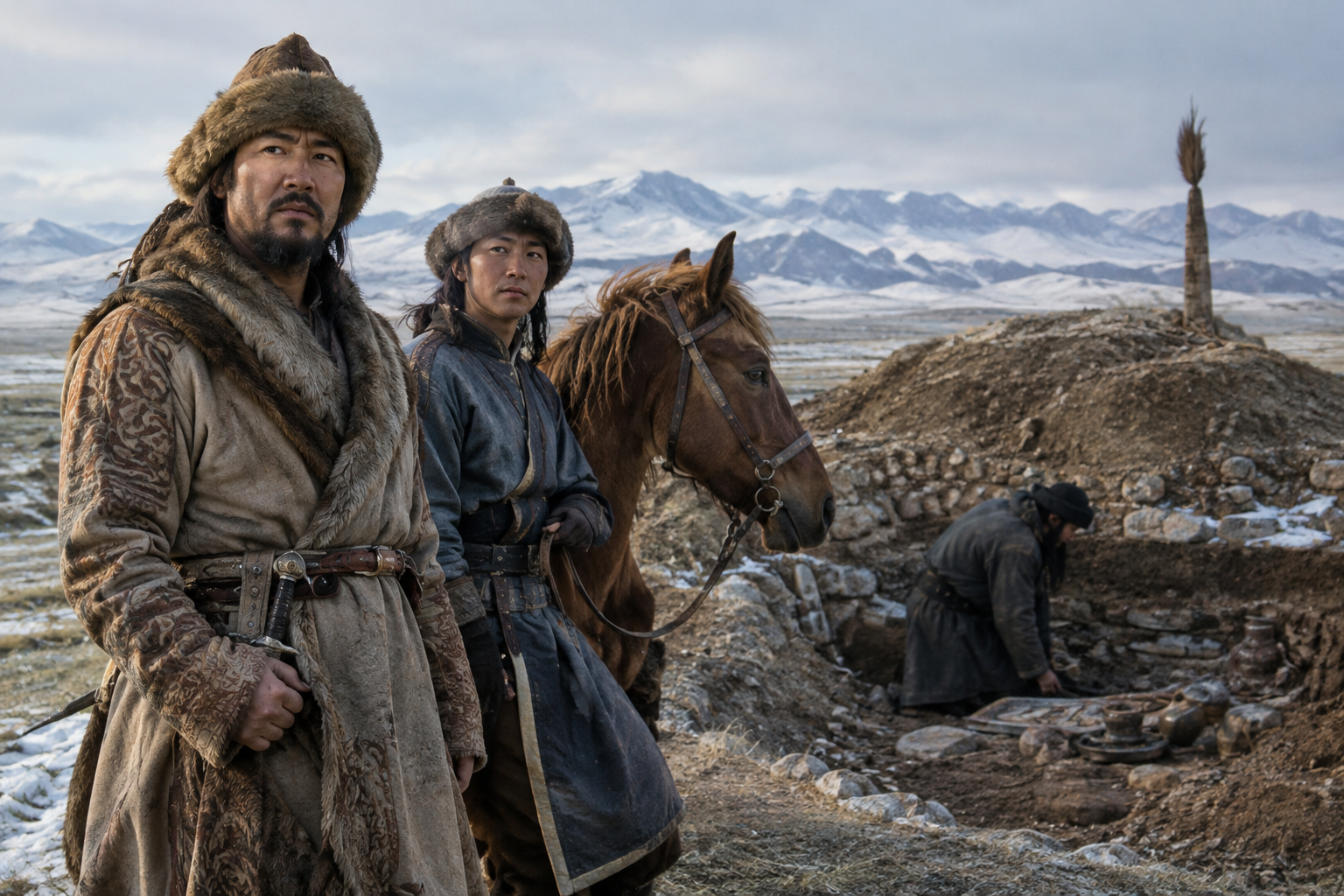
At Berel in eastern Kazakhstan, a small cluster of burials dated to around AD 300-330 has turned up a striking pattern: more than one male from this cemetery complex is associated in MyTrueAncestry's records with Y-DNA haplogroup Q1a1b1a. The individuals are listed as BRE011, described as Xianbei Hun Berel and dated around AD 300; BRE004, from a Xianbei-Hun necropolis at Berel and dated around AD 320; and BRE020, described as Saka Period Kazakhstan Berel and dated around AD 330. Even before one starts telling big stories about peoples and empires, that concentration at one site is interesting in itself.
Because Y-DNA follows a direct paternal line, it is only one narrow strand of ancestry, not a full ethnic label. But when the same paternal branch appears repeatedly in a cemetery on the eastern steppe in late antiquity, it becomes historically useful. It suggests continuity, mixing, or both, in a landscape where labels such as Saka, Hun, and Xianbei often overlap in complicated ways rather than sitting neatly in separate boxes.
Berel is famous in archaeology for much earlier kurgan burials of the Scythian-Saka world, yet the samples here belong to a much later horizon, centuries after the classic Iron Age peak of steppe burial traditions. That matters. It reminds us that some burial grounds were not single-moment monuments but places with long afterlives, reused or reinterpreted by later communities living through the political turbulence of the Hunnic age.
In that setting, Q1a1b1a appears not as an abstract branch on a phylogenetic tree, but as a paternal signal attached to real men buried in the Altai-connected zone of eastern Kazakhstan. BRE011 and BRE004 are both linked with a Xianbei-Hun context, while BRE020 is described as Saka Period Kazakhstan Berel despite its later date. That mixed terminology should make us cautious rather than dismissive. Archaeological labels often reflect burial style, regional tradition, or historical comparison, not a simple one-to-one identity.
An ancient DNA study on eastern steppe populations helped show just how mixed these frontier worlds could be, with political confederations drawing together people of varied backgrounds across Mongolia, the Altai, and adjoining regions. For that wider setting, see this major ancient DNA study of the eastern Eurasian steppe, which underlines how mobile and genetically diverse these societies were.
Haplogroup Q is a broad paternal lineage with a deep history across northern Eurasia and, in other branches, the Americas. But the article haplogroup here is not the whole of Q: it is the narrower branch Q1a1b1a. That distinction is important, because a parent haplogroup can spread across enormous distances and periods, while a specific sub-branch may have a much more focused history.
With the Berel individuals, the safest reading is local and archaeological. Q1a1b1a was present among some males buried in this eastern Kazakh steppe context around the turn of the 4th century AD. Repeated occurrence at one necropolis may hint at paternal continuity within a community, or at least the presence of a branch common enough to appear several times. What it does not prove is that all people at Berel shared one paternal origin, or that a single named tribe can be read directly from a Y-chromosome label.
This is particularly worth stressing at Berel because the site sits at the meeting point of several historical vocabularies. "Saka" belongs mainly to the Iranian-speaking steppe world of the earlier Iron Age; "Xianbei" and "Hun" belong to later confederational politics reaching across Inner Asia. A burial dated around AD 320 can preserve older regional traditions while also belonging to a new political age. Genetics and archaeology together help show that such transitions were rarely clean breaks.
The two Berel individuals BRE011 and BRE004 are the clearest pair in this group because both are explicitly associated with a Xianbei-Hun context. Dated around AD 300 and AD 320, they belong to the period when the eastern steppe world was being reshaped by the collapse and reassembly of large confederations. This was an age of mounted mobility, shifting alliances, and political names that could travel farther than any one bloodline.
That makes the presence of Q1a1b1a especially suggestive. It fits a world in which paternal lines could move through elite networks, local communities, military followings, and family groups without mapping tidily onto a single language or ethnicity. If two men from the same cemetery zone share this branch in a Xianbei-Hun horizon, the most sensible conclusion is that Berel was plugged into those wider Inner Asian currents while remaining rooted in its own regional past.
Readers interested in how steppe burials and elite identities are being re-examined with genetics may want to compare another MyTrueAncestry discussion of Scythian-period power and kinship:
BRE020 is listed as "Saka Period Kazakhstan Berel" and dated around AD 330. On the face of it, that combination is awkward, because the classic Saka horizon belongs earlier than the 4th century AD. Yet archaeology is full of such awkward survivals. Terms can persist because a cemetery lies in a region long associated with Saka burials, because later graves reuse older monuments, or because material culture still shows steppe traditions with deeper roots.
So BRE020 is valuable precisely because it complicates the picture. If this individual also falls under Q1a1b1a, the branch was present not only in the explicitly Xianbei-Hun labeled burials but in a sample described through an older regional-historical vocabulary. That does not mean "the Saka were Q1a1b1a" in any sweeping sense. It means that at Berel, older steppe traditions and later imperial-era identities overlapped in ways that genetic evidence can illuminate but not oversimplify.
A separate research lead associated with these Berel-era materials is available here. Even without pressing it for claims we cannot verify line by line, its inclusion alongside the Berel records points to the continuing scholarly effort to place eastern Kazakh burials within the broader population history of the Altai-steppe zone.
What makes Q1a1b1a at Berel genuinely interesting is not that it unlocks a single grand origin story, but that it sits in exactly the kind of region where continuity and reinvention went hand in hand. Eastern Kazakhstan was never an isolated pocket. It linked the Altai, the Inner Asian steppe, and routes running westward toward the Pontic world and southward toward Central Asia.
Ancient DNA from steppe regions has repeatedly shown that communities there were seldom biologically uniform. They were shaped by long-distance contact, local persistence, and repeated episodes of admixture. A paternal lineage can therefore survive across changing archaeological horizons even while languages, political loyalties, and cultural fashions shift around it.
That is why the Berel cluster matters more than a lone sample might. Three individuals, all from the same general site and all dated to a relatively tight late antique window, make Q1a1b1a visible in a concrete community setting. Not universal, not exclusive, but real and repeated.
For someone exploring Q1a1b1a today, the Berel evidence points toward a paternal line that was present in the eastern Kazakh steppe during the unsettled centuries around AD 300. More specifically, it appears in a cemetery where Saka-rooted regional traditions and Xianbei-Hun era identities seem to meet. That is the most distinctive insight here: not a simple tribal badge, but a lineage visible in a frontier society where older steppe worlds were being folded into new confederations.
If your direct paternal line falls under Q1a1b1a, Berel offers an evocative ancient anchor: men buried in the Altai-connected steppe at a moment when Inner Asia was being politically remade, but local burial landscapes still carried the weight of much older histories.






Comments