Haplogroup Q

– 5 min read


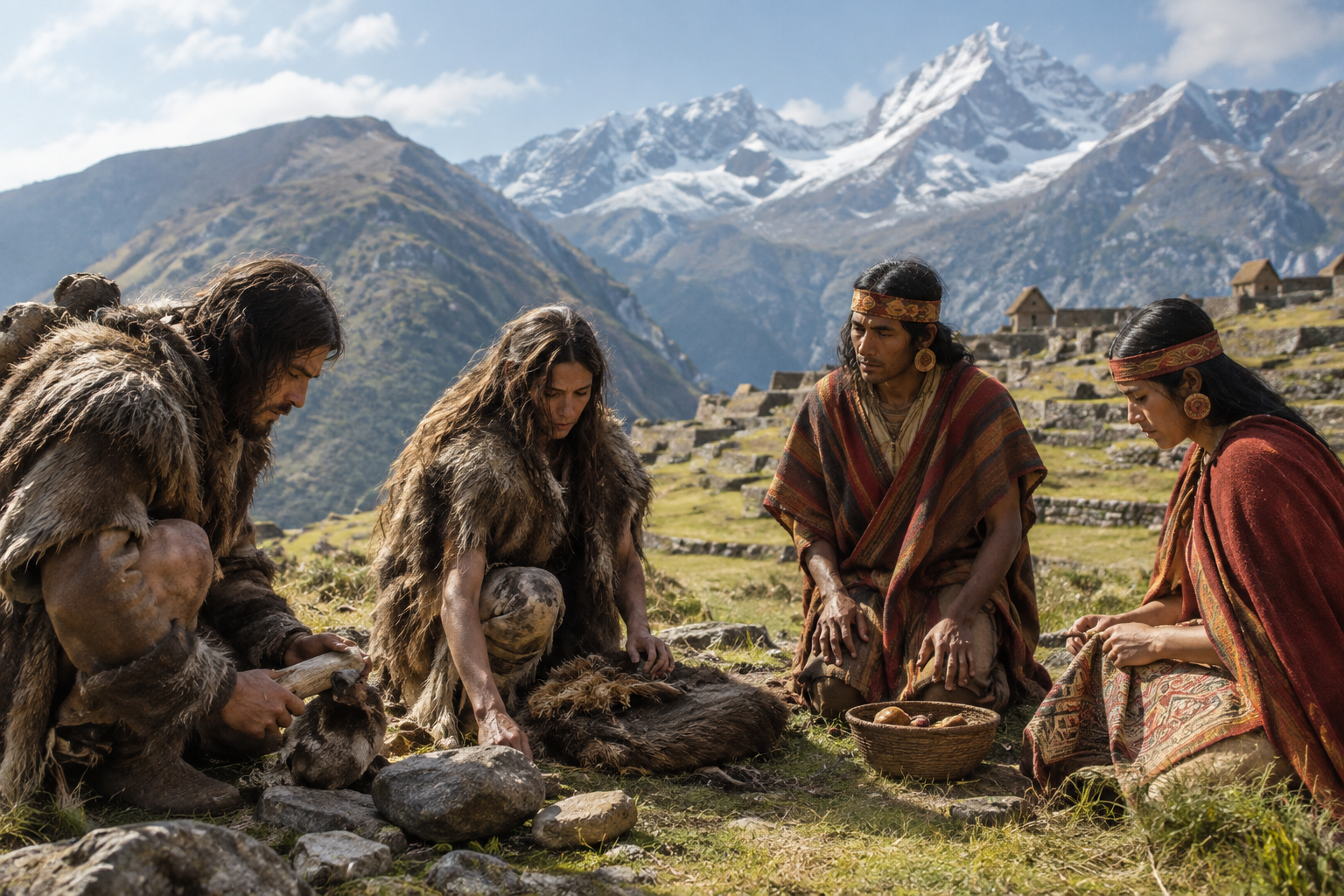
At Qotakalli near Cusco, one ancient man dated to around AD 1425 was reported with Y-DNA haplogroup Q. He appears in the record as sample QKI-9-3, and although that single letter may look deceptively plain, it points to one of the most historically important paternal lineages in the ancient Americas. Haplogroup Q is the major Y-chromosome branch associated with the peopling of the Americas, so seeing it in an Inca-period individual is not surprising. What matters is the setting: not an abstract migration model, but a real person from the late pre-Columbian Andes, living in the world of imperial Cusco.
That is a useful place to begin, because Y-DNA follows one direct paternal line only. It does not describe a person's whole ancestry, social identity, or language. But in the case of haplogroup Q, even a broad assignment can place an individual within an extraordinarily deep story, one that runs from Upper Palaeolithic Siberia to early Holocene foragers near the Dnipro and then, much later, to Indigenous American societies including the Inca world.
The Qotakalli sample is late, urban, and Andean. By the fifteenth century AD, Cusco was the political heart of the Inca state, a place where imperial expansion, local community life, and long-established Andean ancestry all met. Sample QKI-9-3 does not need an invented court drama to be interesting: a haplogroup Q lineage at Cusco in this period neatly fits the wider picture of Native American paternal history while reminding us that imperial centres were populated by real families whose lineages stretched far beyond the empire itself.
In that sense, haplogroup Q is not "Inca" in any exclusive dynastic way. It is older and broader than the Inca state by many millennia. What the Qotakalli individual shows is continuity of a paternal branch deeply rooted in the ancient population history of the Americas.
If Qotakalli gives us a late Andean endpoint, NEO102 from Afontova Gora, Krasnoyarsk, dated here to around 3381 BC, points toward a very different landscape: southern Siberia. Afontova Gora is famous in human prehistory because the wider site complex has produced remains important for understanding the ancient populations of north Eurasia. Those populations matter enormously for the long background to American settlement.
Care is needed here. The date attached to NEO102 is far later than the classic Upper Palaeolithic Afontova Gora remains for which the site is especially well known, so we should not collapse every burial from Afontova Gora into one period or one population. Still, the broader importance of a Q-lineage in the Krasnoyarsk region is that Siberia sits within the great northern zone where branches ancestral to later Native American paternal lines are discussed. Research on ancient northern Eurasian populations, including work published in a major ancient DNA study, has helped clarify just how deep and complex that background was.
What makes this compelling is not a simplistic claim that one Siberian man "became" later Americans. That would be far too neat. Rather, lineages within haplogroup Q belong to a northern Eurasian world from which some paternal branches eventually contributed to the populations that entered and peopled the Americas. Afontova Gora keeps that northern setting firmly in view.
The most surprising sample in this small group may be NEO501 from Vasilevka, Ukraine, dated here to about 8705 BC. That is an early Holocene context in the North Pontic region, far west of Siberia. At first glance it may seem awkward in a story about haplogroup Q, but in fact it is a useful reminder that ancient Y-chromosome distributions were not identical to those of today.
Early postglacial Europe and the adjoining steppe were peopled by hunter-gatherer groups whose genetic landscapes were varied and, at times, surprising. A broad haplogroup assignment to Q in such a context does not mean that haplogroup Q was common across all of Europe, still less that later European populations preserving other dominant paternal lines somehow "lost" a native Q identity. It means only that this branch formed part of the wider mosaic of northern Eurasian male lineages in the early Holocene.
For the archaeology of eastern Europe, that matters. The lands around the Dnipro, the steppe margin, and the Black Sea zone repeatedly appear in discussions of mobility, contact, and population turnover. A genetic study of the broader region, published in Science Advances, has underlined how dynamic these ancient populations could be. Vasilevka therefore adds geographical breadth to haplogroup Q: not just Siberian and American, but present in a wider northern world whose later histories diverged sharply.
One difficulty with an article on haplogroup Q is that the label is broad. Some ancient samples are resolved to very specific downstream branches, while others are reported only at a parent level. Here, the evidence provided points to Q as the relevant paternal umbrella, not to a securely documented terminal subclade for every individual discussed. That distinction matters because the internal branching of Q is what separates lineages concentrated in the Americas from others found in Asia and, more sporadically, elsewhere across Eurasia.
So the safest historical reading is also the most interesting one. Haplogroup Q belongs to a deep northern Eurasian paternal framework. Within that framework, some branches became central to Native American population history, while others appear in ancient Eurasian contexts that remind us how wide the old distribution once was. The three samples here do not form one tidy family tree, but they do form a striking archaeological arc.
It is tempting to tell the story of haplogroup Q as a single march from Siberia into the New World. Real evidence is more complicated than that. Populations split, mixed, vanished, expanded, and moved at different times. Some paternal branches endured locally for thousands of years; others were replaced or reduced. The archaeological record gives us snapshots, not a continuous film.
Even so, the sequence here is powerful. NEO102 at Afontova Gora places Q in the north Eurasian zone so often invoked in discussions of deep ancestry. NEO501 at Vasilevka shows that early Holocene western Eurasia still held paternal diversity that later became patchier. QKI-9-3 at Qotakalli shows Q in one of the great Indigenous civilizations of the Americas, where this paternal heritage was no longer background prehistory but part of lived historical society.
For someone researching a paternal line in haplogroup Q, the strongest supported insight is depth rather than prestige. This is a lineage with roots in ancient northern Eurasia and with exceptional importance in the population history of the Americas. The samples from Vasilevka, Afontova Gora, and Qotakalli do not prove one direct chain of descent, but together they show why Q deserves to be read archaeologically: as a branch that links Ice Age and post-Ice Age northern worlds to later Indigenous American history, including the high Andes on the eve of European conquest.






Comments