Haplogroup P1

– 5 min read


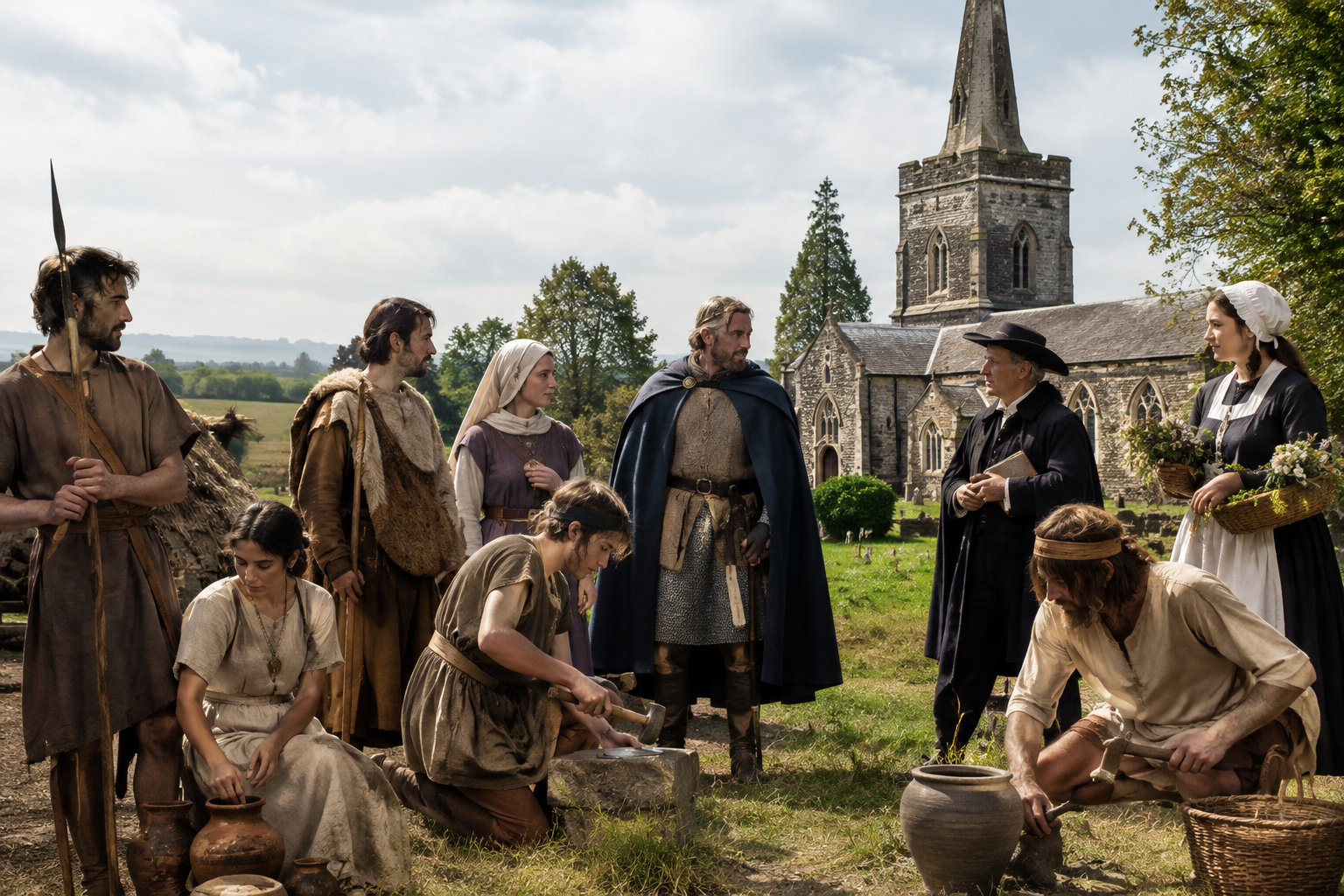
At Barnham Market in Norfolk, an early medieval burial labeled BMN003 places haplogroup P1 in a recognisably Anglo-Saxon setting around AD 600. That may sound like a small fact, but it is exactly the sort of finding that matters in archaeogenetics: not a grand mythic founder, not a fantasy of one tribe marching across a map, but a real man from a documented burial ground whose paternal line can be placed within a changing post-Roman England.
P1 is a very broad Y-chromosome branch. Y-DNA tracks one direct paternal line only, so it is never the whole story of a person's ancestry, language, or identity. Still, when a branch as deep as P1 appears in ancient individuals from Bronze Age Iberia, Bronze Age Moldova, Iron Age island communities, medieval Poland, and early medieval England, it becomes historically interesting for a different reason: it shows just how long-lived and widely distributed some paternal lines could be inside very different societies.
The Norfolk sample BMN003, dated around AD 600, belongs to the period when eastern England was being reshaped by migration, local continuity, and new political identities. "Anglo-Saxon" is useful here as an archaeological and historical label for the early medieval world of cemeteries, settlements, and kingdoms in post-Roman Britain; it should not be mistaken for a simple genetic category.
In that context, a P1-associated Y lineage is a reminder that early medieval England was not populated by one neat paternal signature. Ancient DNA work on Britain has repeatedly shown a mixture of local and continental ancestries, and variation between cemeteries as well as within them. A genetic study of Roman and early medieval Britain, published in Genome Biology, helps frame the broader landscape in which men like BMN003 lived: one of demographic change, but not of total replacement.
Roman and Early Medieval Britain
The later English sample in this set, ATP_PSN_410 from Trinity Church and dated to AD 1844, is very different in character. It belongs to the early modern period, not the migration era, and so it does not tell the same story about Anglo-Saxon England. What it does show is continuity of the broad paternal branch in England across a very long span of time, from the early medieval period into the modern age of parish burials and industrial society.
The oldest samples here sit much further back in time. At Camino de las Yeseras in Iberia, sample I6622, dated to about 2150 BC, places P1 in a Copper Age to Bronze Age world of major social change. This was the period when Iberia saw new patterns of mobility, new burial customs in some regions, and substantial reshaping of ancestry after the arrival of steppe-derived populations.
That does not mean every man carrying a P1-related lineage in Iberia had the same immediate origin, nor that one sample can stand in for the whole peninsula. But I6622 is valuable because it anchors the branch in prehistoric western Europe at an early date. Research on Bronze Age population change across Eurasia, including the broad transformations discussed in this Nature study, gives the wider background for why such a placement matters: these were centuries when paternal lineages could expand, contract, and reappear in new cultural settings.
Further east, I10397 from Ciumai in Moldova, dated to about 2000 BC, adds a second Bronze Age setting. This is not simply "the same story again." Moldova sits close to one of the great contact zones between the Carpathian world, the western steppe, and the Balkans. A P1 assignment here suggests that the branch was present in populations living along exactly the sorts of corridors where people, goods, and marriage ties moved over long distances.
Two later prehistoric samples show P1 in places that are geographically peripheral but historically revealing. The first is I14742 from Cliffs End Farm in Kent, dated around 935 BC in the Late Bronze Age. Kent is often treated as a threshold region, facing both inland Britain and the near continent, and finds from the area frequently speak to exchange rather than isolation.
A Y-lineage like P1 appearing there fits that broader picture rather well. It does not prove that this particular man had recently crossed the Channel, but it does place the branch within a community living in one of Britain's busiest prehistoric contact zones. Coastal areas often preserve exactly this sort of complexity: continuity in some family lines, movement in others, and no tidy boundary between "local" and "foreign."
The second is I26630 from Riduna in the Channel Islands, dated to about 576 BC in the Iron Age. Island archaeology can encourage romantic exaggeration, but the sensible point is better. Islands are not sealed boxes. In the Iron Age Channel Islands, as elsewhere, maritime communities were tied into wider networks of trade and communication, and a paternal lineage found there belongs to that connected world rather than some isolated survival.
The medieval sample PCA0240 from Poznan in Greater Poland, dated around AD 1100, brings the story into a very different political world. By this time we are dealing with a Christian medieval society of emerging towns, dynastic rule, and regional consolidation. A P1-associated male line here is not evidence for a royal house, a noble clan, or an ethnic label by itself. It is evidence that this paternal branch persisted into the medieval populations of central Europe.
That matters because medieval Europe is often where readers most want a lineage to become neat and genealogical. Real evidence is usually messier and more interesting. A branch like P1 does not belong to one people alone. Instead, it can appear in multiple settings over millennia, surviving social upheavals that transformed languages, religions, and states around it.
Greater Poland is especially apt for that lesson. This was a heartland of the early Polish state, but medieval populations there were not created from scratch by political history. They were built from older local and regional ancestries, reshaped over time. Ancient DNA from medieval and early historic central Europe has increasingly underlined this point: political frontiers change faster than paternal lineages do.
With a haplogroup this broad, caution is part of the story. P1 is an upstream branch, ancestral to major later Y-chromosome lineages, so a report of P1 in ancient material may reflect limited resolution, a broad classification, or an association at parent-branch level rather than a finely defined terminal subclade. That is not a flaw. It simply tells us that the useful historical signal here lies less in chasing a single recent founder and more in observing the branch's persistence across very different times and places.
In this small set alone, P1 appears in prehistoric Iberia, Bronze Age Moldova, later prehistoric southern Britain, Iron Age island communities, Anglo-Saxon Norfolk, medieval Poznan, and early modern England. That is not a map of one migration. It is a reminder that paternal history is often cumulative: old lineages endure by being folded into new populations again and again.
If your Y-DNA connects you to P1, the most responsible historical takeaway is not that you descend from one famous tribe or one medieval family. It is that your direct paternal line belongs to a very old branch that turns up in a striking range of European archaeological contexts, from Bronze Age cemeteries to early medieval and later historic burials. The strength of P1, in other words, is not exclusivity but longevity.






Comments