Haplogroup P

– 5 min read


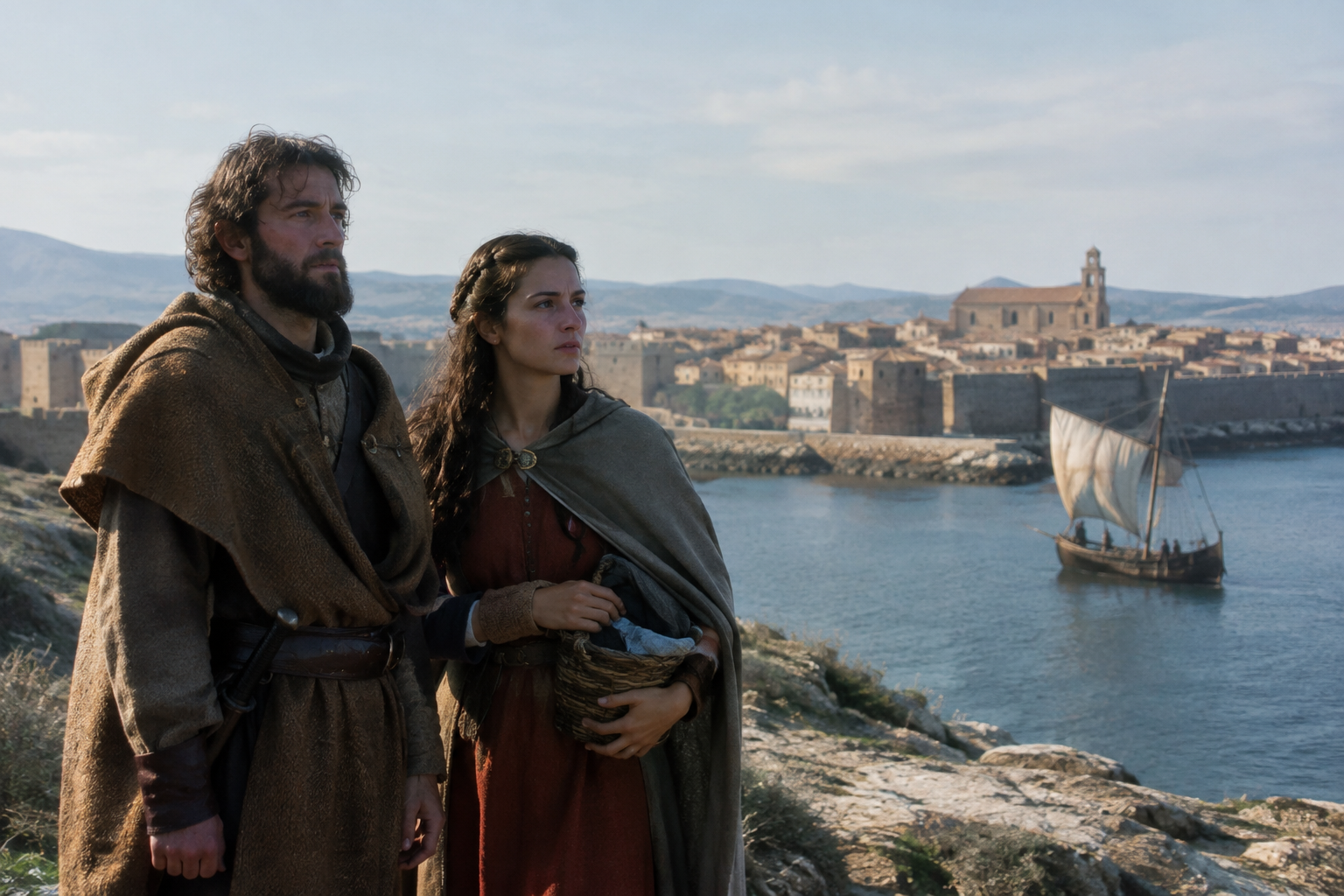
In around AD 650, a man identified as I3778 was buried in post-Roman Barcelona and classified as Basque. That single entry is modest on the page, but historically it is anything but modest. By the seventh century, Barcelona sat in a world shaped by the end of Roman rule, Visigothic power, local continuity, Mediterranean exchange, and the stubborn survival of older regional identities. A Y-chromosome assignment to haplogroup P in that setting is striking precisely because it is so broad and so deep: it points to one of the great ancestral trunks of Eurasian paternal history turning up in an early medieval Iberian context.
That needs saying carefully. Y-DNA traces one direct paternal line only, not a person's whole ancestry, language, or ethnic identity. And in this case, the label is P, not one of the far better known downstream branches such as R or Q. So the interest here lies not in making grand claims from one man, but in asking what it means when an ancient individual from post-Roman northeastern Iberia is reported at this high-level paternal branch.
Post-Roman Barcelona was not a historical blank between empire and the Middle Ages. It was a lived city and region where Roman urban habits, Christian institutions, local Iberian populations, and newcomers from wider Visigothic realms overlapped. Ancient DNA work on Iberia has increasingly shown that late antique and early medieval communities could be locally rooted while also reflecting wider connections across the peninsula and beyond.
That makes I3778 valuable even in the absence of a lavish archaeological dossier. He anchors haplogroup P in a real human setting: not in prehistory, where the deeper branches of Eurasian Y-DNA are often discussed, but in a specific burial landscape near the western Mediterranean at the end of antiquity. A major ancient DNA study of Iberia, published in Science, helped establish just how dynamic the peninsula's population history was across millennia, from prehistory into historical periods. Barcelona's post-Roman burials belong to that longer argument about continuity mixed with change.
Haplogroup P occupies an important place in the Y-chromosome tree because it is an ancestral branch from which several major later lineages emerged. In public DNA discussion, people often know the descendants better than the parent: R is common across much of Europe and parts of Asia, while Q is famous for its importance in Siberia and the Indigenous Americas. But P itself is an older umbrella, and when an ancient sample is labeled simply as P, that usually tells us more about the level of resolution reported than about a neat historical identity.
That is particularly important here. We should not quietly convert I3778 into some narrower subclade unless the evidence actually does so. Nor should we pretend that a man buried in seventh-century Barcelona somehow represents the origin point of haplogroup P. What he does show is that, in at least one post-Roman Iberian individual classified as Basque, the recoverable paternal line was assigned at that higher branch.
For readers researching their own paternal ancestry, this is a good reminder that genetic history works at different scales. A deep branch can connect your line to very old structures in Eurasian prehistory, while the archaeological sample places one bearer of that branch in a very particular historical world: Christian, post-imperial, urban or peri-urban, and Iberian.
The Basque label attached to I3778 deserves careful handling. Basque history is often flattened into a tale of perfect isolation, as if a people could sit in a glass case while Romans, Goths, Franks, and later kingdoms swirled around them. Archaeology and genetics suggest something subtler. Basque-speaking communities preserved distinctive language and regional identity, but they were still part of historical Iberia, with exchange, mobility, and local social change.
That is one reason a burial from Barcelona matters. It hints at Basque presence, movement, or classification in a city well beyond the mountainous core usually associated with Basque-speaking populations. One individual cannot resolve the details. Still, he fits a broader picture in which early medieval Iberia was more mixed, more mobile, and more locally varied than older textbook narratives allowed.
This is also why Y-DNA alone must not be mistaken for ethnicity. A Basque-associated individual can carry a paternal line with a very deep Eurasian pedigree; that is not a contradiction. Human populations are not built from one marker. They are historical communities, formed through language, marriage, politics, migration, and memory, with paternal lines making up only one thin strand of the evidence.
Seventh-century Iberia sat at the crossroads of several overlapping histories. There was the long legacy of Roman rule, with cities, roads, law, and Christianity still shaping daily life. There were Germanic-speaking elites and military traditions associated with the Visigothic kingdom. There were also older local populations whose roots in different parts of the peninsula ran far deeper than either Rome or the Goths.
Ancient DNA from this period increasingly shows communities that cannot be boxed neatly into "Roman" or "barbarian," still less into a single tribal label. A sample like I3778 is therefore most useful when read as part of a layered population history. His haplogroup does not announce a simple migration story; it helps show that paternal diversity in early medieval Iberia could include unexpectedly broad or ancient-seeming classifications.
Research on historically later and regionally nearby populations has reinforced that lesson. The Iberian peninsula repeatedly absorbed newcomers while retaining strong local continuities, and those processes did not stop when the Western Roman Empire faded. That is one reason the post-Roman centuries are so rewarding for archaeogenetics: they show identities being made, not merely inherited.
It is tempting to demand more from an ancient sample than it can bear. I3778 does not give us a dynasty, a surname, a royal house, or a continuous paternal pedigree into the present. Nor does a broad assignment to P let us map a tidy route from Upper Paleolithic Eurasia to one grave in Catalonia. Ancient DNA rarely works like that, and honest history is better for admitting it.
But there is still a real gain in precision. We are no longer talking about a vague "population." We have an individual, from around AD 650, in Barcelona, associated with a Basque context, carrying a paternal lineage reported as P. That combination is enough to sharpen the historical picture. It tells us that the paternal landscape of post-Roman Iberia included lineages that do not fit lazy assumptions about uniformity, and that Basque-associated ancestry could appear within wider urban and regional settings.
Haplogroup P is easy to overstate because of its deep place in the Y-chromosome tree. The better way to read it here is more grounded and more interesting. In the person of I3778, haplogroup P appears not as an abstract prehistoric category, but as the direct paternal line of a real man living in the politically fractured, culturally layered world of post-Roman Barcelona. For anyone exploring this haplogroup today, that is the useful lesson: your paternal line may be ancient in structure, but its historical story is made visible through particular communities, particular burials, and particular moments when archaeology and DNA briefly meet.






Comments