Haplogroup Oa1c1a

– 4 min read


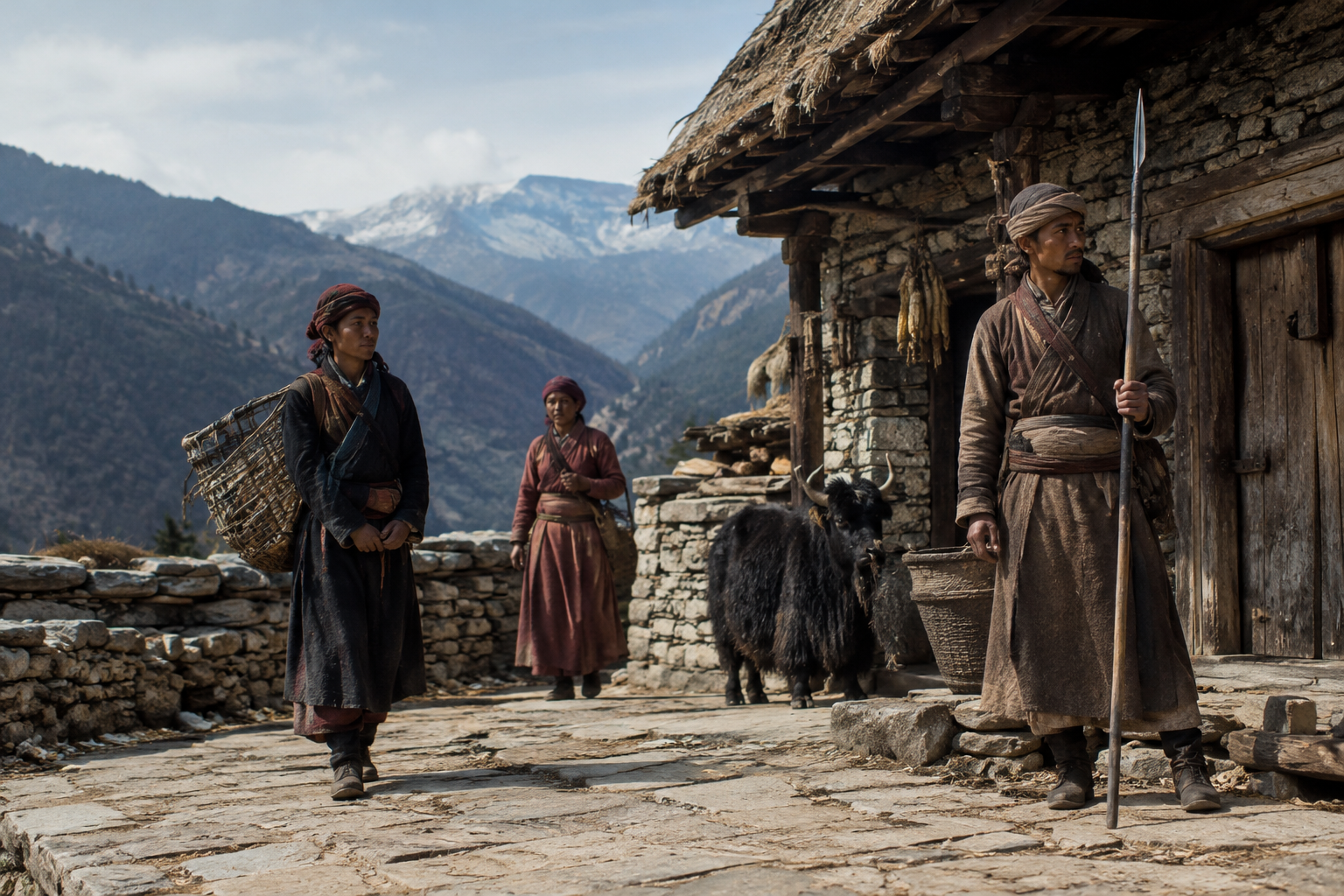
At Samdzong in northern Nepal, archaeologists uncovered a remarkable high-altitude mortuary landscape in the Mustang region, a place where caves, cliffs, and dry air have preserved unusual traces of past communities. One of the individuals linked to this setting, sample S153_S183, dates to around AD 550 and has been associated here with the Y-DNA haplogroup Oa1c1a. That matters because this is not a lineage usually introduced through famous empires or court chronicles, but through a remote Himalayan community sitting at a crossroads between the Tibetan Plateau and South Asia.
That is exactly why the sample is so interesting. A Y-chromosome lineage traces one direct paternal line only, not a person's whole ancestry, but even one paternal line can tell us something important about movement, contact, and continuity in regions where written sources are thin and archaeology does much of the talking. In the case of Oa1c1a, Samdzong gives us a concrete historical foothold: a man living in the mid-1st millennium AD in the trans-Himalayan world, in a landscape shaped by trade, seasonal movement, and cultural exchange.
Samdzong lies in Upper Mustang, close to routes that connected the Himalayan interior with the Tibetan Plateau and, more distantly, the lowlands to the south. This was never a sealed mountain pocket. It was a hard environment, certainly, but also a connected one. Communities here managed herding, exchange, and burial practices in ways adapted to extreme terrain.
Sample S153_S183, dated around AD 550, belongs to that world. With the evidence provided, we should be careful not to pile on details we do not have: no grave goods, kinship pattern, or social rank should be invented for him. But even stripped to essentials, the find is significant. It places a paternal lineage assigned here as Oa1c1a in an Iron Age or immediately post-Iron Age Himalayan context, showing that this branch was part of the human story in Nepal's trans-montane corridor.
A genetic study of ancient Himalayan populations published in Nature Communications has helped frame this broader regional picture, showing that the ancient populations of the area cannot be reduced to a single origin story. That is the real value of Samdzong: not that it gives us a neat tribal label, but that it anchors paternal ancestry in a historically connected mountain society.
Ancient DNA from Himalayan crossroads
The haplogroup name here is Oa1c1a, a narrow branch within the much broader Y-DNA macro-haplogroup O, which today is widely associated with East and Southeast Asian paternal histories. But a broad parent haplogroup is not the same thing as a specific subclade. It would be sloppy to claim that every movement ever linked to haplogroup O automatically explains this one man from Samdzong.
What can be said more safely is that a lineage of this general paternal family was present in the Himalayan zone by the mid-1st millennium AD. In a place like Mustang, that opens useful historical questions. Was this paternal line part of longer-term local continuity? Was it linked to population movements from the plateau? Or does it reflect the kind of multi-directional contact that mountain corridors often preserve better than political maps do? One sample cannot settle all that, but it can stop us imagining the region as isolated or static.
This is one of the recurring lessons of archaeogenetics. Ancient populations often turn out to be more regionally entangled than older models allowed. In mountainous Asia, as in many other borderlands, paternal lineages can appear in settings that reflect centuries of exchange rather than a single dramatic migration.
There is a temptation, when looking at Himalayan archaeology, to treat mountain sites as marginal to the big story. In fact, places like Samdzong are often central to understanding how that big story worked. Frontiers are where languages, burial customs, trade networks, and marriage patterns meet. They are not historical backwaters. They are the gears.
By around AD 550, the Himalayan world was already tied into larger currents moving across Inner Asia and South Asia. Salt, livestock, grain, crafted goods, and ideas did not respect the neat lines later states would draw. A paternal lineage such as Oa1c1a appearing at Samdzong fits well with that kind of connected upland history, where communities were local in daily life but regional in their human contacts.
That does not mean we should force a direct ethnic label onto S153_S183. Archaeology, language, and genetics overlap, but they are not interchangeable. A Y-line can show one paternal thread in a man's ancestry; it does not by itself tell us what language he spoke, how he dressed, or which political identity he would have recognized.
Ladakh and mixed Himalayan ancestry
With some haplogroups, we have dozens of ancient males spread across centuries and regions. Here the evidence in hand is much tighter. That may sound limiting, but it is also useful. A single securely placed ancient individual can be better than pages of vague speculation. Samdzong gives Oa1c1a a real archaeological setting, a date, and a landscape.
That is especially valuable for lineages tied to Asia's interior and upland zones, where older public histories often relied too heavily on later chronicles or on modern population maps. Ancient DNA changes that by putting actual people back into the frame. It tells us that by the mid-1st millennium AD, a paternal line classified here as Oa1c1a was present in the Mustang region of Nepal, among people participating in a distinctive high-altitude way of life.
There is also a methodological point worth making. As more ancient Y-chromosome studies appear, fine-grained paternal branches are becoming easier to place in time and space. That is why articles such as Ancient Y Chromosomes Reveal Coastal and Inland Migrations that Shaped East Asian Paternal History are so relevant to lineages like this one: they remind us that East Asian paternal history was never a single stream, but a set of branching, overlapping regional histories.
Ancient East Asian Y-DNA migrations
If your paternal line falls under Oa1c1a, Samdzong offers a sober but meaningful kind of connection. Not a fantasy pedigree, and not a claim that you descend from one named ancient man, but a demonstration that this branch belonged to the lived history of the Himalayan world by about AD 550. It belonged to men who moved through a demanding landscape that was nonetheless plugged into wider human networks.
That is a fine archaeological lesson in itself. The most revealing ancient DNA stories are often not about imperial capitals, but about places on the edge of several worlds at once. For Oa1c1a, Samdzong in Nepal is one of those places: a cliffside, highland setting where one paternal line helps illuminate the human traffic of the trans-Himalayan past.






Comments