Haplogroup Oa1c1

– 4 min read


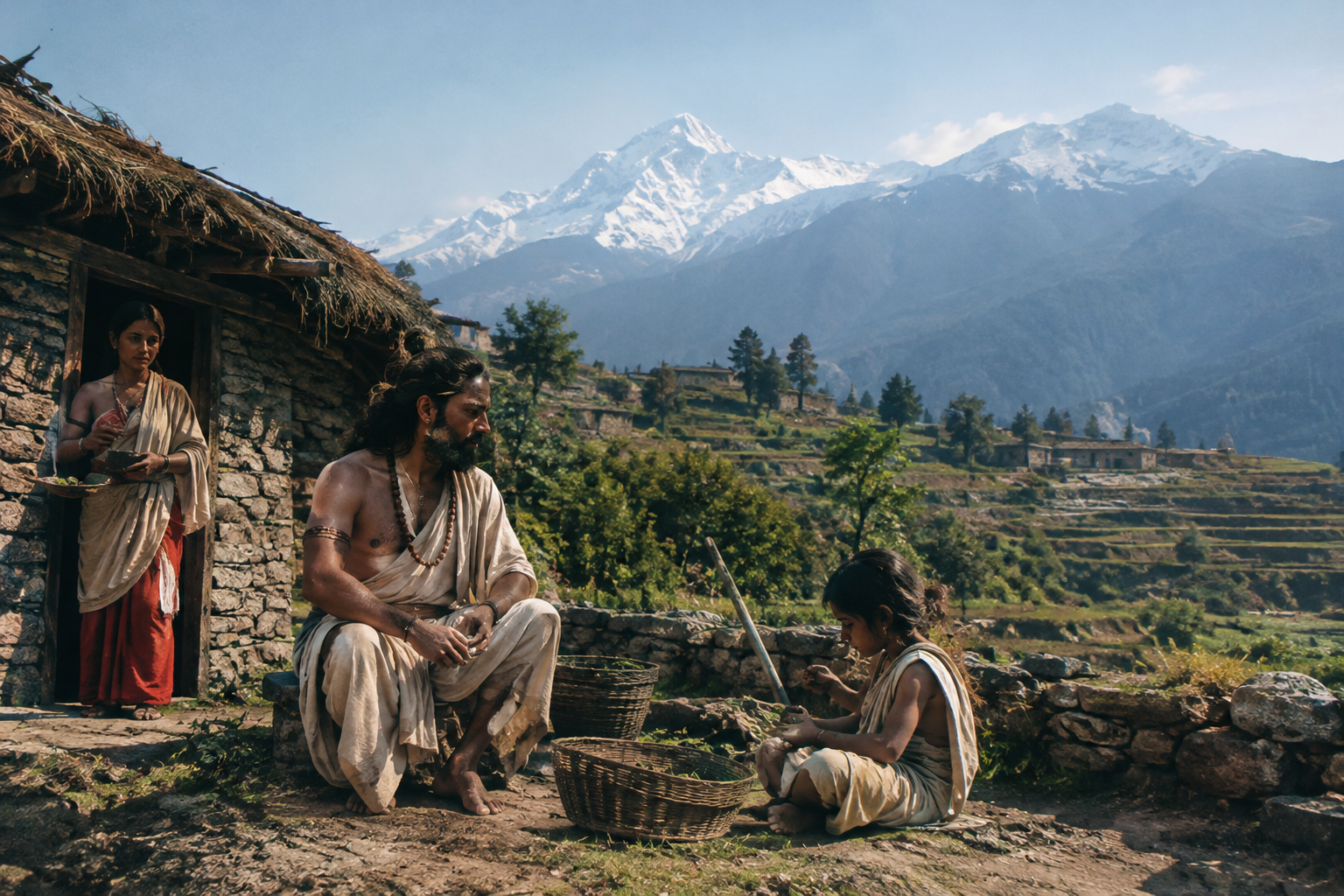
At Chokhopani in Nepal's Mustang region, archaeologists recovered the remains of an ancient high-altitude community living in the Himalayas around the early first millennium BC. One of the men from this site, sample CNE1, dated here to about 785 BC, has been associated with the Y-DNA haplogroup Oa1c1. That makes him a small but valuable witness to paternal ancestry in a part of Asia where mountains preserve history unevenly and where every ancient genome can shift the picture.
Chokhopani matters because it sits in a corridor, not an isolated world. Mustang lies between the Tibetan Plateau and the South Asian foothills, along routes later tied to trade, pilgrimage, and seasonal movement. So when a paternal lineage such as Oa1c1 appears in an Iron Age Himalayan individual, the interesting question is not simply where the lineage exists today, but what its presence tells us about the men living in this upland zone before written political history begins to thicken.
Y-DNA traces one direct paternal line: father to son to grandson, and so on. It does not describe a person's whole ancestry, language, or identity. Even so, a lineage assignment can be historically useful, because it lets us ask whether particular male lines were local, intrusive, long-standing, or part of wider regional connections.
With Oa1c1, caution is especially important. The label provided for CNE1 is already fairly specific, but with an ancient sample we should not assume more detail than the evidence securely supports. What we can say is that this branch belongs within the broad East and Southeast Asian-centered Y-DNA macro-haplogroup O, and its appearance in ancient Nepal fits a larger picture in which Himalayan populations were shaped by ties to the plateau as well as to regions farther south.
An ancient DNA study of prehistoric Himalayan individuals, including material from Nepal, has helped establish that the region preserves deep evidence for these cross-mountain connections rather than a simple story of one-time settlement or total isolation. Research on these populations can be found in this study of ancient Himalayan genomes.
Chokhopani is one of the key archaeological sites for understanding early life in Upper Mustang. The site has long been important because it offers evidence for people living in a demanding environment at significant altitude, where survival depended on careful adaptation, movement, and exchange. That alone makes CNE1 more than a bare laboratory entry: he belonged to a community occupying one of Asia's great passage zones.
The old temptation with Himalayan archaeology was to imagine remote valleys as sealed cultural pockets. Ancient DNA has steadily complicated that idea. Communities in Nepal's highlands could be locally rooted and still connected, with biological ties reflecting repeated interaction across ecological zones. A single Y-chromosome cannot map all that traffic, but it can show that paternal lines now associated with broader East Asian spheres were already present in these mountain populations long before the historic kingdoms of the region emerge clearly in texts.
That matters for another reason. Mountain routes are often treated as marginal, yet they are frequently central to human history precisely because they channel movement. Mustang was never simply "between" worlds in a passive sense; it was one of the places where those worlds met. CNE1's Oa1c1 lineage sits neatly inside that larger archaeological truth.
By the first millennium BC, the Himalayas were not an empty wall dividing civilizations. They were inhabited, worked, crossed, and remembered. The people of sites like Chokhopani lived before the great imperial phases that later connected South Asia, Tibet, and Inner Asia in more familiar political ways, but their existence shows that the social groundwork for connectivity was already there.
For readers with Oa1c1 today, this is perhaps the most useful historical point. The lineage's appearance in ancient Nepal does not prove descent from Chokhopani specifically, nor does it assign every carrier to one ethnic tradition. What it does suggest is that paternal lines of this kind were part of the population history of the Himalayan borderlands by the Iron Age, embedded in real communities rather than floating abstractions on a modern frequency map.
There is only one ancient sample listed here, and that limitation is worth taking seriously. But scarcity does not mean insignificance. In regions where preservation, excavation history, and sampling opportunities are uneven, one securely placed individual can become a crucial anchor point. CNE1 tells us that Oa1c1 was present in ancient Nepal at a date much earlier than any genealogy could reach.
This is one of the quiet strengths of archaeogenetics. It does not only illuminate famous dynasties, rich graves, or dramatic migrations. Sometimes it clarifies the ancestry of ordinary communities in landscapes that later history tends to flatten. In that sense, Chokhopani offers exactly the sort of evidence historians relish: modest in scale, but stubbornly informative.
It also helps correct another common mistake, the habit of treating present-day political borders as ancient biological boundaries. Nepal today is a nation-state; Chokhopani's people were not "Nepalese" in that modern sense. Their genetic and archaeological signatures belong to an older Himalayan world of upland settlements, river valleys, and corridor movement. Haplogroup Oa1c1, in this context, belongs to that older geography.
Ancient East Asian Y-Chromosomes
Ancient DNA from East Asia and adjacent regions is beginning to give us finer-grained paternal histories, but the Himalayas still remain patchier than some better-sampled zones. That makes every early result disproportionately useful. A lineage like Oa1c1 found in Chokhopani helps place Himalayan populations within the wider pattern of East Asian and trans-Himalayan demographic history without reducing them to mere offshoots of somewhere else.
It is also a reminder that lineages do not travel by themselves. They move with herders, farmers, traders, spouses, children, and communities adapting to terrain over generations. Archaeology gives us the setting; genetics gives us one thread of inheritance; together they turn CNE1 from a code into a historical person who belonged to an upland society with deep regional links.
Middle Yellow River Genomic History
The most distinctive thing about Oa1c1 in this case is not royal glamour or a crowded sample list, but its appearance in CNE1 at ancient Chokhopani, high in the Nepalese Himalayas around the early Iron Age. That places this paternal branch within a real mountain community living in one of Asia's great connective landscapes. For someone researching Oa1c1 today, the responsible takeaway is clear: this lineage can reach back into the old trans-Himalayan world, where mobility, altitude, and long regional contact shaped paternal history long before the later states of the region came into view.






Comments