Haplogroup N1c2

– 5 min read


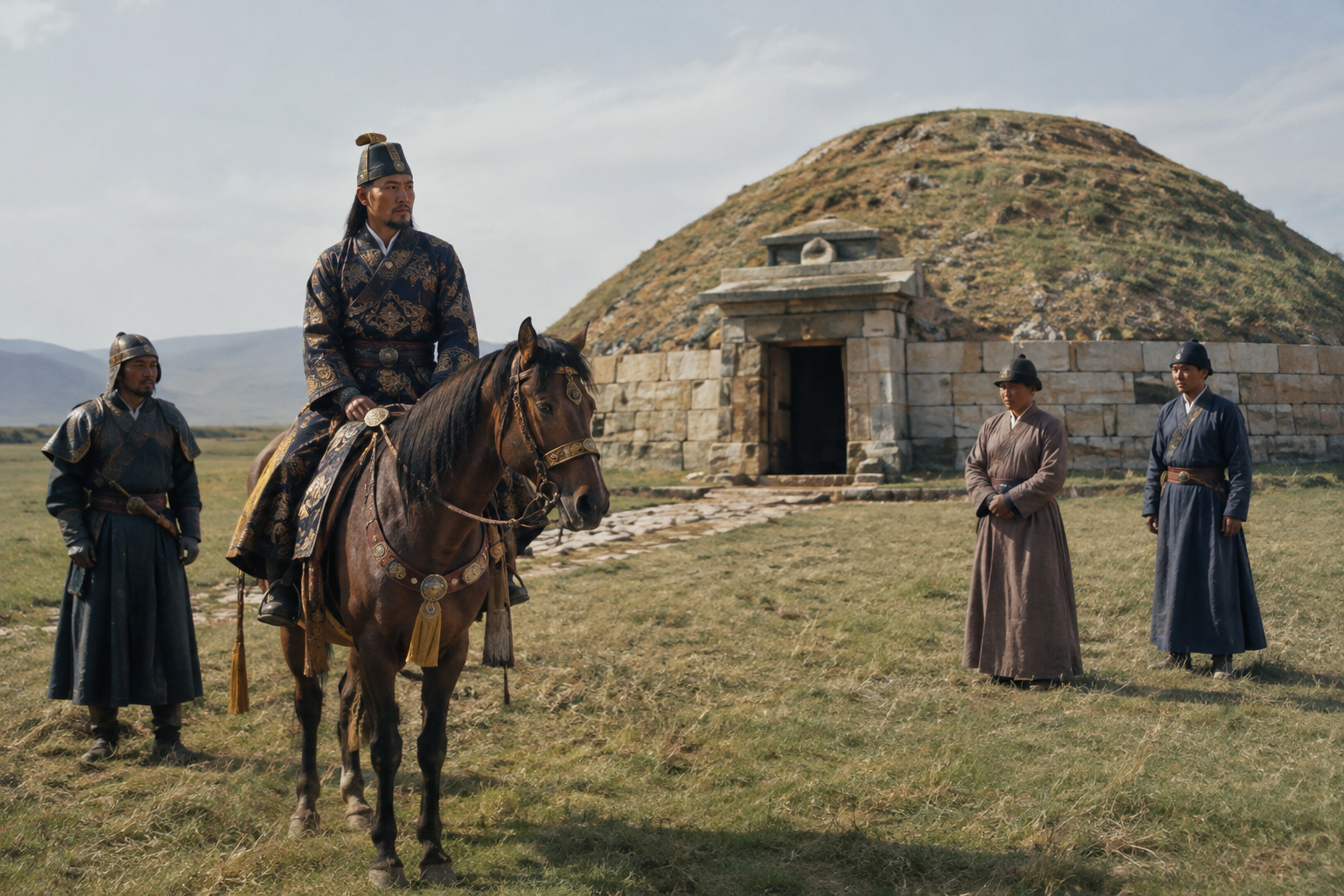
In about AD 800, a man now identified as TUM001 was buried at Shoroon Bumbagar in Mongolia, in what is described as a Tang Dynasty elite mausoleum. That is already an arresting setting: not a village grave, not an anonymous cemetery edge, but a monument tied to the world of frontier power, diplomacy, and aristocratic display on the eastern steppe. For anyone interested in Y-DNA haplogroup N1c2, this single burial matters because it places that paternal line inside a very specific historical landscape, one shaped by the long afterlife of the Turkic empires and by Tang China's entanglement with Inner Asia.
The attraction of TUM001 is not that one man can stand for all of N1c2. He cannot. Y-DNA follows one direct paternal line only, and no single elite burial can define an entire people or language. But he does give us something precious: a documented ancient appearance of the branch in an elite Mongolian context around the early medieval period, where archaeology and genetics meet in a politically charged zone.
Shoroon Bumbagar is one of those sites that immediately reminds us how misleading neat national maps can be. Around AD 800, Mongolia was not a remote margin to the great states of Eurasia. It was a center of movement, alliance, and contest, with older steppe traditions, Chinese imperial ambitions, and mobile elite networks intersecting in ways that archaeology can still glimpse.
TUM001 comes from that setting. The label "Tang Dynasty elite mausoleum" suggests not merely a date, but a social environment in which status was materially staged. The value of the sample lies in precisely that conjunction: a paternal lineage assigned here to N1c2 appearing in a high-status burial from a region where identities were not simple, fixed, or singular.
An ancient DNA study linked to this material, available through this research supplement, has helped bring such burials into the genetic conversation. Even without forcing details the evidence does not provide, the broader point is important. Elite tombs on the Mongolian steppe show that lines like N1c2 were present in historical settings shaped by empire and exchange, not only in later modern populations.
Haplogroup N is a major Y-chromosome lineage with a long history across northern Eurasia. Within that broad family, N1c2 is a narrower branch, and that distinction matters. It is very easy in popular writing to slide from a specific subclade into sweeping claims about all of haplogroup N, or even about all northern Eurasian populations. That is exactly what the evidence does not allow.
What can be said more responsibly is that N1c2 belongs to a paternal network with deep roots in the north and east of Eurasia, and that branches of haplogroup N have often figured in discussions of mobility across the forest-steppe, Siberia, and parts of Inner Asia. TUM001 shows that this was not merely prehistoric background noise. By the early medieval period, a lineage reported within N1c2 could appear in an elite Mongolian burial tied to the Tang-era political sphere.
That does not make N1c2 a "Tang" lineage, a "Mongol" lineage, or a marker of one ethnicity. Archaeology is fuller and messier than that. A man may be buried in a Tang-associated mausoleum, live in Mongolia, move in steppe aristocratic circles, and still belong to a paternal line found in many other regions and communities over time.
Mongolia is important in ancient DNA because it is one of the great hinge zones of Eurasian history. Here, pastoral confederations rose and fell; envoys, captives, merchants, and military households crossed huge distances; and ruling groups often gathered people of varied ancestry into a single political order. That makes any Y-chromosome finding from the region historically suggestive, though never simple.
For N1c2, the significance of TUM001 is geographical as much as chronological. The sample anchors the branch in the Mongolian steppe during the centuries after the great Turkic khaganates and during a period when Tang influence, local power, and trans-Eurasian contacts overlapped. In other words, this is a lineage appearing in one of the key laboratories of Eurasian state formation.
If that sounds grand, it should. But one must keep one's feet on the ground. A single paternal line in an elite mausoleum does not tell us whether the entire ruling circle shared that lineage, whether it had been locally established for generations, or whether it had arrived more recently through marriage, alliance, or political incorporation. Ancient DNA is often best when it narrows the question rather than pretending to finish it.
There is a further historical point worth making about TUM001. Elite burials are not ordinary demographic samples. They are socially selected. That means they can be unusually informative about power, prestige, and political households, but also unusually misleading if we mistake them for the whole population.
So what does an N1c2 result in such a context tell us? First, that this paternal branch was present among men who could be drawn into, or belong within, high-ranking circles on the steppe in the Tang period. Second, that the genetic world of Inner Asian elites was unlikely to have been uniform. Archaeology across the steppe has repeatedly shown that prestige networks were expansive and often incorporated people from different backgrounds.
That broader picture fits well with other MyTrueAncestry discussions of mobility and mixed origins in historical communities. The genetic signal from an elite burial is especially useful when read alongside evidence from larger regional studies rather than treated as a dynastic signature floating above history.
Tang graves and Silk Road ancestry
Because the evidence supplied here centers on a single named ancient individual, the honest article is not a catalogue pretending to know more than it does. Instead, the sensible move is to ask what sort of bigger history TUM001 belongs to. And that history is one of northern Eurasian paternal diversity moving through real institutions: courts, military structures, frontier administrations, and elite families on the steppe.
That is one reason haplogroup N and its branches keep turning up in discussions of the northeast Eurasian past. They belong to regions where mobility was not an exception but a way of life. Forest peoples, pastoral confederations, and imperial borderlands all contributed to the distribution of these lineages. N1c2 in Mongolia around AD 800 fits that wider pattern of movement and interaction rather well, even if it does not solve every question about origins.
Readers interested in how northern populations and Uralic-linked histories are being revisited through genetics may also want to compare this with broader work on Finland and northern Eurasia. Those studies do not prove anything directly about TUM001, but they help place haplogroup N branches within a larger continental story of spread, persistence, and regional reshaping.
The most useful lesson from TUM001 is not a romantic one about lost princes or secret dynasties. It is better than that. It shows that N1c2 was present in a documented elite burial environment on the Mongolian steppe around AD 800, in a world where political power depended on long-distance ties and layered identities.
For someone researching N1c2 today, that is a reminder that a paternal line can travel through very different historical settings over time. Your Y-DNA does not assign you a single ancient ethnicity, but it can connect your direct male line to the kinds of northern Eurasian networks that archaeology is only now beginning to map properly. In this case, the clearest ancient glimpse comes from Shoroon Bumbagar: one man, one mausoleum, and one very suggestive sign that N1c2 belonged to the living history of Inner Asia, not just to modern genetic maps.






Comments