Haplogroup N1a1a1a1a1a2a1a2h1

– 5 min read


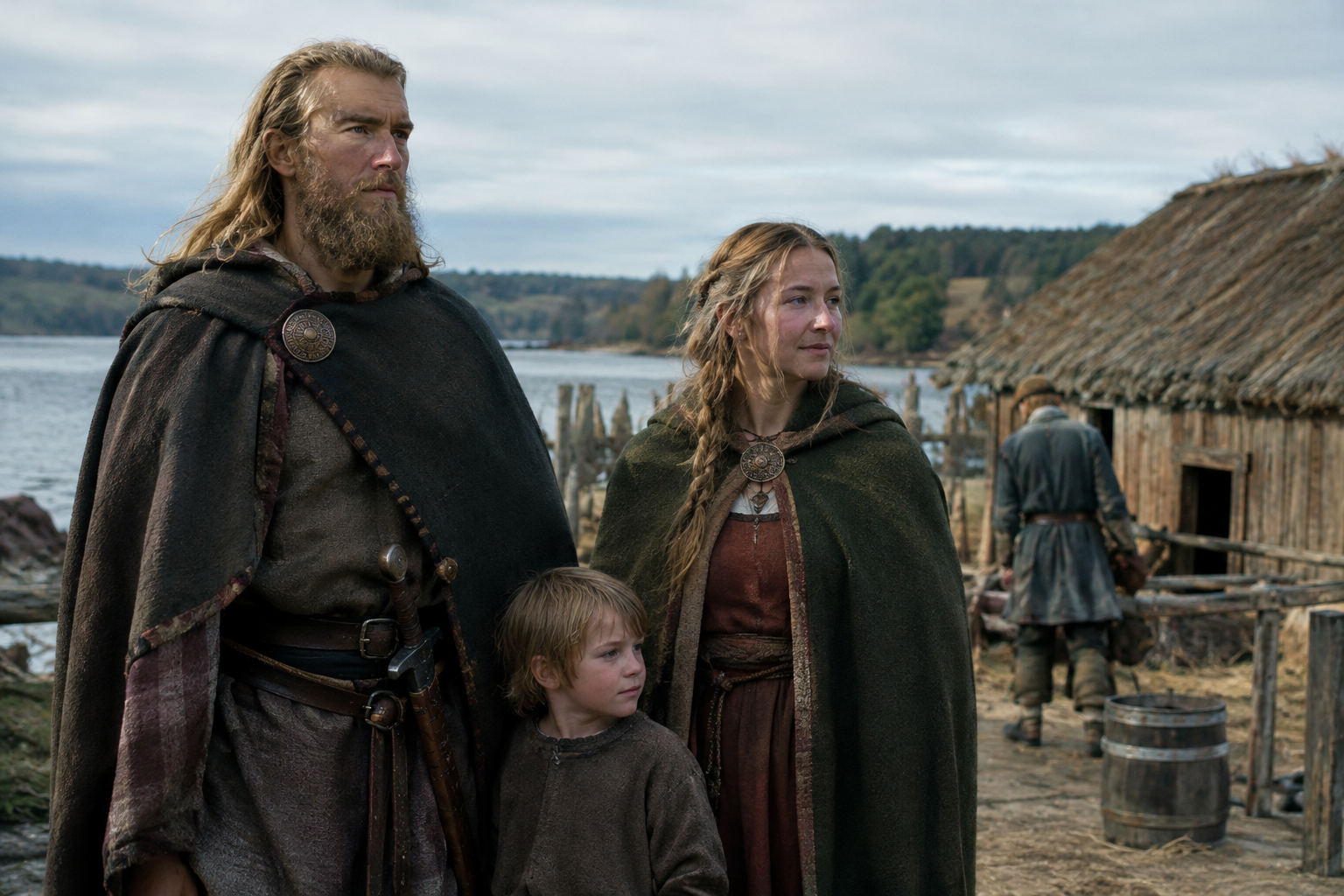
At Varnhem near Skara in Sweden, one ancient male identified as VK395 offers a small but intriguing clue to the paternal history behind the haplogroup N1a1a1a1a1a2a1a2h1. He lived around AD 1050, right in that fascinating Scandinavian moment when the Viking Age was shading into the Christian Middle Ages. That date matters, because it places him not in the heroic haze of saga-writing, but in a real community negotiating old regional identities, new religious institutions, and long-established networks around the Baltic.
The haplogroup itself is a very narrow Y-DNA branch, and Y-DNA traces only one line of descent: father to son to son. So VK395 does not tell us everything about the ancestry of Viking Age Sweden. What he does provide is something more precise and, in its way, more useful: direct evidence that this paternal line, or a reported association with it, was present in medieval Varnhem.
Varnhem is no ordinary place-name in Swedish history. In the province of Vastergotland, close to Skara, it became one of the major ecclesiastical landscapes of medieval Sweden. But by the eleventh century, before later monastic fame fully defined the site, this was already an inhabited and important local world. Burial grounds in the region capture that difficult, interesting overlap between late pagan traditions and emerging Christian norms.
That is the setting in which VK395 becomes valuable. A man buried around AD 1050 at Viking Age Skara Varnhem anchors this otherwise very fine-grained haplogroup in an actual excavated person, an actual Swedish landscape, and an actual historical transition. We should be careful not to turn one individual into a whole people. Even so, one securely placed ancient male can be more illuminating than pages of speculation.
A broad ancient DNA study of Viking Age populations helped show just how connected and regionally varied Scandinavia was, and Varnhem sits comfortably within that larger picture of movement, exchange, and local continuity rather than any simplistic idea of a single "Viking type." The relevant research tradition can be traced through this ancient DNA study on Viking Age populations, which helped shift discussion away from legend and toward excavated human lives.
The first thing to say is that N1a1a1a1a1a2a1a2h1 is not the same thing as haplogroup N in the broadest sense. The longer the label, the narrower the branch, and the narrower the branch, the more cautious we must be. Broad haplogroup N lineages are widely associated with northern Eurasia and with several Uralic-speaking and northeastern European populations, but that large background must not be pasted uncritically onto this exact terminal subclade.
Still, the larger family context matters. In northern and northeastern Europe, branches of N became historically important in populations around the Baltic and across the forest zone stretching eastward. When a lineage of that wider family appears in Viking Age or early medieval Scandinavia, it raises good historical questions about mobility across the Baltic, local assimilation, and the sheer complexity of Scandinavian population history.
That complexity is precisely the point. Medieval Sweden was not isolated. It was tied into routes running west toward the North Sea world and east toward Finland, the eastern Baltic, and beyond. A paternal lineage like this one therefore fits best into a history of contact zones, not neat ethnic boxes.
Modern readers sometimes inherit a rather tidy picture of the Viking world: Scandinavians in one block, neighbors in another, all marching through history under clear labels. Ancient DNA has been wonderfully rude about such assumptions. The evidence from Viking and early medieval cemeteries keeps showing that identity, language, ancestry, and political allegiance did not line up as neatly as later nationalism would like.
VK395 is a good example of why. A man living in Sweden around AD 1050 could belong to a local community and still carry a paternal line whose deeper history points into wider northern Eurasian patterns. That is not strange at all. It is what we should expect in a region linked by trade, intermarriage, raiding, seasonal travel, military service, and religious change.
This is also where readers should resist an old temptation: to treat a Y-DNA lineage as a badge of fixed ethnicity. It is not. One paternal line can move through different languages, kingdoms, and identities over centuries. A lineage present in medieval Sweden need not mean that its bearer thought of himself in any modern ethnic terms, or that everyone with similar Y-DNA shared the same cultural life.
Germanic languages and genomes
If one asks what makes this haplogroup especially interesting in a Swedish Viking Age context, the answer is the Baltic horizon. Sweden's eastern connections were old and deep. Contacts with Finland and the eastern Baltic were not peripheral episodes but part of the ordinary business of life for many communities. Goods moved, people moved, and with them moved families and paternal lines.
That does not mean VK395 can be assigned a biography of migration from the evidence we have. We cannot honestly say where his father's father's line entered Scandinavia, or in which century. But the wider distribution of N-family lineages in northern Europe makes the find historically suggestive. It reminds us that Viking Age Sweden belonged not only to a western seaborne world of England and the North Atlantic, but also to an eastern one of Gulf of Bothnia crossings, Baltic exchange, and contact across forest and coast.
Research on early medieval populations around Finland and the Baltic has underlined just how dynamic that zone was. Anyone interested in that nearby setting may want to compare this Swedish evidence with broader work on the region's medieval population shifts and contacts.
The date of VK395 matters for another reason too. Around AD 1050, Sweden was undergoing institutional and ideological change. Christianity was becoming more firmly rooted, ecclesiastical centers were consolidating, and burial customs were changing accordingly. Ancient individuals from this period are not just "Vikings" in the popular sense; they are witnesses to the making of medieval Scandinavia.
That is why Varnhem is such an evocative setting for this lineage. Later, the place would become famous for its monastery and elite medieval associations, but the earlier cemetery evidence reminds us that the site's importance was built on a deeper human landscape. A Y-DNA branch like N1a1a1a1a1a2a1a2h1 appearing here places this paternal line inside the social fabric of a region becoming recognizably medieval.
There is a useful parallel here with other Swedish early Christian burial studies, where genetics has begun to recover kinship, diversity, and local community structure from graves once read only through material culture. Those studies do not flatten the evidence into one ancestry profile; they sharpen the sense of how varied these communities could be.
For someone researching N1a1a1a1a1a2a1a2h1 today, VK395 offers one clear and defensible historical anchor: this paternal branch, or a closely reported association with it, was present in Viking Age Sweden at Varnhem near Skara around AD 1050. That does not prove royal descent, tribal identity, or a single dramatic migration story. What it does suggest is something subtler and more historically satisfying: this lineage belonged to the mixed, mobile, and regionally grounded world of the medieval Baltic north.
In other words, the value of this haplogroup is not that it points to a cartoon Viking, but that it connects a living paternal line to a real man in a real Scandinavian landscape at a moment of major historical change.






Comments