Haplogroup N1a1a1a1a1a2a1a1

– 5 min read


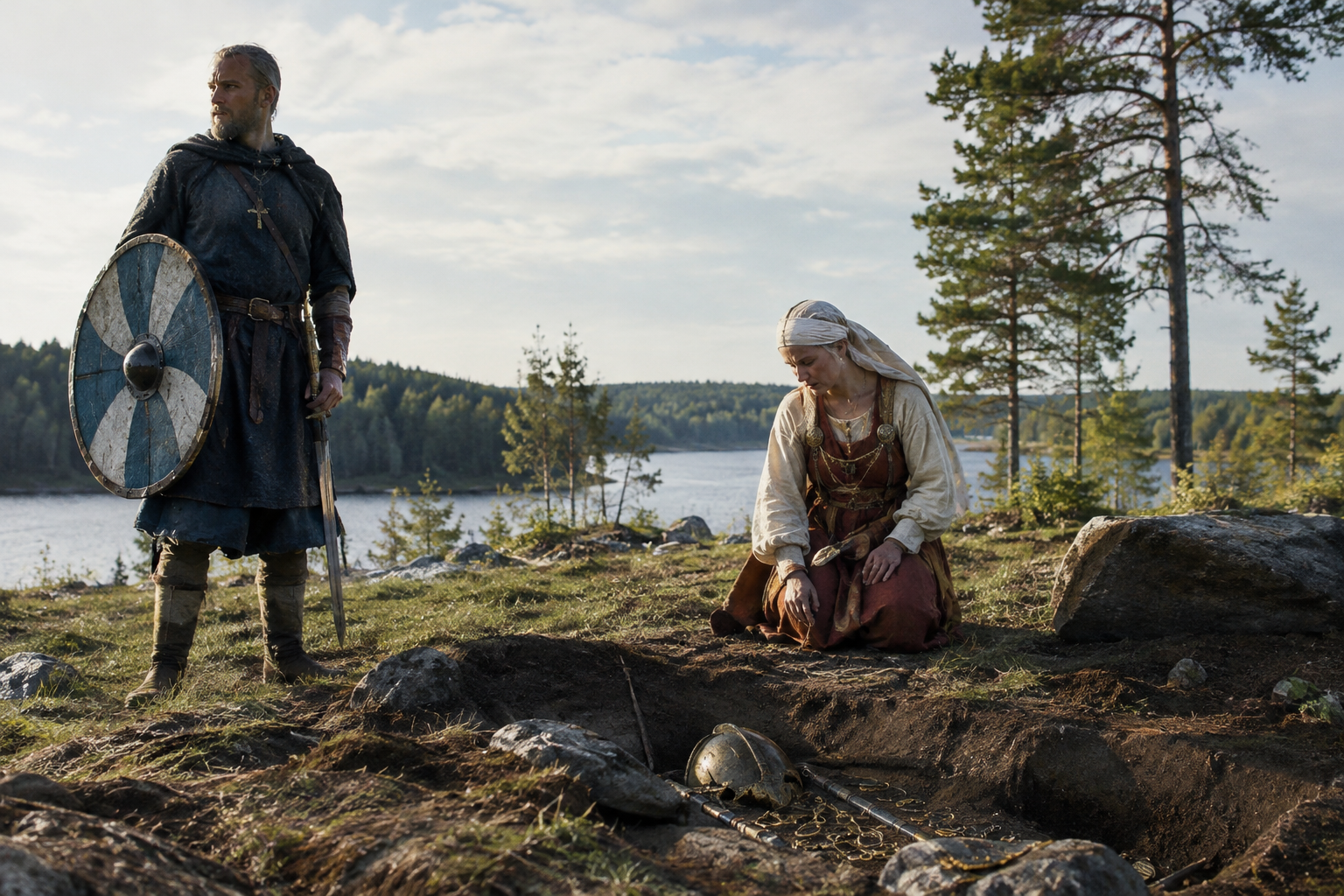
At Pahnainmaki in Hameenlinna, archaeologists uncovered a medieval grave that stands out even from its short catalogue description: a rich burial from around AD 1175, represented in the ancient DNA record as HMP001. That alone would make it interesting. But for Y-DNA researchers, the more striking point is that this man has been associated with the very specific paternal branch N1a1a1a1a1a2a1a1, a fine-grained twig within the wider haplogroup N lineages that are so important in the population history of northern Eurasia.
He is not alone. Another ancient individual, TMP003 from Vilusenharju near Tampere, dated to around AD 1000 and described as Viking/Crusader Age Finland Tavastia, points to the same narrow paternal story in medieval inland Finland. Two men, two Tavastian-region sites, roughly two centuries of overlap: that is not enough to write a grand saga of origins, but it is enough to see a local paternal lineage appearing in a recognizably historical landscape.
HMP001 comes from Hameenlinna Pahnainmaki, in the heart of historical Hame or Tavastia. The label "rich grave" matters here, though it must be handled carefully. It tells us that the burial stood out materially within its archaeological setting, not that we can confidently turn this man into a chieftain, landowner, or dynastic founder. Archaeology is often less obliging than later legend.
Still, a well-furnished burial in inland southern Finland around the late 12th century belongs to a revealing period. This was a time when local communities in the Finnish interior were tied into the wider Baltic world through exchange, conflict, and changing religious practices. A paternal lineage like N1a1a1a1a1a2a1a1 appearing in such a context reminds us that medieval Finland was not an empty fringe waiting for history to arrive. It already had deep local populations, social distinctions, and male lines that had clearly persisted long enough to show up in more than one excavated individual.
A genetic study of early medieval and medieval Finland has been central to this broader picture, linking burials from the region to questions of continuity and Baltic contact without reducing them to a single simple origin story. For readers who want the wider setting, MyTrueAncestry has also covered Early Medieval Finland: Genomics, Population Change, and Baltic Connections.
TMP003, dated to about AD 1000 at Vilusenharju in the Tampere area, adds something different. The description places him in the Viking/Crusader Age of Finland, a useful reminder that Finland's archaeological chronology does not simply mirror the better-known political timelines of Scandinavia or western Europe. Around AD 1000, Tavastia was part of a connected but locally distinct northern world, facing both east and west across the Baltic networks.
Here again, the significance lies in repetition. A branch associated with N1a1a1a1a1a2a1a1 turns up not in one isolated burial but in another Tavastian individual from an earlier horizon. That does not prove direct kinship between TMP003 and HMP001, and it certainly does not mean every Tavastian male belonged to this line. What it does suggest is that this paternal branch had some degree of persistence in inland southern Finland across the transition from the late Viking Age into the medieval period.
That sort of persistence matters because Y-DNA traces one direct male line only. It does not tell us a person's whole ancestry, language, or identity. But when the same narrow paternal signature appears in multiple burials from the same broad region, it becomes part of the archaeological texture of that place.
The haplogroup in question, N1a1a1a1a1a2a1a1, is a highly specific designation nested within the much wider N haplogroup family. That wider family is famous in discussions of northern Eurasia and especially among many Uralic-speaking and Finnic-speaking populations. But one must not lazily pour the whole history of haplogroup N into this single sub-branch. A deep parent lineage can spread across vast regions and many millennia; a terminal or near-terminal branch is a much more local and historically contingent matter.
So the right historical question is not "where did haplogroup N come from?" in the abstract. The sharper question is why this particular branch shows up in medieval Tavastia, and what that says about local male-line continuity there. On current evidence, the answer is modest but meaningful: it points toward a paternal line present among men living in the Finnish interior during a period of social change, long-distance contact, and emerging medieval structures.
Research associated with these Finnish ancient remains is archived through ancient DNA project materials at https://www.ebi.ac.uk/ena/browser/view/PRJEB88970, which forms part of the scientific framework behind these identifications. Just as importantly, the wider historical interpretation depends on archaeology as much as genetics.
It is easy to talk about medieval Finland as though it were merely peripheral to Sweden, Novgorod, or the crusading imagination of later chroniclers. Tavastia complicates that. Inland Hame was not just a route between coasts but a region with its own burial traditions, settlement history, and social worlds. The presence of the same narrow Y-lineage in Hameenlinna and Tampere suggests that local paternal continuity deserves as much attention as outside influence.
That is especially useful because medieval Finnish history often survives unevenly in written sources. Ancient DNA cannot fill every gap, but it can restore a human scale to places that texts treat only dimly or not at all. Men like HMP001 and TMP003 are not literary stereotypes from saga or crusade chronicle. They are excavated individuals from specific places, carrying a paternal signature that helps anchor history in the ground.
There is also a larger northern comparison worth keeping in mind. Finland's medieval populations emerged from interactions among local Iron Age communities, Baltic contacts, and broader northeastern European currents. If that topic interests you, MyTrueAncestry's discussion of The Finnic Peoples of Russia: Comprehensive Analysis Using Genome-Wide and Y-Chromosomal Data offers useful comparative background.
One reason haplogroup N branches attract so much interest is that they often sit near old debates about eastern connections in northern Europe. Linguists, archaeologists, and geneticists have long argued over how populations, languages, and male lines moved between Siberia, the forest zone, the Baltic, and Fennoscandia. Yet the medieval Tavastian evidence is valuable precisely because it keeps us honest. It does not show a migration in motion; it shows a lineage already rooted in Finland by around AD 1000 to 1175.
That point may sound restrained, but it is actually powerful. Once a lineage is securely present in medieval inland Finland, the historical work shifts from dramatic tales of arrival to slower questions of local survival, regional structure, and social transmission through father-to-son descent. In other words, this is less a story of sudden intrusion than of established presence.
A broader ancient DNA study of the region, available at https://link.springer.com/article/10.1186/s13059-026-04277-7, has helped frame these debates by placing Finnish burials into a longer population history. Even without forcing every detail, the message is clear enough: medieval Finland was genetically varied, regionally structured, and historically connected.
16th-Century Finland and Mobility
The most distinctive thing about N1a1a1a1a1a2a1a1 in the present evidence is not imperial grandeur or legendary ancestry. It is something quieter: this branch appears in two medieval Tavastian contexts, one around AD 1000 and one around AD 1175, linking a Viking-Age horizon and a later high-status burial in inland Finland. For anyone researching this paternal line today, that is a useful clue. It suggests that at least one strand of this lineage was part of the male population of medieval Hame, embedded in the local history of Finland rather than floating vaguely across a map of northern Eurasia.






Comments