Haplogroup M1a1a2a1

– 5 min read


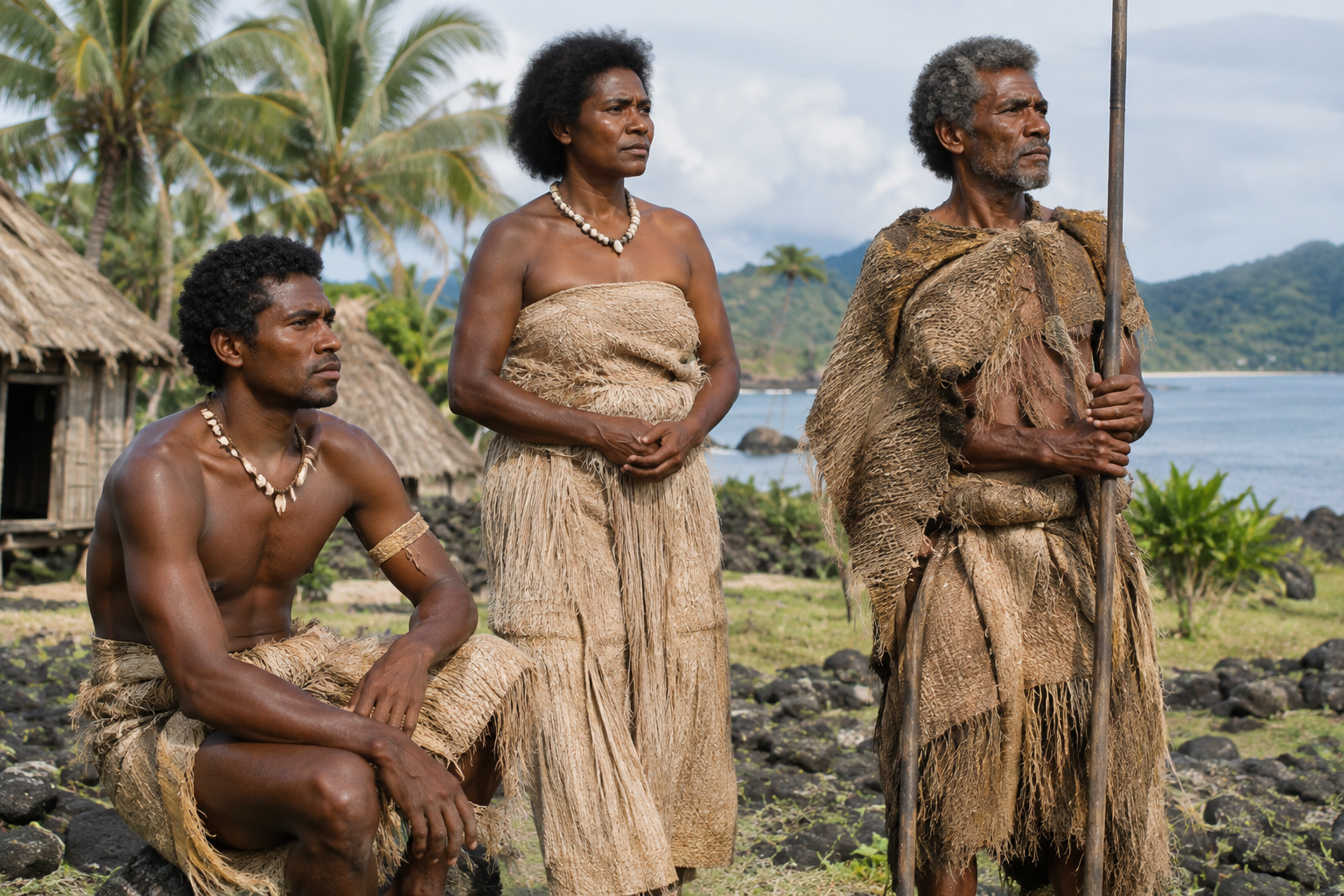
At Sigatoka on the island of Viti Levu in Fiji, one ancient burial stands out for anyone tracing the Y-DNA haplogroup M1a1a2a1. The individual identified as SIG023, dated to around AD 630, places this paternal line in the western Pacific in the early medieval period, long before European ships began filing these islands into imperial maps. That matters because in Oceania, the really interesting historical question is rarely simple isolation. It is movement: who arrived, when, and how communities changed while still remaining recognisably local.
The evidence here is necessarily narrow. Y-DNA follows one direct paternal line rather than a person's whole ancestry. But even a narrow line can be historically revealing when it appears in well-dated archaeological contexts. In this case, M1a1a2a1 is linked not to a grand dynasty or a famous battlefield, but to something better for archaeology: real people from excavated burial sites in Fiji, separated by more than a thousand years.
SIG023 comes from Sigatoka, one of Fiji's best known archaeological landscapes. The Sigatoka sand dunes have yielded burials and settlement evidence that have long been central to discussions of Fijian prehistory and the wider peopling of Remote Oceania. A burial dated to about AD 630 sits in a period when island societies in the region were already well established, but still part of larger patterns of contact across archipelagos.
For a lineage such as M1a1a2a1, that setting is more informative than any fantasy of a single founding ancestor. It tells us that this paternal branch was present in Fiji by the early first millennium AD, embedded within a living island community. That does not make SIG023 "the origin" of the haplogroup, nor does it prove a single migration event. What it does show is that this line belonged to the human story of Fiji during a formative period of Pacific history.
More broadly, ancient DNA research has been transforming how we understand Oceania, especially the balance between long-term local continuity and incoming ancestry streams. A useful wider background is provided by MyTrueAncestry's discussion of Near Oceania in Archaic DNA and Long Isolation in Near Oceania.
The second striking piece of evidence comes from Bourewa, also on Viti Levu. Two later individuals, BOU009 dated around AD 1765 and BOU012 dated around AD 1755, are associated with the same haplogroup article. Archaeologically, this gives us not a single isolated appearance, but a repeated signal from the same island across a very long span of time.
That time depth is the real story. Between SIG023 and the Bourewa burials lies more than eleven centuries of Fijian history: changing settlement patterns, shifting local power structures, exchange networks across island Southeast Asia and the Pacific, and eventually the approach of the colonial world. To find the same paternal branch represented at both Sigatoka and Bourewa suggests durability. However complex the wider ancestry of these island communities may have been, this male line remained part of the population over many generations.
Bourewa itself is an important place in discussions of Fiji's deep past because the site has figured prominently in archaeological arguments about early settlement and the development of local communities. Even without claiming that BOU009 and BOU012 were close relatives, the repetition of the branch there is a reminder that lineages do not just arrive; some persist.
A haplogroup label as specific as M1a1a2a1 sounds precise, and genetically it is. Historically, though, precision can be deceptive if we ask the wrong question. A direct paternal lineage can mark continuity between men living centuries apart, but it cannot by itself define language, status, ethnicity, or political identity. A man with this Y-DNA in seventh-century Fiji and a man with the same line in the eighteenth century may have shared one paternal thread while differing in many other ancestral lines.
That is particularly important in Oceania, where population history is built from repeated voyaging, marriage exchange, local adaptation, and regional interaction. The ancient DNA picture for the Pacific is not one of static islands sealed off from history. It is one of communities that were connected, sometimes surprisingly so, while also developing distinct local identities.
An ancient DNA study of Pacific populations, published in research on the region's ancient genomes, helps frame this wider context, even where a single article reader should be cautious about pushing any one sample beyond what its burial and genetic assignment can securely support.
One ancient Y-DNA result is intriguing. Three results from two Fijian sites become much more historically useful. SIG023 anchors M1a1a2a1 in Fiji around AD 630. BOU009 and BOU012 show that the line was still present in western Fiji in the mid-eighteenth century. This does not prove uninterrupted descent from one named ancestor, but it does make random coincidence less persuasive as an explanation.
In other words, the pattern looks like a local paternal lineage with staying power. Archaeologists are often interested in dramatic change, but persistence can be just as historically important. A stable male line surviving through centuries of cultural transformation tells us something about the social fabric of island life: families endured, descent mattered, and communities carried older biological histories into later periods that written documents barely touched.
That kind of continuity is easier to appreciate when set beside other ancient DNA case studies where lineages and communities can be followed across time. For readers interested in how archaeogenetics handles that broader question of population persistence and change, MyTrueAncestry's overview Archaeogenetics: Using Ancient DNA to Decode Human History is a useful companion.
It is tempting to read every Pacific lineage as a clue to one great migration route. Sometimes that is justified; often it oversimplifies matters. Fiji sits in a region shaped by both Near Oceanian and Remote Oceanian histories, and by interactions that did not stop once the first settlers arrived. The archaeological importance of sites such as Sigatoka and Bourewa lies precisely in showing Fiji as a lived landscape, not merely a stop on a map.
That broader Pacific frame matters for M1a1a2a1. The branch's appearance in Fiji should be read first as evidence of presence within Fijian communities, and only then as part of bigger debates about mobility and ancestry in Oceania. The strength of the evidence is local, concrete, and human-scaled: named individuals, excavated places, and dates spanning more than a millennium.
Readers interested in island population structure on the far side of Wallace's Line may also find an illuminating comparison in Reconstructing Indonesia's Ancient West-East Genetic Divide Across Wallace's Line, which explores how genetic history in maritime worlds often turns out to be more regionally complex than neat migration stories suggest.
For someone carrying Y-DNA haplogroup M1a1a2a1, the strongest ancient signal here is not royal glamour but longevity in Fiji. From SIG023 at Sigatoka around AD 630 to BOU009 and BOU012 at Bourewa in the eighteenth century, this paternal line appears in real archaeological communities on Viti Levu across an impressively long stretch of time. Responsibly interpreted, that suggests a branch with deep roots in the Pacific island world and a history tied to continuity as much as movement.






Comments