Haplogroup J2b2a2a

– 5 min read


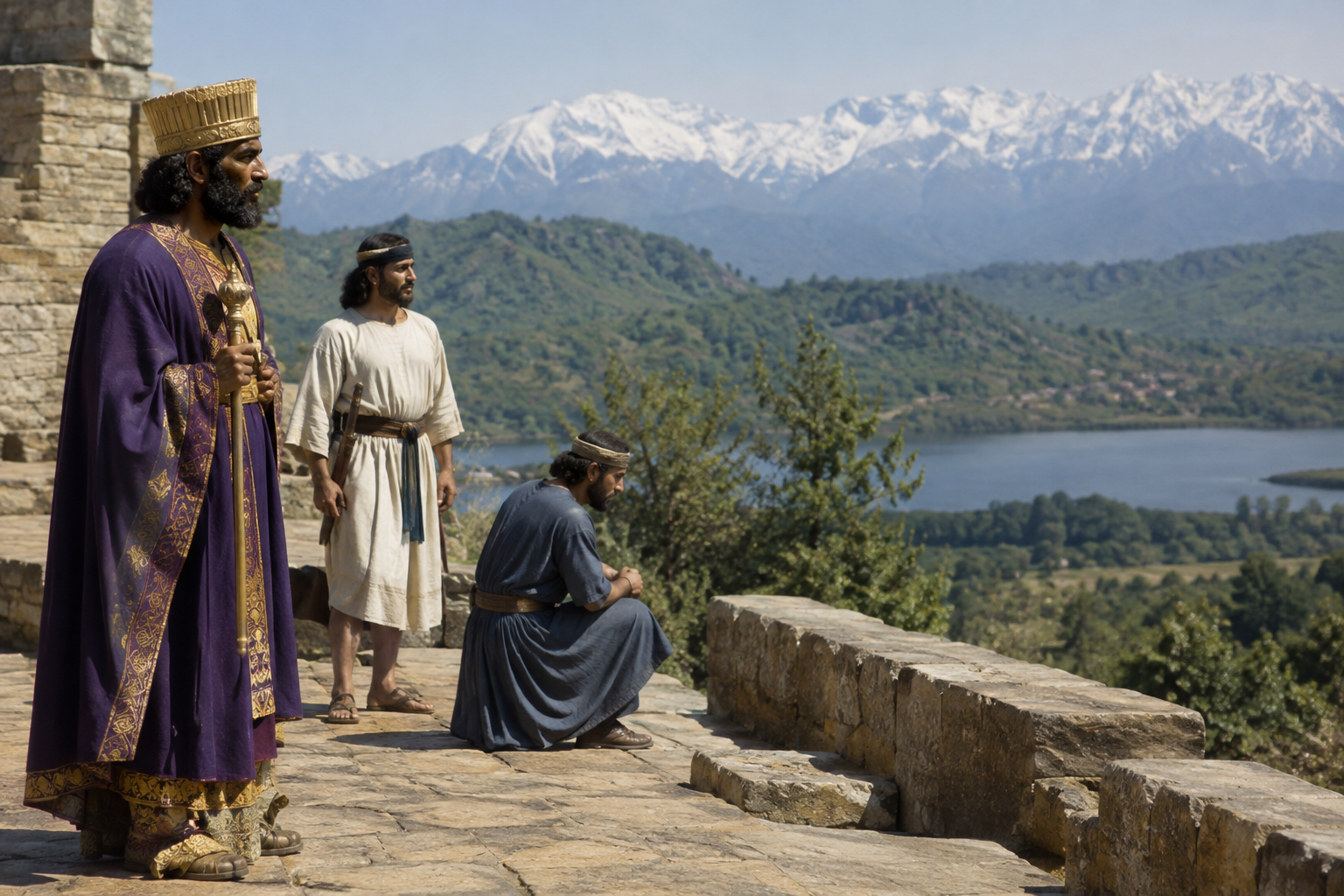
At Liarsang-Bon in Mazandaran, on the southern side of the Caspian, one ancient male labeled IRN65 has become a surprisingly useful witness for the Y-DNA haplogroup J2b2a2a. He is dated to around 355 BC, in the age of the Achaemenid Empire, and although one individual never tells the whole story, he places this paternal line in northern Iran at a moment when that region sat between imperial power, mountain communities, and the traffic of the wider Iranian world.
That matters because J2b2a2a is a very specific branch inside the broader J2 family. Y-DNA follows one direct paternal line only, so it does not define a person's whole ancestry, language, or identity. But when a branch turns up in a securely dated ancient context, it gives us something better than guesswork: a man, a place, and a historical horizon.
Mazandaran is not a trivial setting. This is the strip between the Alborz mountains and the Caspian Sea, a region that has often acted less like a remote fringe and more like a corridor with its own stubborn local character. In Achaemenid times it belonged to an imperial landscape stretching from Anatolia to Central Asia, yet northern Iran also preserved strong regional patterns of settlement and mobility that do not collapse neatly into court-centered history.
The importance of IRN65 lies precisely in that combination of specificity and restraint. We are not looking at a legendary king, nor at a grand literary figure, but at an excavated ancient individual from a real site in a real province. The assignment to J2b2a2a suggests that this paternal line was present in northern Iran by the 4th century BC, within a population shaped by long local continuity as well as wider imperial-era connections.
A genetic study focused on the northern Iranian plateau has emphasized how useful this region is for tracing continuity and change across long periods of time, from prehistoric communities into later historical eras. For readers interested in that broader setting, see this research on ancient genomes from northern Iran.
Ancient DNA articles are sometimes tempted by quantity alone, but a single well-placed sample can be historically valuable. IRN65 sits in the later Achaemenid period, just before the old imperial order gave way to the upheavals associated with Alexander's conquests and the Hellenistic kingdoms. A paternal line documented here is therefore anchored before that political transformation, not after it.
That lets us say something quite careful. J2b2a2a was not merely a later medieval or modern arrival in this part of Iran; it was already present there in antiquity. What we cannot say, from one sample alone, is whether it was common, elite, rural, urban, or tied to any named ethnic group. The archaeology gives us a firm point on the map, not a total census.
There is also a broader methodological lesson. Haplogroups often get dragged into heroic migration stories far too quickly. In reality, a branch such as J2b2a2a may have spread through many ordinary mechanisms over centuries: household continuity, regional marriage networks, military service, trade, resettlement, and the slow demographic churn of settled life. Northern Iran under the Achaemenids was exactly the kind of world where several of those processes could overlap.
The parent haplogroup J2 has a long and complicated history across western Asia, the Caucasus, the eastern Mediterranean, and parts of Europe and South Asia. But it is crucial not to dump all of that history onto J2b2a2a as though every branch behaved identically. A narrower subclade can have a different distribution, a different chronology of expansion, and different local histories from the wider parent group.
So what can be said responsibly here? First, IRN65 shows that this exact branch, or at least the reported association with it, appears in ancient northern Iran in the mid-1st millennium BC. Second, that placement fits comfortably with the broader archaeological picture of Iran as one of the major zones where J2 lineages have deep historical relevance. Third, the specific branch should be read as a clue to paternal continuity and movement within the Iranian and neighboring worlds, not as a badge of a single people.
For anyone exploring their own results, that distinction is worth holding onto. If your paternal line is J2b2a2a, the most defensible link is not to a romanticized empire in the abstract, but to real male-line ancestry that could have been part of long-standing networks in regions like northern Iran.
When we hear "Achaemenid Empire," it is easy to think only of royal inscriptions, Persepolis, tribute, and kings. But ancient DNA has a useful habit of pulling us away from the court and back toward populations. A man from Mazandaran reminds us that empires are lived from the ground up: by villagers, pastoralists, craftspeople, soldiers, and families whose names do not survive in texts.
That is especially important in northern Iran, where ecology and topography matter. The Caspian zone has long differed from the drier Iranian plateau to the south. Mountain barriers, coastal plains, and regional pockets of settlement can preserve local structure even while larger political systems come and go. In that sense, IRN65 is not just "an Achaemenid sample"; he is evidence for how an imperial-period population in Mazandaran contained paternal lines that may have deep local roots.
Research on Iranian population history increasingly points to exactly this mixture of continuity and connection. Northern Iran was never sealed off, but neither was it simply overwritten by each new dynasty. A Y-line found there in the 4th century BC may reflect both older regional ancestry and participation in the broader human movement that linked the Iranian plateau with the Caucasus, Mesopotamia, Central Asia, and beyond.
One of the pleasures of ancient DNA is that even a modest find can sharpen comparisons elsewhere. If J2b2a2a appears in Achaemenid-period Mazandaran, then later appearances of related J2 lineages around the eastern Mediterranean, the Balkans, or South Asia need not be imagined as detached from Iranian history. That does not create a direct chain from IRN65 to every later case, of course. It simply gives us a firm ancient foothold in one historically central region.
That foothold also sits neatly beside other MyTrueAncestry discussions about Iranian and western Eurasian population history. The larger question is not whether one haplogroup "belongs" to one civilization, but how paternal lines persisted, mixed, and reappeared across different political worlds. Empires rise and fall more quickly than lineages do.
There is a useful comparison here with work on neighboring and connected regions. Studies of ancient mobility around the Black Sea, the Caucasus, and the eastern Mediterranean repeatedly show that male lines do not map neatly onto one language or one state. That is why an Achaemenid-era J2b2a2a result is most interesting not as a label for "Persian blood," but as evidence of a paternal strand embedded in the complicated human geography of ancient Iran.
The clearest ancient signal in this case is simple and strong: J2b2a2a is documented in northern Iran by around 355 BC through sample IRN65 from Liarsang-Bon in Mazandaran. That places the lineage within an ancient Iranian setting shaped by both regional continuity and imperial-era movement. For someone researching this paternal branch today, the best-supported takeaway is not a promise of descent from famous rulers, but a tangible connection to the populations of the Iranian world in antiquity.






Comments