Haplogroup J2b2a1a1a1b

– 7 min read


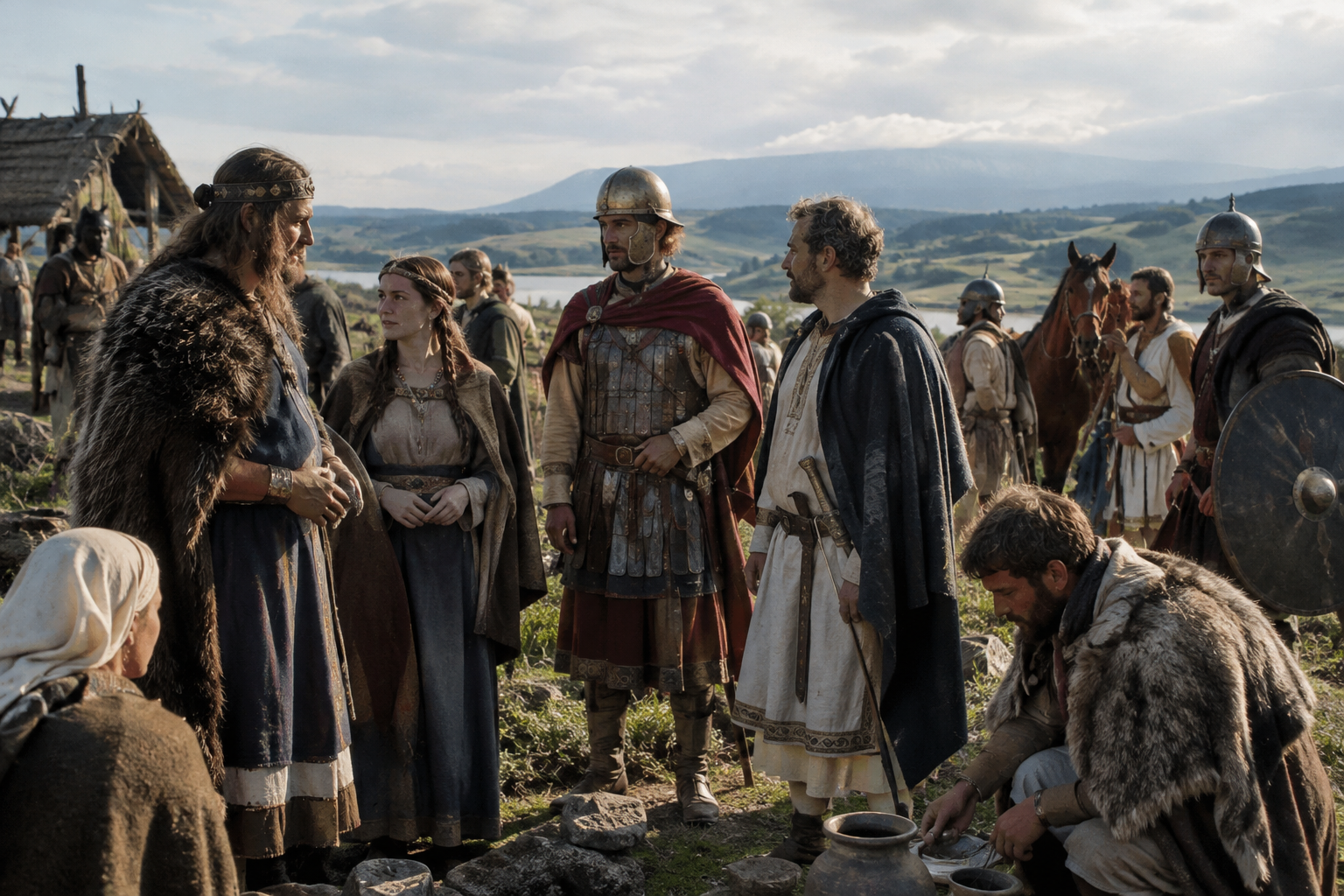
There are some Y-DNA lineages that turn up once or twice in the record and then vanish into the mist. And then there are lineages like J2b2a1a1a1b, whose story seems to keep reappearing in unexpected places: Bronze Age communities in the western Balkans, Iron Age hillfort worlds, Roman provincial landscapes, Celtic burials north of the Alps, and medieval Poland. Not as a neat tale of one people marching across a map, but as something more interesting: a paternal line moving through real human worlds that changed language, custom, empire, and political allegiance over many centuries.
That is what makes this haplogroup historically so compelling. Y-DNA haplogroups trace one direct paternal line only, from father to father to father, and so they do not describe a person's whole ancestry. But they can illuminate how particular male lineages persisted, spread, or were absorbed into new societies. In the case of J2b2a1a1a1b, the ancient DNA supplied here points especially toward a long and rather striking presence in southeastern Europe, with later appearances reaching into Central Europe and medieval Polish settings.
J2b2a1a1a1b is a very specific downstream branch within the wider Y-chromosome haplogroup J2. Broadly speaking, J2 has long been associated in ancient DNA studies with populations linked to the eastern Mediterranean, the Balkans, and parts of Europe touched by farming, trade, and later imperial movement. But we need to be careful here: the deep history of the broad parent haplogroup J2 should not be casually pasted onto this far narrower branch as if nothing happened in between. The value of the supplied evidence is that it lets us look at this particular lineage through actual excavated individuals.
What stands out most clearly is the density of finds in Croatia, Montenegro, Serbia, Slovenia, and nearby regions over an enormous timespan. That suggests that for this branch, or very closely related paternal lines, the Balkans were not merely a corridor but a durable zone of presence. By the Iron Age and Roman period, however, the same lineage also appears further north and west, which is a reminder that paternal lines travel not only through migrations on a grand scale but also through soldiering, marriage, trade, elite exchange, and local mobility.
If you wanted to begin this story somewhere solid, you would start in Bronze Age Croatia and Montenegro. The samples I5080 from Proto-Illyrian Bronze Age Croatia, Zavojane-Ravca, dated to 1685 BC, and I5073 from Proto-Illyrian Bronze Age Croatia, Koprivno, dated to 1637 BC, place this paternal line in the eastern Adriatic world very early indeed. So do I5074 from Matkovici, dated to 1447 BC, and the Cetina Valley individuals I18746, I18747, I18748 at 1800 BC and I19032 at 1700 BC.
This is not trivial. When one lineage appears again and again across nearby Bronze Age sites, one begins to suspect not a random arrival but a recurring local presence. Add I4331, labelled Illyrian / Dalmatian and dated to 1600 BC, plus the Montenegro burials I13775 and I13777 from Velika Gruda at 1350 BC, and the pattern grows stronger. We are looking at paternal continuity in the western Balkans across communities usually discussed in archaeological terms as pre-Illyrian or Illyrian-related settings.
That does not prove that all later Illyrians shared this lineage, nor that haplogroups map neatly onto ethnic names. It does show that men carrying this branch, or a very close paternal equivalent, were present in the region long before Roman rule and long before medieval kingdoms emerged.
By the Iron Age, the picture becomes even more interesting. In Croatia and neighboring regions the lineage appears in samples such as I23911 from Smiljan at 840 BC, I23995 at 740 BC, I24638 at 690 BC, I26742 from Jazinka Cave at 700 BC, I24639 from Illyrian Smiljan at 530 BC, and I24882 from the Pannonian hill fort Mala Metaljka at 490 BC. There are also related finds in Slovenia and Hungary, including I5691 from Kapiteljska njive at 665 BC, I22940 from zagorje ob Savi at 420 BC, and I4998 from Vas County at 299 BC.
That is the sort of evidence that makes historians sit up. These are not all one "people" in any simple sense. They belong to a changing frontier of hillfort societies, Adriatic networks, inland communities, and later contact zones with La Tene culture.
Then suddenly the lineage turns up in unmistakably Celtic contexts further northwest: MBG006, an Elite Celtic Burial from Magdalenenberg, Villingen-Schweningen in Germany, dated to 530 BC; and 3432 and 3433, both Gallo-Celtic samples from Pont de Cornaux-Les-Sauges in Switzerland, dated to 200 BC. That does not mean J2b2a1a1a1b was "a Celtic haplogroup" in any exclusive sense. It means men bearing this paternal line were present inside Celtic archaeological worlds as well as Balkan ones. That is a more interesting and more realistic conclusion.
Discover Celtic Switzerland DNA
The Roman period multiplies the evidence. In Croatia alone, we find R2040, R2040a, and R2040c at Sisak Pogorelec, all dated to 245 AD. At Karlovac in Pannonia Savia there are BBC019, BBC027, BBC008, BBC009, and BBC012, dated to 275 AD. Hungary adds CGG021924 from Kiskundorozsma at 243 AD, while Serbia contributes I15546 from Timacum-Minus-Slog, Zaje ar District, Knja evac, Ravna, dated to 395 AD.
By now, we are in the world of roads, garrisons, veteran settlements, tax districts, and provincial towns. A Y-lineage that had deep roots in the Balkans could now spread through very Roman mechanisms. Equally, Roman rule could have drawn in men from multiple directions who happened to share this paternal background. Ancient DNA cannot always separate those scenarios on its own, but it can show that the lineage remained active in these provincial societies.
One especially suggestive sample is PL085, described as a Roman Outlier from Maslomecz Wielbark in Poland, dated to 250 AD. This is precisely the kind of find that reminds us how mobile the Roman and near-Roman world could be. Maslomecz is famous for complex cultural contacts on the empire's fringes, and this sample fits a picture in which paternal lines from southeastern Europe or the wider Roman orbit could appear far to the north in mixed communities.
There are even wider Mediterranean hints. I24032, from Hellenic-Carthago Kerkouane Tunisia Pantelleria, dated to 426 BC, and R474, an Etruscan sample from Civitavecchia dated to 650 BC, suggest that related paternal branches could also be found in Mediterranean maritime worlds. Again, caution is needed: these do not make the lineage "Punic" or "Etruscan" in any simple label. But they show how connected the ancient Mediterranean had become.
The line does not disappear with Rome. In Croatia, the Early Medieval site of Velim-Velistak yields a cluster of samples: VEM009 and VEM015 at 750 AD, and VEM024, VEM048, VEM051, and VEM064 at 775 AD. There is also R3543 from Migration Period Croatia, Gardun, dated to 525 AD, and much later R9918 from Medieval Doclea, Bjelovine, Montenegro, dated to 1150 AD.
That long continuity in the Adriatic-Balkan zone matters when we turn north toward Poland. Medieval Poland enters this story not as proof of a single unbroken family tree, but as a region where such paternal lines could become part of later historical populations. The supplied medieval samples GRK016 and GRK024 from Grodek nad Bugiem, dated to 1100 AD, and the earlier Polish outlier PL085 help bridge the gap between ancient frontier mobility and the medieval landscapes of the Polish realm.
Explore Maslomecz and Gothic Diversity
This is where the historical scenery changes dramatically. Instead of burials and bone reports, we arrive in the world of dynasties, offices, and castles. The House of Lubomirski is associated here with Nowy Wisnicz Castle in southern Poland. The site began in the 14th century as a Gothic stronghold of the Kmita family, before Stanislaw Lubomirski transformed it in the early 1600s into an imposing fortified residence in the Italian style, with bastions, courtyards, and lavish decoration. In other words, a medieval fortress refashioned into a statement of aristocratic power.
It is a lovely example of how elite families made stone do the work of memory. The castle later suffered in the Swedish wars and in later upheavals, was altered for practical purposes including use as a prison in the 20th century, and only gradually recovered after the Second World War. It now stands as a reminder that family prestige, like genetic inheritance, survives in fragments, interruptions, and restorations.
Then there is Wawel Castle in Krakow, the seat of Polish Royalty for centuries and one of the great layered sites of Central Europe. It began as an early medieval stronghold and accumulated Romanesque, Gothic, Renaissance, and later additions. On Wawel Hill, royal ceremony, bishops, dynastic politics, and national memory all gathered in one place. If J2b2a1a1a1b or related paternal lines were present in medieval Polish populations, Wawel provides the perfect historical counterpoint: not genetic proof of a dynasty, of course, but a setting in which many paternal lineages from many regions could be absorbed into the ruling and serving classes of a major kingdom.
That is the key distinction. Castles preserve the history of families and states; Y-DNA preserves one paternal thread. The two can sometimes illuminate one another, but one does not automatically verify the other.
Discover the Lubomirski Family
So what does J2b2a1a1a1b reveal? First, that a paternal lineage can have remarkable time depth in one broad region - here especially the Balkans and Adriatic hinterland - while also appearing in Celtic, Roman, and medieval settings far beyond it. Second, that ancient DNA is at its best when it complicates old stories. It shows that the men buried in "Illyrian," "Celtic," "Roman," or "Germanic" archaeological contexts were not sealed biological blocks. They were participants in connected worlds.
And third, it reminds us that paternal ancestry is both precise and limited. Precise, because it follows a direct line. Limited, because that line is only one among thousands in your family tree. Sharing a broad haplogroup with an ancient individual does not prove direct descent, still less membership in a noble house. But it can place your paternal line in a genuinely fascinating historical landscape - among Bronze Age communities of the western Balkans, Iron Age hillfort people, Roman provincials, and medieval populations stretching into Poland.
If you want to see whether your own DNA shows links to ancient individuals like MBG006, PL085, I5080, or the Velim-Velistak burials, MyTrueAncestry can help you explore those connections. Ancient DNA matches will not prove that you descend from a king at Wawel or a magnate at Nowy Wisnicz, but they may reveal that your ancestry shares part of the same deep human story.






Comments