Haplogroup J2b2a1a1a1a1a2a

– 5 min read


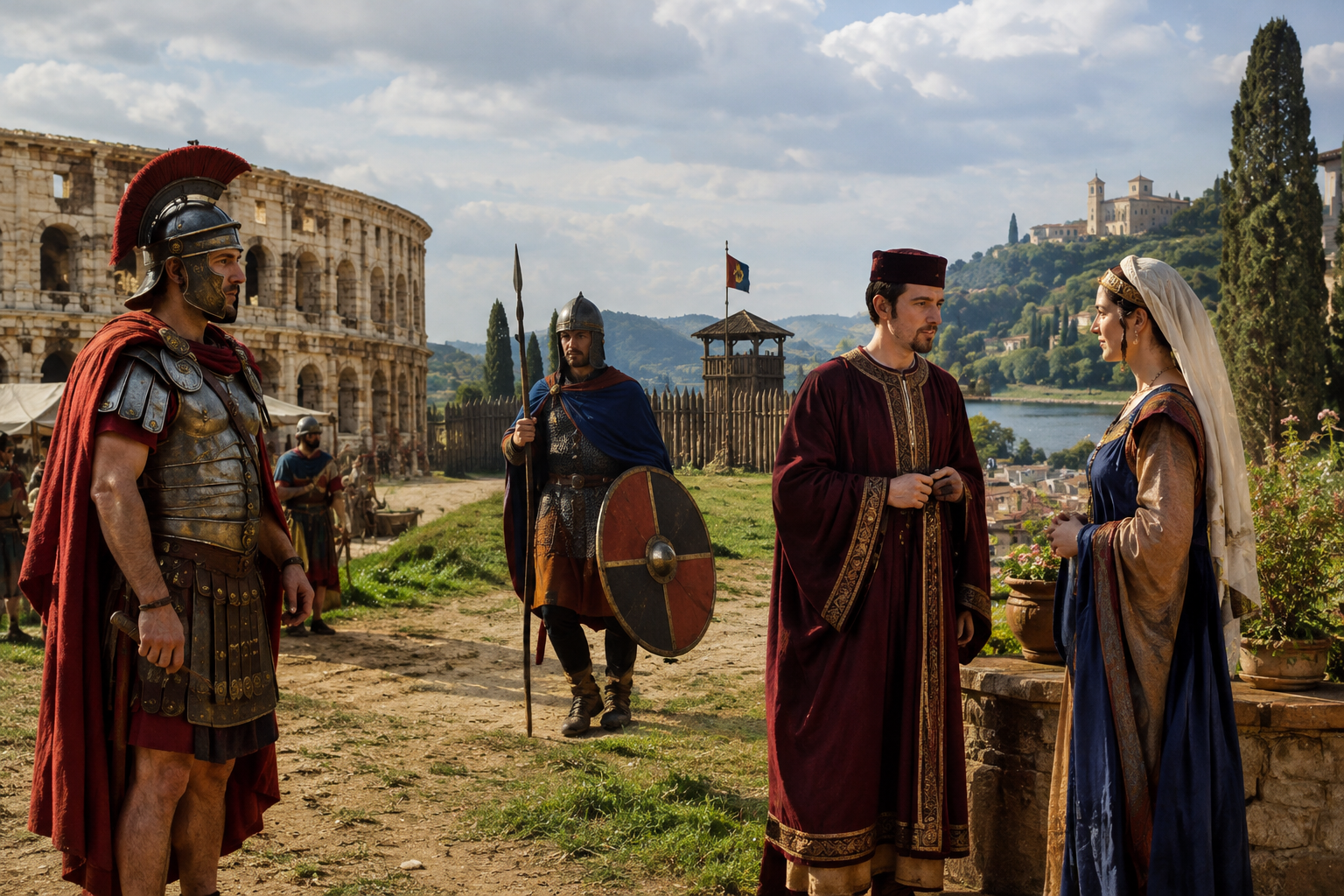
At Mursa in Roman-era Croatia, one excavated man dated to around AD 200, sample I26752, carries the very specific Y-chromosome line J2b2a1a1a1a1a2a. That matters because Mursa was not some remote village on the edge of events. It stood in a busy frontier world on the Drava, in a landscape shaped by soldiers, merchants, imperial administration, and the steady movement of people through the Balkans. A single paternal line does not tell us everything about a man, but it can pin one strand of family history very firmly into place.
For this haplogroup, the striking thing is not one grand royal pedigree. It is the sequence of appearances: an Imperial Roman individual in Croatia, a Carolingian-period man in western Hungary, and a late medieval man in Tuscany. Put cautiously, that is a small but suggestive chain across central and southern Europe, linking frontier provinces, post-Roman reorganization, and later medieval Italy.
Mursa, near modern Osijek, belonged to a Roman provincial zone where local continuity and imperial mobility constantly overlapped. Men arrived through military service, trade, settlement, and family migration; children were then born into communities that were neither simply "native" nor simply "Roman". In that setting, a lineage such as J2b2a1a1a1a1a2a is most useful not as a badge of ethnicity, but as evidence that one direct paternal line was present in this mixed frontier society by the early 3rd century AD.
The wider J2 family is often associated with long histories in the Mediterranean and parts of the Near East and Balkans, but one must be careful here: that broad background cannot simply be projected onto this exact downstream branch. What we can say securely is narrower and more interesting. By the Roman Imperial period, this paternal line was already embedded in a provincial community of the middle Danube basin.
Mursa has attracted attention precisely because Roman Croatia preserves evidence for changing paternal lineages across time while many local populations also show continuity in other parts of their ancestry. A related MyTrueAncestry article on this broader regional pattern is here:
Croatia's shifting paternal lines
Research on ancient genomes from the Roman world has repeatedly shown that the empire did not move everybody in the same way. Some communities remained locally rooted, others became intensely cosmopolitan, and many were both at once. A major ancient DNA study of the Roman period and its aftermath can be found here, and it provides the larger frame for understanding why a Croatian Roman sample can illuminate much wider histories of contact and mobility.
J2b2a1a1a1a1a2a is a very fine-grained paternal label. In plain English, it marks one direct male line: father to son to son across many generations. That is powerful, but limited. It does not describe a person's full ancestry, language, legal status, or cultural identity, all of which were far more complicated in the Roman and medieval worlds.
Still, very specific branches become archaeologically valuable when they recur in separated places and periods. Here the recurrence is not huge in number, but it is historically well placed. We are looking at a line that appears in the Roman Balkans, then in the post-Roman-Carolingian sphere of the Carpathian Basin, and then in medieval Italy. That distribution invites a historical question: was this one of the paternal threads that endured through the political collapse of Rome and the reshaping of Europe that followed?
The second key appearance comes from AHS32, dated to about AD 850 at Zalavar-Varsziget in medieval Hungary, within the Carolingian-period world. This is a fascinating setting. Zalavar sat in a borderland shaped by late Avar legacies, Frankish influence, Slavic populations, and the political fragmentation and rebuilding that characterized central Europe before the Hungarian conquest.
That is exactly why a paternal match matters here. Not because it proves one tidy migration route, but because it shows this lineage surviving into a radically altered landscape after Rome. Between I26752 at Mursa and AHS32 at Zalavar, we can glimpse continuity of one male line across six centuries of imperial change, military upheaval, and cultural realignment.
Western Hungary in this period is often treated as a corridor, and rightly so. But corridors are inhabited places, not just arrows on maps. A man buried at Zalavar was part of a real settlement history in which old provincial populations, newcomers, and mixed communities all contributed to what early medieval Europe became.
For a wider look at this region after the Roman world, see:
The third sample, R54, comes from Villa Magna in Tuscany and is dated to about AD 1355. By then we are in a wholly different historical world: communes, lordships, church institutions, dense agrarian settlement, and the social stresses of the later Middle Ages. Yet the same direct paternal branch appears again.
This late medieval Tuscan occurrence is important because it prevents the story from becoming too Balkan- or frontier-specific. J2b2a1a1a1a1a2a was not merely a line stranded in a former Roman military zone. By the 14th century, it was also present in central Italy, in a region whose population history included very old local roots as well as centuries of movement within the peninsula and across the Mediterranean.
Ancient DNA from medieval and earlier Italy has increasingly complicated the old habit of talking about "Italians" as though they were a single stable block across time. Tuscany, Latium, and other regions each have their own local stories, and medieval cemeteries often reveal a mixture of continuity and mobility rather than either one alone.
A related article on medieval Italy that helps set this sample in context is here:
Three samples do not map the full history of a haplogroup. But they can reveal the sort of historical environments in which it turns up. In this case, the environments are telling: a Roman provincial center on the Danube, an early medieval power zone in western Hungary, and a late medieval community in Tuscany. None of these are accidental backwaters. All sit in regions where states, armies, trade, and local kin groups met and remade one another.
There is also a methodological point worth making. Haplogroup articles can tempt us into drawing thick lines between ancient burials and modern identities. Better to think in terms of documented footholds. J2b2a1a1a1a1a2a has firm archaeological footholds in at least these three settings, and together they suggest durability across some of Europe's biggest historical transitions.
Another useful comparison comes from Roman and post-Roman Iberia, where ancient DNA has likewise shown how imperial systems could spread people without erasing regional variation:
Roman Hispania's genetic legacy
For the broader early medieval transformation of Europe, including the kinds of population mixtures relevant to places such as Zalavar, an ancient DNA study in Science Advances offers a useful research backdrop. The key lesson is not that one haplogroup explains history, but that carefully placed ancient genomes let us watch family lines persist through changing political worlds.
If your paternal line falls under J2b2a1a1a1a1a2a, the best-supported historical picture is a European one with documented ancient appearances in the Roman Balkans, the Carolingian-era Carpathian Basin, and late medieval Italy. That does not pin your family to one ethnicity or one migration event. What it does suggest, rather nicely, is a paternal ancestry with roots in the interconnected worlds of the Balkans and Mediterranean Europe, and with a line resilient enough to remain visible across more than a thousand years of upheaval and change.






Comments