Haplogroup J2b2a1a1a1a1a1a

– 6 min read


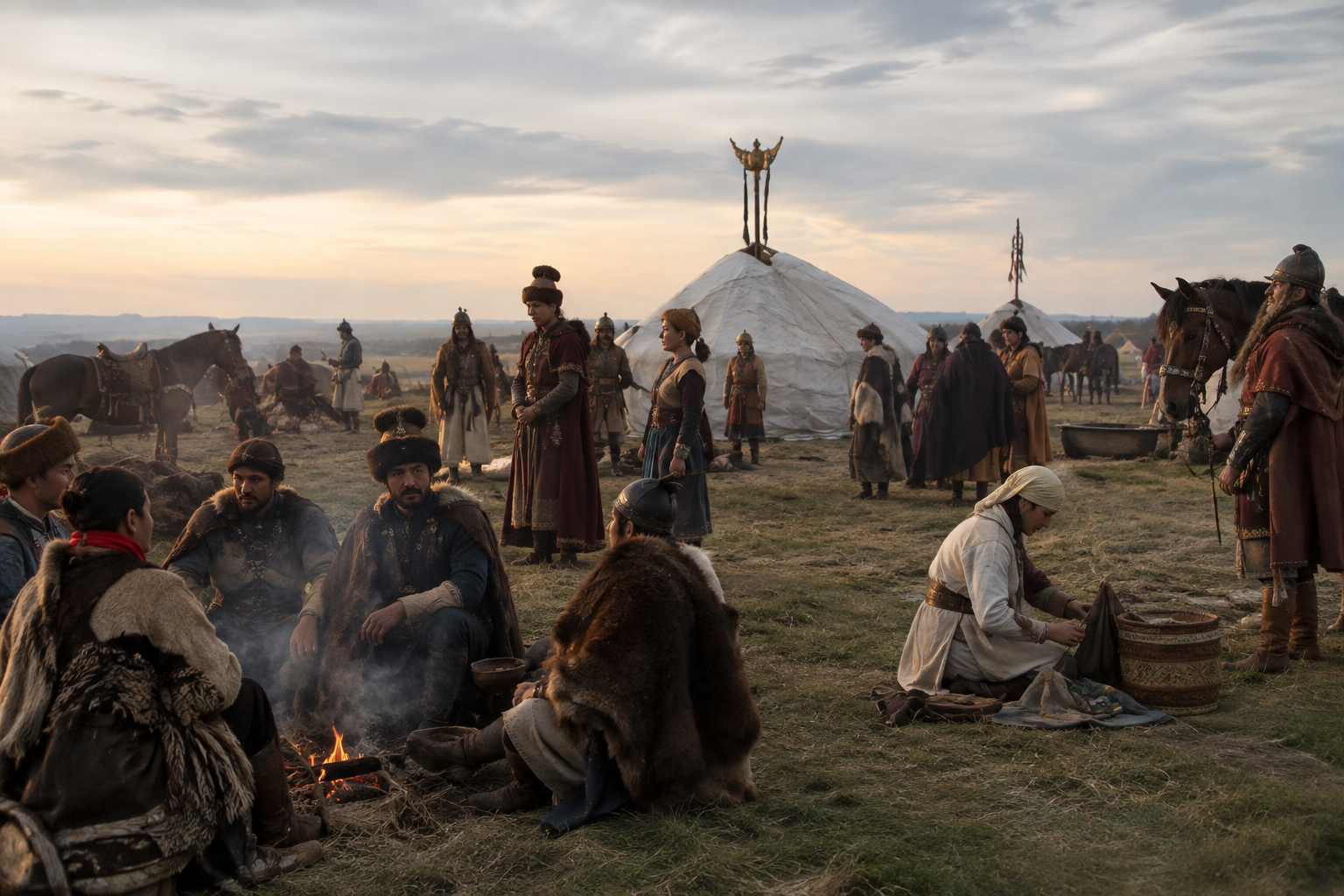
Some Y-DNA haplogroups arrive with trumpets: they are broad, famous, and easy to map onto familiar episodes in history. J2b2a1a1a1a1a1a is not like that. It is a very specific paternal branch, tucked deep inside the Y-chromosome tree, and that is precisely what makes it interesting. Narrow branches often stop us from telling lazy stories. They force us to look closely at the real evidence: where ancient men carrying related paternal lines were found, what worlds they lived in, and how those worlds changed from Bronze Age strongholds to Roman frontiers, Avar cemeteries, and medieval castles.
Y-DNA traces one direct paternal line only: father to son to son across the centuries. It does not describe a person's whole ancestry, culture, language, or identity. But in the right archaeological setting it can illuminate something remarkably concrete: the survival, movement, and reshaping of male lineages over long stretches of time. For a subclade like J2b2a1a1a1a1a1a, the most responsible approach is to place it within the wider history of J2 and then follow the ancient evidence with care, especially across the Balkans, the Adriatic, Pannonia, and medieval Italy.
The wider J2 family is generally associated with deep prehistoric and ancient connections across parts of the Near East and the Mediterranean, and some of its branches became well established in southeastern Europe. But that broad background should not be pasted carelessly onto a much narrower lineage like J2b2a1a1a1a1a1a. What matters here is that the ancient sample list points repeatedly toward a corridor running through the Balkans, the eastern Adriatic, Pannonia, and northern Italy.
That pattern is striking because these were not marginal lands. They were some of the busiest crossroads in European history. Armies marched through them, merchants crossed them, imperial borders were drawn and redrawn across them, and local communities persisted through every upheaval. If you want to understand how a paternal line can survive while regimes collapse, this is exactly where you would look.
The older anchors in the dataset sit in the western Balkans and Adriatic hinterland. There are Illyrian-era samples from Velika Gruda in Montenegro: I13778 and I13169 dated to 1350 BC, and I14498 dated to 1150 BC. There is also I26726 from Middle Bronze Age Gudnja Cave in Croatia, dated to 1460 BC. None of these men can be turned into simple ethnic labels for modern purposes, but taken together they suggest that related paternal lines were present in this wider region long before Rome, long before Slavs, and long before medieval dynasties.
By the Roman and post-Roman periods, the story becomes richer and much more human. We begin to see this paternal signature in places that were plugged into imperial administration, military movement, and frontier society. In the Balkans and neighboring provinces the evidence includes BBC017 from Imperial Roman Croatia Karlovac Pannonia Savia, dated 275 AD; I15548 from Late Imperial Roman Serbia Timacum Kuline Ravna Village, dated 395 AD; I34294 from Late Imperial Roman Croatia Hvar Radosevic Palace, dated 400 AD; and R3544 from Late Imperial Roman Period Croatia Gardun, dated 431 AD.
These are not random dots on a map. They lie in a world of roads, forts, estates, and mixed populations shaped by Roman rule. What they suggest is not a single migration event but continuity and circulation: paternal lines already established in the region appearing within Romanized settings as empire held, strained, and then fragmented.
The post-Roman evidence is especially revealing. In Hungary there are SZL082 and SZL087 from Pannonia Savaria Szeleste Barbaricum, both dated 525 AD, and GHD012 and GHD019 from Arrabona Gyirmot Barbaricum, dated 550 AD. In Italy there are P9892g and P9892d from the Post Roman Empire Italy Castel Sozzio Necropolis, dated 600 AD. In Germany we even see Alh_119 from Merovingian Period Bavaria Altheim, dated 600 AD, along with BRC024x from Migration Period Roman Saxony-Anhalt Bruecken, dated 500 AD and several Saxon graves from Lower Saxony Hannover-Anderten dated 400 AD: ADN010, ADN005, ADN009, and ADN001.
That distribution is a salutary reminder. A Y-line can move with soldiers, settlers, clients, captives, traders, or local families adapting to new masters. Shared haplogroup background does not mean all these men belonged to one people in the old-fashioned sense. It means that one paternal branch, or branches close to it, had become part of a very connected European landscape.
The most eye-catching concentration in the entire dataset comes from Rakoczifalva in Hungary, above all around 650 AD. Here the lineage appears again and again in both Migration Period and Avar Elite contexts: RKF031, RKF029, RKF198, RKF142, RKF213, RKF015, RKF160, RKF046, RKF157, RKF170, RKF141, RKF127, RKF032, RKF218, RKF010, RKF012, RKF016, RKF041, and RKF231, alongside Avar Elite individuals such as RKC026, RKF047, RKC046, RKC047, RKC050, RKC011, RKC038, RKC035, RKC002, RKC028, RKC039, RKC012, RKC043, RKC042, RKC020, RKC031, RKC005, RKC030, and RKC045. Later related appearances at the same wider site include RKF210 from 775 AD and RKF219 from 770 AD.
Now that is a pattern worth pausing over. One sample can be a curiosity. A cluster like this suggests something structural: a lineage embedded in a local population, perhaps also visible among socially prominent burials. But even here caution matters. "Avar Elite" is an archaeological and historical label for burial context and status, not proof that every man so labelled shared the same ethnic origin or exact paternal pedigree. The important point is that this Y-line was clearly present and persistent in a zone where steppe, Byzantine, local Balkan, and post-Roman influences met.
The same story carries onward into the early medieval centuries nearby: I34800 from Early Medieval Croatia Nustar Dvorac dated 800 AD, I28397 from Medieval Croatia Nustar dated 850 AD, and VEM033 and VEM025 from Early Medieval Croatia Velim-Velistak dated 775 AD. Then there is SP-2 from Hungarian Conqueror Elite Sarretudvari-Poroshalom, dated 950 AD. Across these finds, the impression is not of disappearance and replacement, but of recurrence under different political banners.
Italy enters this story in more than one way. The Castel Sozzio samples, P9892g and P9892d, show this paternal background in post-Roman northern Italy by around 600 AD. Sicily also makes an appearance far earlier with I24671 from Phoenician Era Mozia Sicily, dated 805 BC. That does not prove a straight paternal line from Phoenician Mozia to medieval Romagna, of course. But it does underline an important historical fact: Mediterranean and Adriatic worlds were interconnected for a very long time, and male lineages could travel, settle, and persist in ways that written history only partially records.
That wider Italian setting gives us a sensible way to think about the House of Manfredi and the Rocca Manfrediana in Faenza. The fortress, reshaped in the fifteenth century under the Manfredi family, belonged to a Romagna where city walls, papal pressure, local lordship, and foreign intervention collided repeatedly. The Rocca was not merely a residence. It was part of the defensive anatomy of a contested city, later transformed under the Manfredi into a stronger military work with towers, walls, and a great keep. After the fall of Faenza to Cesare Borgia at the opening of the sixteenth century, it passed into papal control and gradually lost its front-line role, later serving practical purposes including as a prison.
Why mention the Manfredi here? Not because the castle proves a Y haplogroup, and not because we can claim documented descent from ancient Balkan or Pannonian men. Rather, because Faenza stands in a region shaped for centuries by the same broad forces visible in the DNA record: Roman connectivity, post-Roman reshuffling, medieval militarization, and the survival of local lineages through political change. A haplogroup like J2b2a1a1a1a1a1a belongs naturally in that sort of history.
Discover the House of Manfredi
The sober conclusion is also the most interesting one. J2b2a1a1a1a1a1a appears, in this evidence, within a long arc stretching from Bronze Age Montenegro and Croatia to Roman Dalmatia, post-Roman Pannonia, Avar-period Hungary, early medieval Croatia, and medieval Italy. That is not a neat tale of one tribe marching from A to B. It is the much messier and more convincing history of a paternal lineage surviving in a region where continuity and migration happened at the same time.
Ancient DNA is so useful here because it does something chronicles and family legends often cannot. It shows us ordinary and elite men alike, buried in caves, necropoleis, frontier settlements, and defended landscapes. It lets us compare worlds that historians too often keep apart: Illyrian tombs, Roman provinces, Avar cemeteries, Hungarian conqueror elites, and Renaissance strongholds like the Rocca Manfrediana. What it does not do is magically identify a noble house from a broad haplogroup match.
For MyTrueAncestry users, that is the real excitement. A paternal haplogroup can place your direct male line in a deep historical context, while ancient sample matches can show where related populations appeared across time. The result is not a certificate of descent from a prince or an Avar noble. It is often something better: a view of how your line may fit into the durable human history of the Balkans, the Danube frontier, and the medieval Mediterranean.
If you would like to explore the Italian side of that story further, especially the wider setting of ancient and medieval mobility, the community article on ancient Italy is a good next stop.
Upload your DNA to MyTrueAncestry to see whether your results show connections to ancient individuals, archaeological cultures, and historical populations like those discussed here. These matches can offer a fascinating perspective on your ancestry, even though they do not by themselves prove direct descent from a specific ancient person or noble family.






Comments