Haplogroup J2a2a1a1a
– 5 min read


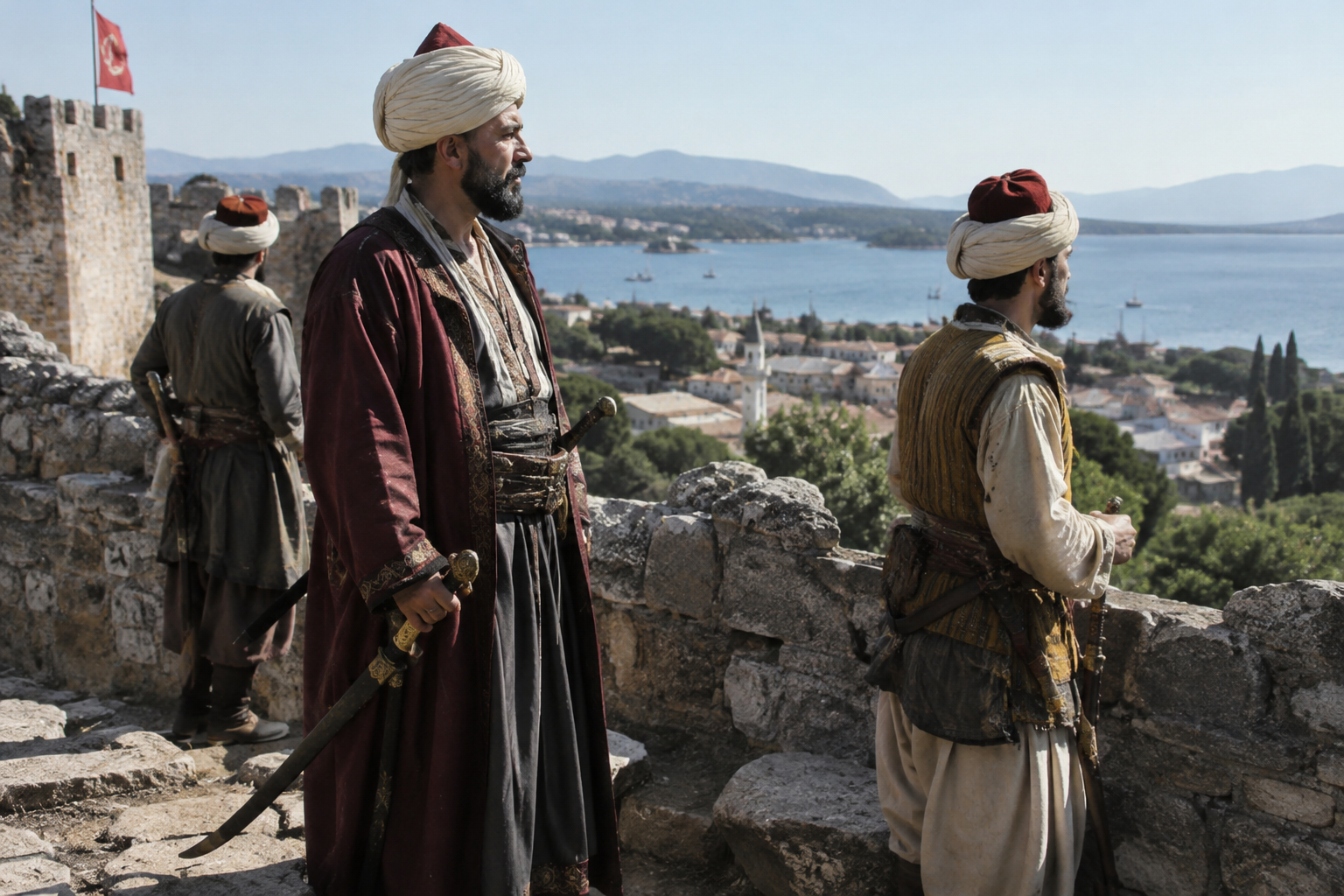
In the Aegean corner of southwestern Turkey, a man buried in the Ottoman period at Mugla Yatagan has been identified in ancient DNA work as sample I20326, dated to around AD 1475. On paper that can look almost disappointingly brief: one individual, one place, one late medieval date. But in fact it is exactly the kind of find that makes a Y-DNA branch such as J2a2a1a1a historically interesting, because it places a specific paternal line inside a region that had already lived many different political lives: Bronze Age Anatolia, Greek-speaking coastal worlds, Roman provinces, Byzantine frontiers, and then the expanding Ottoman state.
That is the first point worth making clearly. Y-DNA tracks one direct paternal line only, not a person's whole ancestry or identity. Still, when a branch like J2a2a1a1a turns up in a documented medieval Anatolian context, it invites a very grounded historical question: what does it mean to see this lineage in a place where continuity, migration, conversion, empire, and local survival were all happening at once?
The sample I20326 comes from Mugla Yatagan in Aegean Turkey, a landscape of inland valleys and routes linking the southwestern coast with the Anatolian interior. By the later 15th century, this was firmly within the Ottoman world, but not in any simple sense a blank slate newly populated by one incoming group. Western Anatolia had long been one of the most entangled regions of the eastern Mediterranean, shaped by older Anatolian populations, Hellenistic and Roman urbanism, Byzantine rule, Turkic-speaking arrivals, and the gradual social transformations of the medieval and early Ottoman centuries.
That makes a paternal lineage here especially valuable as evidence of human continuity through change. J2 in its broader sense is widely associated with the eastern Mediterranean and Near Eastern world, but that broader reputation must not be lazily pasted onto every narrower branch. What the Mugla Yatagan individual gives us securely is something smaller, and in a way more useful: proof that the branch reported here as J2a2a1a1a was present in southwestern Anatolia in the Ottoman period.
An important large-scale study of medieval and early modern populations in the region of the eastern Mediterranean and adjacent worlds was published in Science. Without pretending that one paper solves every local question, this is the kind of research framework that allows single individuals such as I20326 to be placed into a wider history of movement and mixture rather than treated as isolated curiosities.
To understand why this one Ottoman-era sample matters, it helps to step back from the subclade and look at the parent branch carefully. Haplogroup J2, and especially parts of J2a, appears again and again in discussions of the eastern Mediterranean, Anatolia, the Caucasus, the Levant, Iran, and lands tied into long-distance trade and farming expansions. It has deep time depth and a very broad historical footprint. None of that means every bearer came from the same people or spoke the same language; rather, it means that this paternal background has been woven into many societies over millennia.
That is precisely why Anatolia is such a good setting for it. Anatolia was not merely a bridge between continents, as travel writing likes to say, but a place where populations stayed, mixed, reorganized, and developed new identities. A J2a-line man in 15th-century Mugla could stand within that long local history whether his nearer paternal ancestors were Greek-speaking, Turkic-speaking, or part of some other regional community absorbed into Ottoman society. The Y chromosome alone does not decide that question, but it does keep the paternal thread visible.
In public ancestry discussions there is often a temptation to turn any eastern Mediterranean haplogroup into a dramatic tale of merchants, colonists, or conquerors. Sometimes those stories are true in part; often they are too tidy. With I20326, the real interest is subtler and better: J2a2a1a1a appears not in a legendary founder or courtly genealogy, but in an ordinary human burial from a very complicated historical landscape.
The late medieval centuries in southwestern Anatolia were marked by political change, but population history rarely follows political borders in neat lines. Ottoman incorporation did not erase earlier Byzantine or Anatolian inhabitants, and ancient DNA from the wider region increasingly shows that medieval communities could carry a mixture of local and incoming ancestries. What shifts over time is often not the total replacement of people, but the social framework in which they lived: tax systems, religion, language use, military recruitment, and patterns of marriage and mobility.
Seen in that light, J2a2a1a1a in Mugla Yatagan fits a region where paternal lines could persist through changing imperial labels. One can imagine modern readers wanting the lineage to point cleanly either to "old Anatolian" continuity or to some later medieval influx, but the honest answer is that one sample cannot do that on its own. What it can do is anchor this branch in an actual excavated historical population of Ottoman-era western Anatolia.
That matters because western Anatolia and the Aegean are among the places where the old categories in school textbooks begin to fall apart. Greek and Anatolian, Roman and local, Byzantine and Turkic, Christian and Muslim: these are vital historical categories, but they are not the same thing as a Y-DNA branch. Ancient DNA is useful partly because it forces us to keep those categories separate and then ask how, in specific places, they interacted.
Mugla sits in a world tied both to inland Anatolia and to the Aegean basin. That is worth stressing because haplogroups do not travel by magic; they move through people, and people move through marriage, settlement, military service, trade, enslavement, pilgrimage, and plain old local continuity. Southwestern Turkey, facing the islands and the wider Mediterranean, has for thousands of years been part of just such a connected zone.
For readers with J2a2a1a1a today, the Mugla individual is therefore less a single "origin point" than a historically legible waypoint. It shows the branch present in a post-Byzantine, Ottoman-Aegean context where multiple older Mediterranean layers were still alive inside the population. That is one reason related research on Greek and south Italian populations can also be historically suggestive, though not directly probative for this exact subclade.
Greek-speaking Mediterranean genetics
The broader eastern Mediterranean pattern also helps explain why J2 branches can appear in places linked by sea as much as by land. The Aegean has never been a hard frontier. It is a zone of circulation, and the paternal histories found there often reflect that long entanglement.
There is a pleasing modesty about sample I20326. He is not dressed up for us by chronicles, royal pedigrees, or heroic legend. Instead, he offers something more dependable: a direct paternal marker in a real archaeological setting, from a real Ottoman-era community in southwestern Anatolia.
That does not make J2a2a1a1a an "Ottoman haplogroup," nor a specifically Greek, Turkish, Byzantine, or Anatolian one in any exclusive sense. It does mean that if your paternal line falls within this branch, one historically grounded place to look is the mixed and durable population history of the eastern Mediterranean, especially Anatolia and the Aegean world. Research on nearby regions, including work on ancient Iranian populations, also helps frame the broader environment in which J2-related lineages have long been part of western Asia's history.
Ancient Iran and regional context
The most distinctive thing about J2a2a1a1a here is not a claim to fame, but a claim to place. Through I20326 from Mugla Yatagan, we can see this paternal line in the lived history of 15th-century southwestern Anatolia, a region where empires changed but people and families often remained, adapted, and merged. For anyone tracing this haplogroup today, that is a useful lesson: your paternal line may belong not to a single dramatic migration story, but to the long, layered human history of the Aegean and Anatolia.






Comments