Haplogroup J2a1a2b

– 5 min read


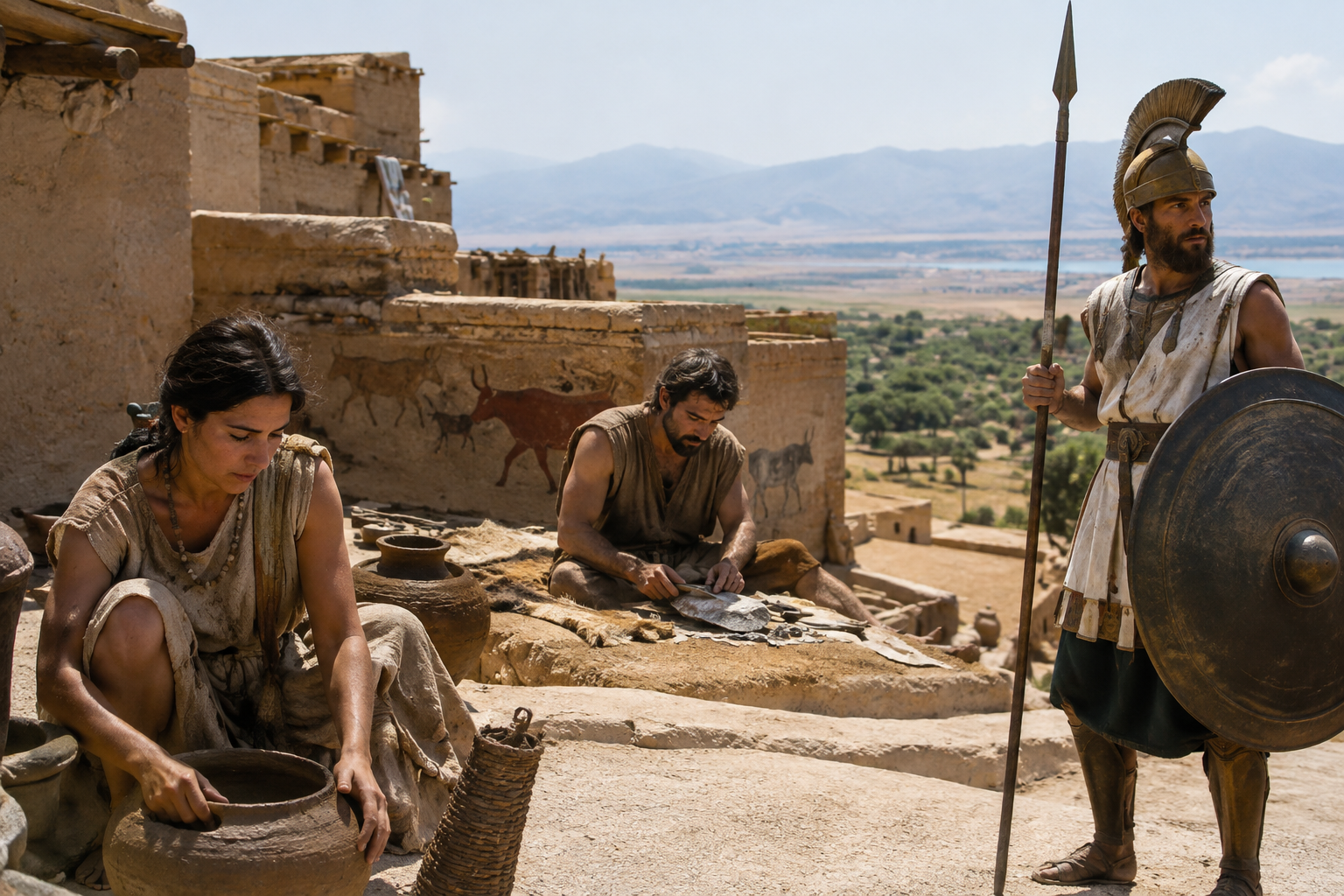
At Tiryns in the Argolid, one of the most famous citadel sites of Mycenaean Greece, an ancient man identified as TIR001 was dated to around 1200 BC. That date matters. It sits right on the threshold of the Late Bronze Age collapse, when palace systems across the eastern Mediterranean were under strain or already falling apart. A Y-chromosome assignment connecting this individual to J2a1a2b is therefore not just a technical label. It places a paternal line associated with the wider J2 world inside one of the great centers of Aegean prehistory.
The most striking thing about J2a1a2b in this small group of ancient evidence is not empire or conquest, but duration. The same branch appears in two much earlier individuals from Catalhoyuk in Anatolia, one from around 7000 BC (cch139) and another from around 5200 BC (cch109). That gives us a cautiously suggestive pattern running from one of the best known early farming settlements in southwest Asia to a Mycenaean center in southern Greece. Y-DNA follows one direct paternal line only, not a whole people or culture, but even so, the timespan is extraordinary.
Catalhoyuk has long occupied a special place in archaeology because it belongs to the earliest village-farming world of Anatolia. It is not merely old; it is one of the classic sites for thinking about how settled life changed human society. Houses were densely packed, access was often from the roof, and generations lived in close proximity within a built environment that still feels startlingly unfamiliar.
The two ancient samples connected here with J2a1a2b come from very different moments in the life of the settlement. cch139, dated to around 7000 BC, belongs to the early Neolithic horizon at Catalhoyuk. cch109, dated to around 5200 BC, comes from a much later phase, by which time the great florescence of the site was already in the past. Even without inventing family ties or direct descent between these men, the recurrence of the same Y-branch across nearly two millennia at one site is exactly the kind of thing ancient DNA can make newly visible.
It suggests that some paternal lines could persist through major changes in settlement history, architecture, economy, and social life. Archaeology had already shown continuity and change at Catalhoyuk through buildings, burials, and material culture. Y-DNA adds a more intimate strand of evidence: some direct male lines were still present across very long local timescales.
A research discussion touching on these Anatolian burials and their genetic context can be found in this ancient DNA study, which is relevant because Catalhoyuk remains one of the key places for understanding how early farmers were structured over time.
It is tempting to turn any branch of haplogroup J2 into a grand map of Mediterranean civilization. That would be too neat. The wider J2 family is often discussed in connection with West Asia, the Aegean, and the broader Mediterranean, but J2a1a2b is a narrower branch, and the evidence here is specific rather than universal. We should resist claiming more than the samples can bear.
What can be said responsibly is that this branch appears in early farming Anatolia and later in Mycenaean Greece, which fits a larger archaeological picture in which the Aegean and Anatolia were never isolated worlds. They exchanged crops, technologies, ideas, and people over thousands of years. A paternal lineage appearing in both regions is therefore historically plausible and archaeologically interesting, even if it does not prove one simple migration story.
That is often the most useful way to read Y-DNA. Not as a badge of ethnicity, and not as a shortcut to a named ancient nation, but as one thread moving through wider human histories that archaeology already tells us were connected.
The larger historical value of these three individuals lies in geography as much as date. Catalhoyuk sits in inland Anatolia, while Tiryns belongs to the Mycenaean world of the Greek mainland. Between them stretches the long history of the Aegean-Anatolian zone: coastlines, islands, trade routes, intermarriage, seaborne travel, and repeated cultural contact.
By the Bronze Age, this was a highly interactive world. Mycenaean palaces dealt with other centers across the eastern Mediterranean, and the Greek mainland was anything but cut off. So when a paternal branch with earlier Anatolian evidence appears in a Mycenaean individual, it does not need melodrama to be significant. It simply reflects the deep entanglement of neighboring regions whose histories were never separate for long.
This is also where chronology matters. The Catalhoyuk samples do not make the Mycenaean man a "Neolithic farmer" in any simple sense. Nearly six thousand years separate cch139 from TIR001. Many layers of population change, mixture, and local development sit in between. Yet the survival of a paternal branch across that span reminds us that lineages can outlast political systems, languages, and archaeological cultures.
TIR001 is especially evocative because Tiryns is no obscure village. It is one of the major fortified centers of the Mycenaean age, famous for its massive walls and palace complex. An individual from around 1200 BC there belongs to a moment when the old order was under acute pressure across the eastern Mediterranean.
We should not turn one Y-chromosome into a palace genealogy. Nothing in the evidence here says that TIR001 was elite, royal, or part of a ruling house. But his presence at Tiryns does show that J2a1a2b had reached, or persisted within, a central Mycenaean setting by the end of the Bronze Age. That alone makes the branch historically vivid.
An archaeological-genetic conference report associated with prehistoric Aegean material is available here. It is useful less for dramatic claims than for the broader point that ancient DNA is increasingly being brought into conversation with sites long known from classical and prehistoric archaeology.
Three samples are not a population census, but they can still tell a sharp story. Here the story is one of persistence across time and recurrence across connected regions. cch139 and cch109 show J2a1a2b in the deep Neolithic of Anatolia; TIR001 places it later in Mycenaean Greece. The pattern does not prove uninterrupted inheritance from one named community to another, but it does place this paternal branch firmly within the long history of the eastern Mediterranean world.
For anyone researching J2a1a2b today, that is the real interest. Your direct paternal line may belong to a branch with visible ancient footholds in both early farming Anatolia and Bronze Age Greece. Not a mythic dynasty, not a single migration, but a durable male line moving through some of the most important archaeological landscapes on earth.
The best-supported insight for J2a1a2b is its appearance in two very early men at Catalhoyuk and a much later man at Tiryns. That combination makes this branch a small but telling part of the story linking the first farmers of Anatolia with the later societies of the Aegean. If this is your haplogroup, the ancient evidence points not to a single identity label, but to a paternal line already present in the eastern Mediterranean's earliest settled worlds and still visible there thousands of years later.






Comments