Haplogroup J2a1a1b2a1b2b1c
– 4 min read


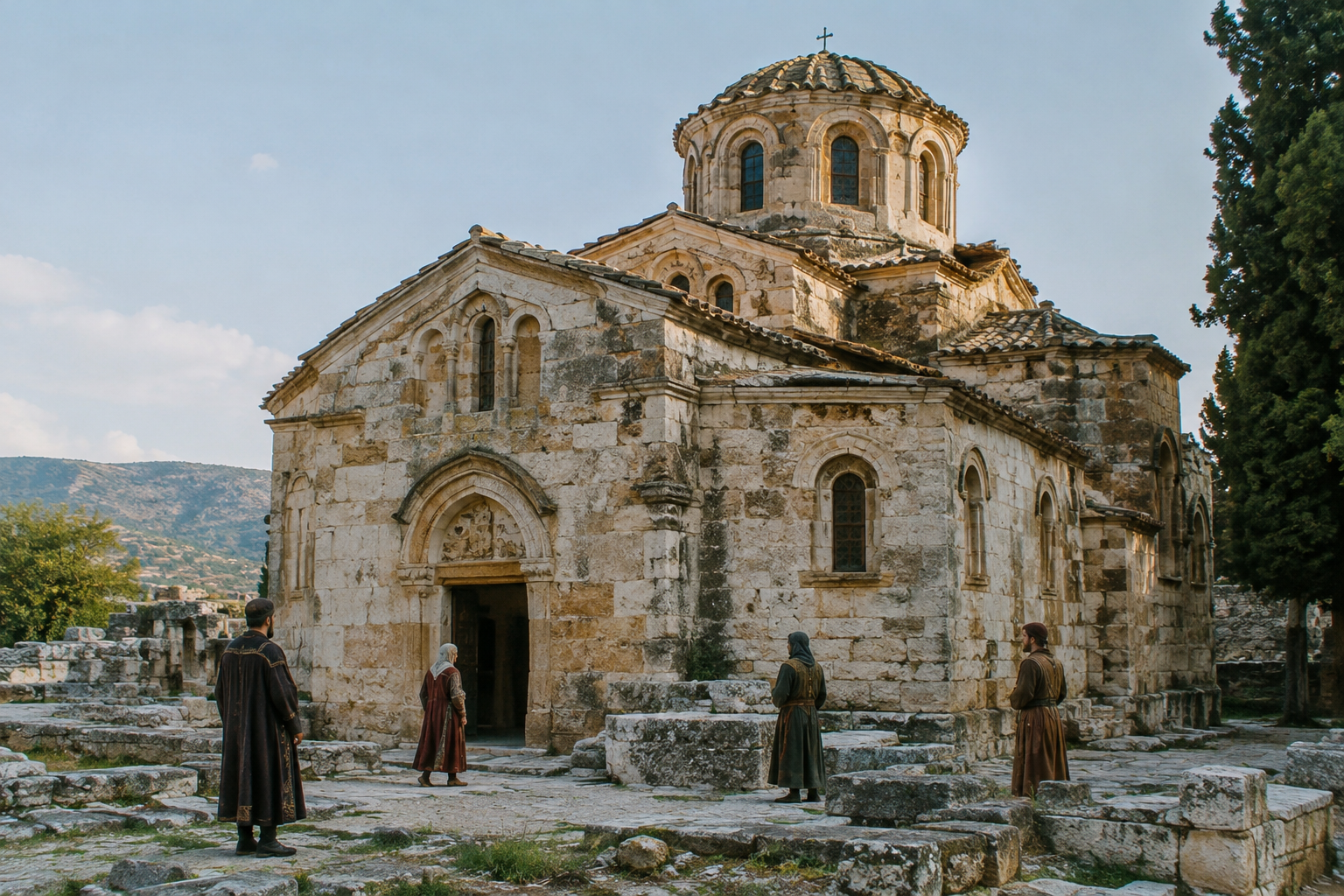
At Stratonikeia in southwestern Anatolia, one man buried in a church during the Byzantine period has given this very precise Y-chromosome branch an unusually clear archaeological foothold. The individual, sample I20187, is dated to around AD 975 and comes from a Christian burial context at the site. For the haplogroup J2a1a1b2a1b2b1c, that matters because it places a direct paternal line not in an abstract map of modern surnames, but in a real medieval community living among the ruins and continuities of an old Anatolian city.
That is the right place to begin, because J2 lineages are deeply associated with the broader history of the eastern Mediterranean and Near East, yet a terminal branch as specific as J2a1a1b2a1b2b1c should not be treated as if it automatically carries the whole biography of haplogroup J2. Y-DNA tracks one direct paternal line only, not a person's total ancestry. Still, when a branch turns up in a documented Byzantine church burial, it gives us something solid: a father-to-son line present in medieval western Anatolia, inside a world shaped by Greek-speaking Christianity, Roman institutions, and long regional continuity.
Stratonikeia had a very long life. Founded in the Hellenistic period and flourishing under Rome, it continued into the Byzantine era as part of the dense settlement network of western Asia Minor. By the 10th century, when I20187 was buried, the city was no museum piece. It was a living Christian landscape, where churches stood within an urban fabric layered over many centuries.
The significance of this sample is not that it proves a grand dynasty or a dramatic migration on its own. It is that it anchors this paternal line in a place where several historical worlds overlap: Hellenistic foundations, Roman provincial life, and Byzantine religious community. For anyone carrying J2a1a1b2a1b2b1c today, that is a much more useful historical image than a vague claim about "Mediterranean ancestry."
A major ancient DNA study of the Byzantine world, published in Science, helped show just how varied and locally grounded medieval eastern Roman populations could be. Even where there was mobility, these communities were not simple colonies of outsiders. Anatolia remained one of the empire's great demographic cores, and that makes a church burial from Stratonikeia especially informative.
The wider haplogroup J2 is often discussed in connection with the Near East, the Aegean, and the Mediterranean worlds of farming, trade, and urbanism. That broader picture is reasonable at high level, but it can become misleading if every downstream branch is forced into the same storyline. J2a1a1b2a1b2b1c is a narrow twig on a very old tree. Its appearance in medieval Anatolia tells us where one particular paternal line was found, not where every ancestor of that man came from, nor when that exact sub-branch first formed.
Still, Anatolia is exactly the kind of region where such a branch makes historical sense. This was a crossroads long before the Byzantine period: home to Bronze Age kingdoms, Greek cities, Persian rule, Roman government, and Christian bishoprics. Paternal lines could persist there through enormous cultural change. The man in Stratonikeia may have spoken Greek, worshipped in a church, and lived under Byzantine authority, while his paternal line reached back through many earlier layers of Anatolian and eastern Mediterranean history.
Modern imagination often treats Byzantium through the lens of emperors, sieges, and court intrigue. But most genetic history is found lower down, in ordinary burials from towns, villages, and churches. A sample like I20187 reminds us that late 10th-century Anatolia was one of the empire's central heartlands. This was the countryside and small-city world that sustained armies, monasteries, tax systems, and local worship.
That matters for interpretation. A Y-line in this context does not have to be read as exotic, intrusive, or newly arrived. Quite the opposite: the most economical reading is local or regionally integrated ancestry within the Byzantine population of western Anatolia. In other words, J2a1a1b2a1b2b1c appears here not on the edge of the medieval Mediterranean, but within one of its oldest settled cores.
Late Byzantine Burials on Chios
One of the most interesting things about Stratonikeia is continuity. Cities like this did not simply vanish at the end of antiquity. Their public buildings were reused, their neighborhoods shifted, their religious life changed, and their dead were buried within new sacred geographies. A church burial from around AD 975 belongs to that transformed urban world, where Roman civic space had been folded into Byzantine Christian memory.
For genetic historians, such places are gold. They let us observe not merely a population at one moment, but a landscape with deep historical depth. A paternal lineage found there may have passed through many changes of language, state, and religious practice without any break in biological descent. That is one reason why Anatolian samples are so valuable: they illuminate continuity as much as movement.
This also connects well with other work on Mediterranean population history. Studies of Roman and post-Roman communities repeatedly show that political change did not erase local people. Empires recruited, taxed, converted, and reorganized them, but much of the underlying population remained in place, albeit mixed to different degrees over time.
Greek-Speaking Communities and DNA
With only one ancient individual directly cited here, caution is essential. I20187 does not stand for all Byzantines, all Anatolians, or all J2 men. Nor does one church burial identify an ethnicity in any simple sense. Medieval people belonged simultaneously to households, parishes, cities, provinces, military obligations, and religious traditions; genetics touches only one part of that story.
But one sample can still be historically powerful. It confirms that a paternal line associated with J2a1a1b2a1b2b1c was present in Byzantine western Anatolia in the later 10th century. That alone helps narrow the imaginative field. Instead of a diffuse and speculative origin story, we have a documented man from a known place and period: Christian, Byzantine, Anatolian, and buried at Stratonikeia.
If you belong to J2a1a1b2a1b2b1c, the most responsible takeaway is not a claim to one ancient identity, but a likely connection to the long-settled worlds of Anatolia and the eastern Mediterranean. The burial of I20187 at Stratonikeia suggests that this paternal branch was part of the human fabric of Byzantine Asia Minor, where classical cities, Roman government, and Christian institutions had fused into something distinctly medieval.
That is a modest conclusion, but a rich one. Your direct paternal line may not point to a single tribe or famous house; instead, it may lead into one of history's great zones of continuity, where old cities endured, languages shifted, and families carried their Y-chromosomes through centuries of change.






Comments