Haplogroup J2a1a1a2b2a3b1a1
– 5 min read


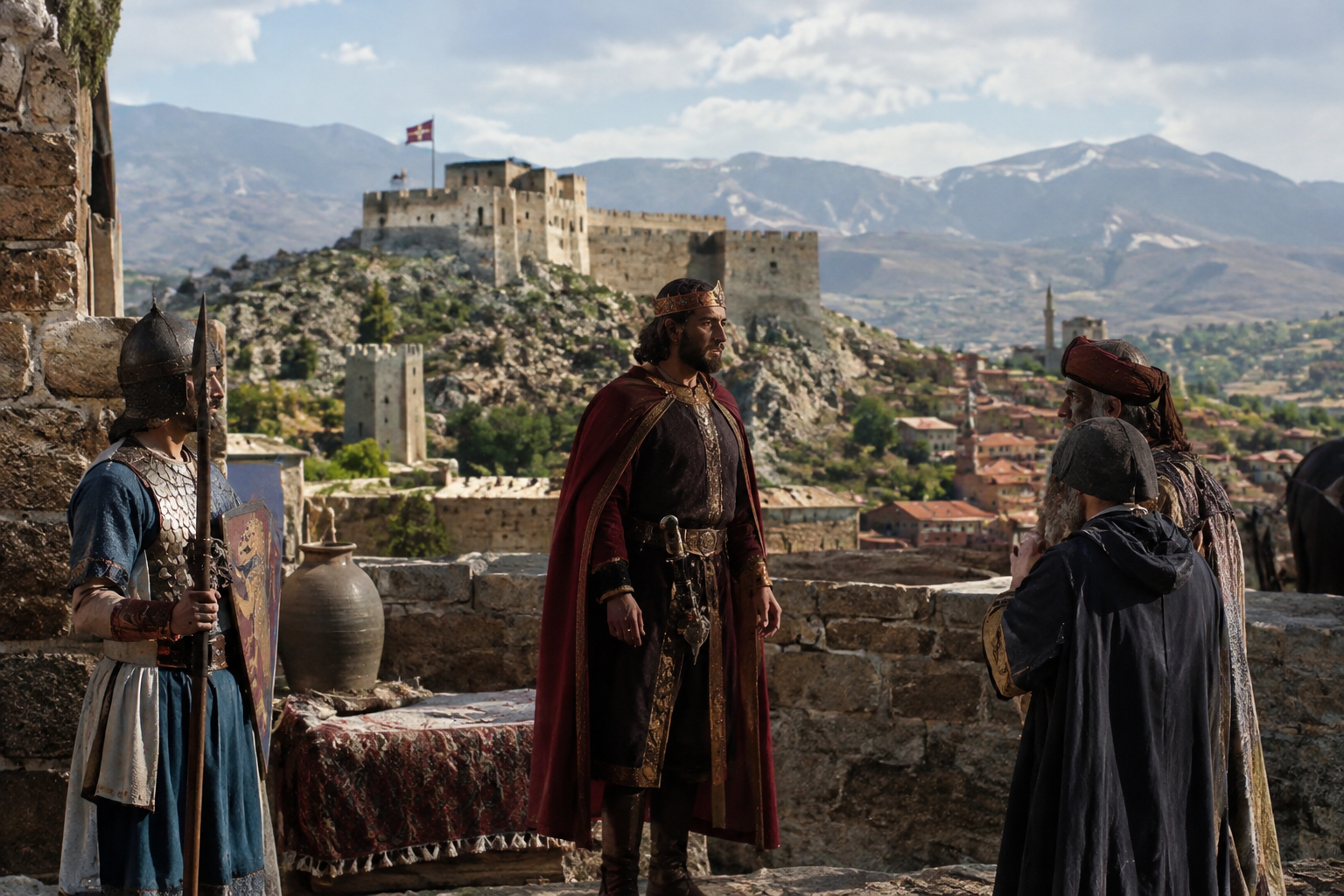
At first glance, sample I14652 looks almost maddeningly modest: one medieval man, dated around AD 1200, from the region of Gaziantep in southeast Anatolia, associated with the Armenian Kingdom of Cilicia. Yet that is exactly why he is interesting. A lineage as specific as J2a1a1a2b2a3b1a1 does not arrive in history with trumpets and banners; it appears in one excavated person at a time, in places where trade, war, pilgrimage, and dynastic politics all overlapped.
That makes Cilician Armenia an unusually good setting for thinking about this paternal branch. Y-DNA follows one direct male line only, not a person's whole ancestry, but in a frontier kingdom perched between Anatolia, northern Syria, the Caucasus, and the eastern Mediterranean, even a single paternal line can open a window onto a much larger historical world.
The broad setting matters here. By around AD 1200, the Armenian Kingdom of Cilicia was not an isolated mountain refuge. It was a political state tied to Armenian migration into Cilicia after the Seljuk advance, but also to Byzantine legacies, Crusader contact, commercial exchange, and the wider traffic of peoples moving through the northeastern Mediterranean.
Gaziantep lies just beyond the Cilician heartland proper, in a zone that has long functioned as a hinge between regions. That means a man carrying J2a1a1a2b2a3b1a1 in this context should not be imagined as representing a single, sealed ethnic story. He lived in a landscape where Armenian rule, local Anatolian populations, Near Eastern connections, and long-established eastern Mediterranean lineages all met.
Research on the region's ancient populations has helped underline just how complex this world was. A large ancient DNA study of the South Caucasus and neighboring regions, published in Science, has been especially important for showing long-term continuity mixed with repeated episodes of contact and reshaping across Armenia, Anatolia, and adjacent zones. Even when one sample stands alone in a narrow subclade, it belongs to that broader historical pattern.
The long string of letters and numbers can look forbidding, but the key is to read it in layers. J2 is a major West Eurasian Y-chromosome branch with deep roots in the Near East and eastern Mediterranean. J2a is one of its best-known subdivisions, and many ancient and modern J2a lineages are associated, at a broad level, with populations of Anatolia, the Caucasus, the Levant, Mesopotamia, Iran, and the Mediterranean world.
But the article haplogroup here is not "J2a in general." It is the much narrower branch J2a1a1a2b2a3b1a1. That distinction is crucial. We should not casually assign to this precise subclade every migration or every historical population ever associated with the wider J2a family. What we can say, more carefully, is that a medieval man linked to the Cilician Armenian sphere carried a very specific paternal descendant branch nested inside a lineage family long familiar in the Near East and eastern Mediterranean.
In practical terms, this kind of result often points not to a dramatic one-off movement, but to persistence through generations in places where male lines could endure while political masters, languages, and imperial borders changed around them. Southeast Anatolia is exactly such a place.
Cilician Armenia has a habit of being flattened in popular imagination into a simple tale of refuge and resistance. In reality, it was a deeply connected kingdom. Armenian elites established power there, but they ruled a mixed landscape and negotiated with Byzantines, Franks, Muslim neighbors, and local communities already embedded in the region's history.
That makes a lineage like J2a1a1a2b2a3b1a1 historically plausible in several overlapping ways. It could represent a paternal line already present in the broader Anatolian-Near Eastern zone before Armenian political consolidation in Cilicia. It could also reflect the kind of regional continuity that survived changes in language, lordship, and confession. The point is not to force one route, but to recognize that this kingdom was built in a zone where old lineages and new political identities regularly met.
Archaeology and genetics have repeatedly shown that frontier societies are rarely biologically simple. They are often conservative in some respects and cosmopolitan in others. Medieval Cilicia, with its ports, hill country, fortified settlements, and strategic roads toward Syria and Anatolia, fits that pattern very well.
The most useful historical frame for I14652 is not a neat national story, but a regional one. Armenian history cannot be disentangled from neighboring eastern Anatolia and the South Caucasus, and neither can their genetic history. Across these lands, populations experienced imperial incorporation, local continuity, resettlement, and long-distance cultural exchange over many centuries.
That matters because a subclade found in a man linked with the Armenian Kingdom of Cilicia may reflect a paternal line shaped by processes much older than the kingdom itself. Medieval Armenian polities inherited people, places, and kin networks formed through Hellenistic, Roman, Parthian, Sasanian, Byzantine, Arab, and Seljuk periods. A Y-line surviving into AD 1200 may therefore be medieval in its documented appearance, but much older in its regional embedding.
There is also a methodological lesson here. With only one supplied ancient individual for this exact branch, caution is not a weakness; it is the whole craft. One man from Gaziantep can securely tell us that this paternal line was present in the Cilician-Armenian world around AD 1200. He cannot, by himself, define the full distribution, social rank, or original homeland of the branch. Still, one securely placed sample is far better than a grand story built on guesswork.
If J2a1a1a2b2a3b1a1 feels at home in this setting, that is because southeast Anatolia in the high medieval period was anything but peripheral. It stood close to the routes connecting northern Mesopotamia, the Levant, the Armenian Highlands, and the Mediterranean coast. Men carrying closely related paternal lines could have been villagers, soldiers, craftsmen, merchants, clergy, or landholders; the Y chromosome alone cannot distinguish among them.
What it can do is anchor paternal continuity in a place where history often emphasizes only upheaval. The Armenian Kingdom of Cilicia was born from displacement and power struggles, but it was sustained by people living ordinary lives inside a connected regional world. Sample I14652 belongs to that quieter history: not merely kings and campaigns, but the inheritance of male lines through centuries of adaptation.
Medieval Mediterranean Diversity
For someone who carries J2a1a1a2b2a3b1a1 today, the strongest ancient signal here is a medieval one: this branch is documented in a man from the Cilician Armenian and southeast Anatolian world around AD 1200. That does not make every modern carrier Armenian, Cilician, or descended from this individual in any recent genealogical sense. It does suggest that this paternal line belonged to the long-lived male population history of the Near East's northern frontier, where Anatolia, Armenia, and Syria met.
In other words, this is a lineage with a properly historical setting: not abstractly "Middle Eastern," but present in a medieval borderland where identities were layered, mobile, and durable all at once.






Comments