Haplogroup J2a1a1a2b2a1b1

– 5 min read


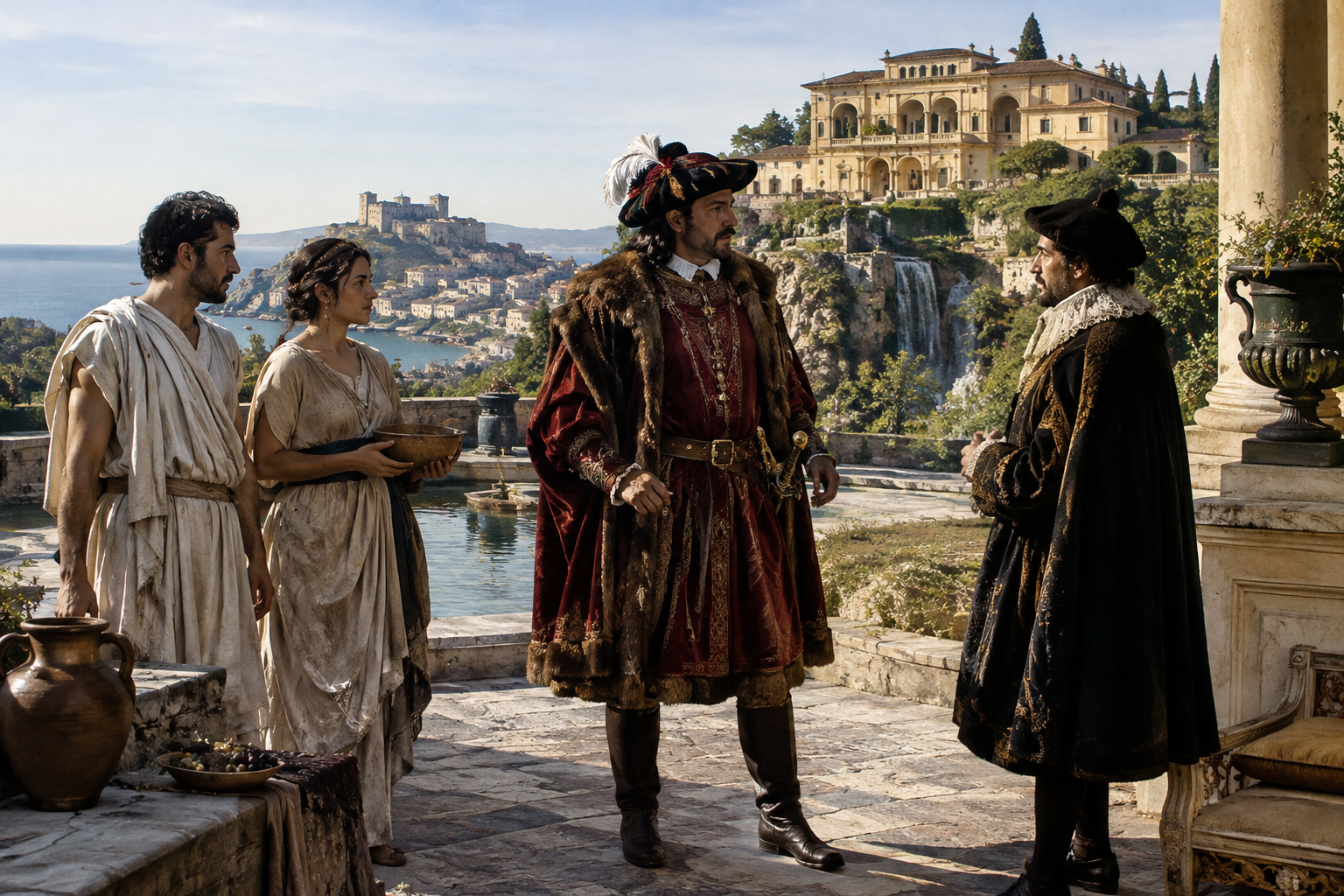
One of the more intriguing appearances of haplogroup J2a1a1a2b2a1b1 in the MyTrueAncestry ancient set comes from a man identified as PER04A, a medieval Hungarian noble associated with the Báthory family and dated to around AD 1500 at Pericei. That is already a striking setting: not a vague prehistoric horizon, but a named noble milieu in the late medieval and early modern Carpathian world, where family memory, landholding, and dynastic identity mattered enormously.
Yet the same branch is also linked in this set to a very different world altogether: I22232 from Kerkouane in Tunisia, dated to around 426 BC and described as Carthaginian, and R969 from Tivoli, dated to about AD 1650 in a Late Renaissance context. Taken together, these samples do not tell a simple tale of one people marching neatly across a map. They suggest something more Mediterranean, and more historically interesting: a paternal line turning up in Punic North Africa, in Renaissance Italy, and in a noble context in Hungary, all places tied together at different times by trade, empire, religion, and elite mobility.
The earliest sample here is I22232 from Kerkouane, a major Punic site on the Cap Bon peninsula of Tunisia. Kerkouane is especially valuable to archaeology because it preserves a Carthaginian town without later Roman rebuilding across the whole settlement. That makes it one of the clearest windows into Punic urban life in North Africa.
In that context, a Y-chromosome line associated here with J2a1a1a2b2a1b1 sits comfortably within what we know of the wider eastern and central Mediterranean world. Haplogroup J2, at broader levels, is often discussed in connection with populations shaped by long histories of farming dispersal, maritime exchange, and urban societies across the Near East and Mediterranean. But it is important to be precise: the article's branch is a very narrow twig on that much larger tree, and one ancient man at Kerkouane does not define the whole paternal profile of Carthage.
What it does show is that this lineage can be placed in a firmly documented Punic setting in the late first millennium BC. Research on Punic and Phoenician-associated populations has repeatedly underlined that these communities were not biologically uniform colonies planted intact from one homeland. They were mixtures, often highly local as well as mobile. That broader picture is reflected in MyTrueAncestry's own discussion of Punic population history here:
An ancient DNA study of Iron Age Mediterranean populations published in Science helped establish just how mixed and connected these worlds could be, especially around the central Mediterranean. Without forcing a direct claim about one individual beyond the information at hand, Kerkouane gives this haplogroup a credible foothold in a cosmopolitan Punic environment.
For anyone carrying J2a1a1a2b2a1b1 today, the key point is that Y-DNA follows one direct paternal line only: father to father to father. It does not capture a person's full ancestry, language, social identity, or ethnicity. What ancient matches can do, though, is place that paternal line in real historical settings.
Here the settings are unusually revealing. Instead of a single cluster from one cemetery or one century, the branch appears in three very different moments: Punic Tunisia, late medieval Hungary, and Late Renaissance Italy. That spread does not prove an unbroken documented family chain between them, but it does suggest a lineage comfortable in the kinds of regions where Mediterranean and European history overlapped most intensely.
The sample PER04A, described as a medieval Hungarian Báthory male nobility individual from Pericei around AD 1500, brings the branch into a world of noble genealogy and frontier politics. The Báthory family rose to major prominence in the Kingdom of Hungary and later in Transylvania, and their history belongs to the turbulent zone between Latin Christendom, the Ottoman frontier, and the shifting aristocratic networks of Central Europe.
That matters because noble lineages are among the places where paternal continuity can sometimes be traced more closely than in ordinary archaeological populations. Still, caution is essential. One noble individual associated with the Báthory milieu is not proof that every historical Báthory man carried exactly the same terminal subclade, nor that everyone genetically matching this branch descends from that family. What it does provide is a documented elite setting in which this paternal line was present.
MyTrueAncestry has covered this family and its genetic investigation in more detail here:
Recent archaeogenetic work on medieval Hungarian elites has made this sort of evidence particularly valuable, because it shows that aristocratic society in the Carpathian Basin was not genetically simple or isolated. A broader study of medieval Hungarian elite burials published in Nature adds useful context for how inherited status, conquest-era legacies, and later noble identities could intersect in the region. PER04A belongs in that larger conversation, even if one should not overstate the exact genealogical reach of a single result.
The third sample, R969, is dated to around AD 1650 and comes from Tivoli Palace in a Late Renaissance setting. Tivoli, just east of Rome, had a long and distinguished life in Italian history, from the ancient town of Tibur to a landscape of villas, ecclesiastical power, and aristocratic display in the early modern period.
Here again, the value of the sample lies less in any grand claim than in the social world it represents. By the seventeenth century, Italy was a crossroads of local continuity and imported prestige, with clerics, nobles, administrators, and retainers moving through courts and palace households. A paternal line found in Punic North Africa centuries earlier, and in Hungarian nobility later on, appearing again in an Italian Renaissance context is exactly the sort of pattern that reminds us how misleading modern national boxes can be when applied to older DNA.
Nor is this out of step with what archaeogenetics increasingly shows for Italy. Roman and post-Roman populations, and later medieval and early modern ones, were shaped by recurrent mobility from many directions. For readers interested in how these continuities and disruptions played out on the peninsula, this related article is especially relevant:
It is tempting to pin a lineage like J2a1a1a2b2a1b1 to one neat origin story: Phoenician, Roman, Italian, Balkan, noble, merchant. The evidence here resists that sort of tidiness. Its ancient appearances belong instead to connected historical systems: Punic seafaring and settlement, the long afterlife of Mediterranean mobility, and the elite networks of Central and Southern Europe.
That makes this haplogroup particularly interesting from a public-history perspective. It does not belong to one famous migration story alone. Rather, it appears in places where cities, courts, ports, and ruling houses drew people together. The branch may be narrow, but the worlds in which it appears are broad ones.
There is also a regional logic to the spread. Tunisia, Italy, and Hungary were not isolated compartments. Carthaginian exchange tied North Africa into Sicily and beyond; Roman and post-Roman movements reworked those links; and by the late Middle Ages the political map of Central Europe had become deeply entangled with Adriatic, Italian, and Mediterranean currents. A paternal lineage need not have moved in one dramatic leap to end up represented in all three spheres.
If this is your Y-DNA branch, the strongest supported takeaway is not a promise of descent from a single royal house or ancient people. It is something subtler and, in many ways, more revealing: your direct paternal line has ancient company in some of the most connected societies of the Mediterranean and Central European worlds, from Punic Tunisia to noble Hungary and Renaissance Italy. That is the kind of evidence that points toward long participation in corridors of movement, exchange, and inherited status rather than a single isolated homeland.




Comments