Haplogroup J2a1a1a2a2a2

– 5 min read


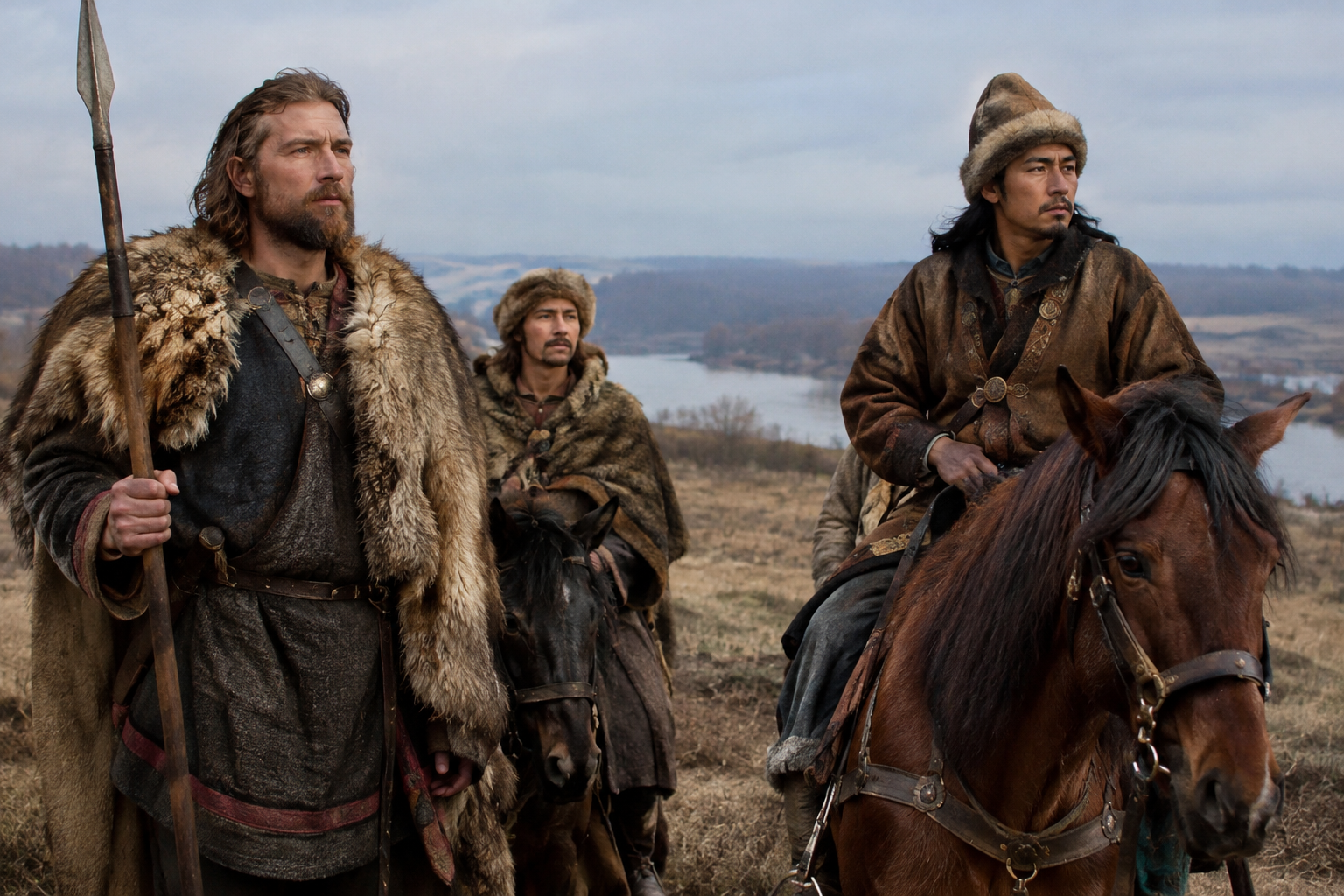
At Rakoczifalva in Hungary, one man dated to around AD 650 carries an unexpectedly long and specific paternal label: J2a1a1a2a2a2. He appears in the record as sample RKO019, from the Germanic Migration Period. That combination is what makes him so interesting. J2 is a lineage more often discussed in connection with the eastern Mediterranean, the Caucasus, and western Asia, yet here it turns up in a post-Roman community on the Great Hungarian Plain, in a world usually narrated through Goths, Gepids, Lombards, Avars, and other mobile powers of the 5th to 7th centuries.
Another ancient individual linked to the same haplogroup, CGG022004, comes from Zaragizh in Russia and is dated to around AD 425, with an Alan Migration Period context. Put those two finds side by side and the immediate lesson is not that one simple migration route has been solved. It is that this paternal branch belonged to the mixed and shifting human landscape between the steppe and central Europe. Y-DNA traces one direct male line, not a person's whole ancestry, but even one line can be revealing when it appears in precisely these frontier settings.
The first thing to say is that J2a1a1a2a2a2 is a very narrow twig on the larger Y-chromosome tree. The broader haplogroup J2 has a long and complex history across western Eurasia, but that does not mean every tiny downstream branch followed the same path or belonged to the same population in every era. With ancient DNA, the safe approach is to stay close to the excavated people we actually have.
In this case, the branch appears in two Migration Period-era settings: one Alan-associated burial in the North Caucasus region, and one individual in early medieval Hungary. That is already enough to suggest a paternal line moving within, or surviving inside, the corridors that linked the Caucasus, the Pontic-Caspian world, and the Carpathian Basin. It is not a royal pedigree, not a tribal badge, and not proof of language. It is a clue about male-line presence in regions where populations were visibly on the move.
A broader ancient DNA study of the Carpathian Basin in and after the Hunnic period has helped show just how varied these communities were, with people of quite different ancestries buried within overlapping historical horizons. That wider context matters for understanding why a J2 branch in Hungary is not an oddity to be dismissed, but part of a genuinely cosmopolitan post-Roman landscape. See this ancient DNA research on the region for the larger population framework.
Sample RKO019, dated to around AD 650 at Rakoczifalva, belongs to a period when the Carpathian Basin was anything but isolated. Roman power had long since withdrawn, but the region was no backwater. It was a zone of settlement, resettlement, alliance, conquest, and coexistence, where material culture and biological ancestry do not always line up neatly with the names used by chroniclers.
Calling this context "Germanic Migration Period Hungary" is useful as a historical shorthand, but it should not tempt us into imagining a genetically uniform Germanic people. The value of RKO019 lies precisely in the opposite direction. A paternal lineage of J2a1a1a2a2a2 suggests that men with lineages more typical farther to the southeast or east could become part of communities in the Hungarian Plain during the early medieval centuries.
That does not tell us whether this man identified with a Germanic-speaking group, lived under Avar rule, had recent ancestors from the steppe, or descended from older populations already present in the region. Ancient DNA rarely hands over such tidy answers. What it does show is that male-line diversity in these communities was real, and that the political map drawn from texts cannot simply be pasted onto the genetic one.
The second key sample, CGG022004, comes from Zaragizh in Russia and is dated to around AD 425, identified in an Alan Migration Period setting. This is historically important because the Alans sit at a crossroads of steppe and Caucasus history. Iranian-speaking and deeply entangled with the Sarmatian world, Alan groups moved, fragmented, and reappeared across a huge geographic zone, from the North Caucasus to the western Roman world.
Finding J2a1a1a2a2a2 in such a context is plausible and informative. The North Caucasus has long been a meeting ground where steppe lineages, Caucasian lineages, and lineages with deeper links to the Near East could interact. An Alan-associated burial carrying this branch fits that frontier logic rather well: not because J2 automatically equals "Alan," but because Alan-period communities were themselves products of mixture, mobility, and local continuity.
A more recent preprint on ancient individuals from the broader region provides useful context for these northern Caucasus and migration-era interactions, even where every fine-grained haplogroup detail still requires caution. The wider significance is the regional setting: a contact zone where paternal lines like this one could persist, move, and be folded into new identities. The relevant research trail can be followed here: regional ancient DNA work on these populations.
If we place Zaragizh and Rakoczifalva on the map, a historically familiar corridor begins to emerge. The North Caucasus and the Pontic steppe fed people, goods, and military followings westward for centuries. Huns, Alans, Sarmatian descendants, Goths, and later Avar-linked groups all operated in connected worlds, even if their identities changed over time and from place to place.
That is the most sensible way to read this haplogroup's present evidence. Not as a single ethnic signature, but as a paternal line attested in the very belt of territory where Roman, steppe, and Caucasian histories collided. J2a1a1a2a2a2 may have reached the Carpathian Basin through any number of historical processes: direct migration from the east, incorporation into mixed military groups, movement through the Caucasus, or survival within already diverse provincial and post-provincial populations.
What makes the pair of samples valuable is that they narrow the discussion from the immense and rather vague history of haplogroup J2 to one specific branch found in real people of Late Antiquity and the early Middle Ages. That is how ancient DNA becomes historically useful: not by producing grand myths, but by pinning a lineage to actual times and places.
For someone researching a modern paternal line in J2a1a1a2a2a2, these ancient matches point toward a story of connectivity rather than isolation. So far, the branch appears in two historically charged settings: an Alan-period individual in the wider Caucasus world, and a Migration Period individual in Hungary. That is a small sample, but it is a meaningful one. It places the lineage inside the traffic of late antique Eurasia, where communities were assembled and reassembled across old imperial borders.
In other words, this is not just a lineage of one region or one people in the evidence we currently have. It is a lineage found where worlds met.
The clearest insight from J2a1a1a2a2a2 is its appearance in the human middle ground between the Caucasus and the Carpathian Basin during the Migration Period. With CGG022004 at Zaragizh and RKO019 at Rakoczifalva, the branch is tied not to legend but to excavated people living in a famously mixed age. For descendants exploring this paternal haplogroup today, that is the strongest responsible takeaway: your direct male line belongs to a history of movement, contact, and frontier society across late antique Eurasia.






Comments