Haplogroup J1a2b1b2c1

– 6 min read


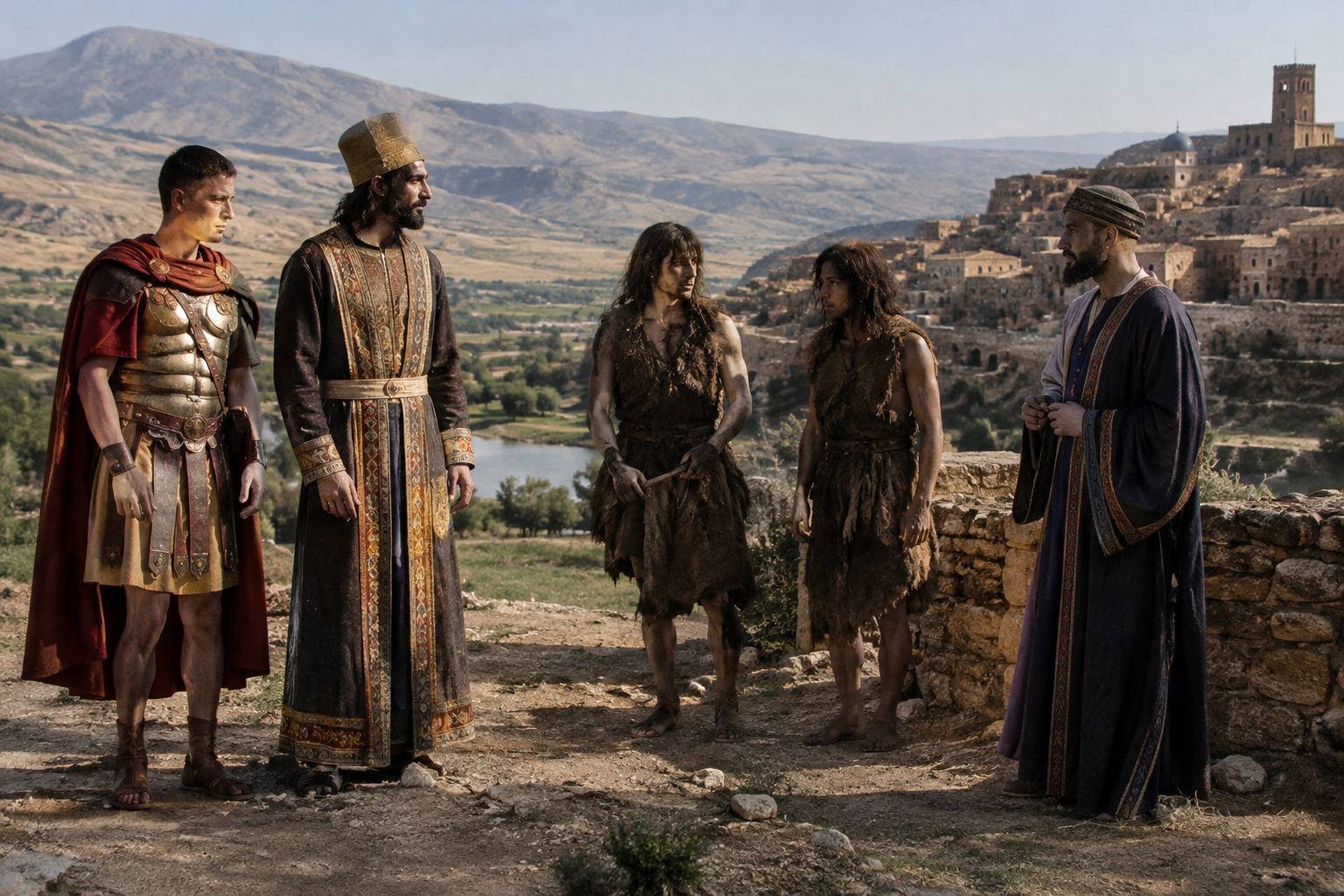
Some Y-DNA haplogroups announce themselves in the historical record with a trumpet blast. Others appear more obliquely: in a Bronze Age cemetery in Armenia, an Iron Age burial in Iran, a Byzantine-era individual from southeast Anatolia, and then, unexpectedly, in the long political afterlife of kingdoms further west. Haplogroup J1a2b1b2c1 belongs to that second category. It is interesting not because it can be turned into a tidy slogan, but because it sits in a region of the Y-chromosome tree deeply bound up with the ancient Near East, the South Caucasus, and the eastern Mediterranean world.
As ever with Y-DNA, a note of method comes first. A Y-haplogroup traces one direct paternal line only: father to father to father. It does not describe a person's full ancestry, culture, language, or identity. Nor does sharing a haplogroup prove close kinship. Still, when ancient DNA finds related paternal branches in burials spread across centuries and landscapes, it gives us something rare: a way to watch one thread of male-line history persist through changing kingdoms, empires, and frontiers.
J1a2b1b2c1 is a very specific downstream branch within the broader Y-DNA haplogroup J1. That larger haplogroup has long been associated with parts of the Near East and adjoining regions, but one must be careful here: the history of a broad parent lineage is not automatically the history of every narrow sub-branch beneath it. For a lineage as specific as J1a2b1b2c1, the most responsible approach is to lean heavily on the ancient samples we actually have and then place them in their wider archaeological setting.
What those samples suggest is a story centered not on one modern nation or one neat ethnic label, but on the corridor running between the South Caucasus, northern Mesopotamia, northwest Iran, and the eastern Mediterranean. This was never a quiet backwater. It was a zone of fortified hills, trading routes, imperial borderlands, and old farming landscapes repeatedly reorganized by Bronze Age polities, Iron Age kingdoms, Rome, and Byzantium.
Explore Ancient DNA and Archaeogenetics
The earliest anchors in this story come from the Dzhoghaz Cemetery in Bronze Age Armenia. Two individuals, I14341 dated to 2450 BC and I14340 dated to 2385 BC, place this paternal line, or a very closely related one, in the South Caucasus at a strikingly early date. That matters because the Bronze Age Caucasus was one of the great hinge-regions of western Eurasia. Ideas, metals, livestock, and people moved through it in several directions at once.
A cemetery is not a nation, and two men do not define an entire culture. But these burials do show that this paternal branch was already part of settled human communities in the Armenian highland world more than four millennia ago. In plain terms: by the mid third millennium BC, this was not some fleeting newcomer glimpsed once and lost. It had a place in the social landscape.
That in turn fits the broader archaeological impression of the South Caucasus as a region of continuity mixed with contact. Communities here were linked southward toward Mesopotamia, eastward toward the Iranian plateau, and westward into Anatolia. A paternal lineage found in Bronze Age Armenia could therefore remain local, move gradually, or do both at different times. Ancient DNA is useful precisely because it stops us pretending there was only one route.
Move forward many centuries and the same broad historical zone still produces evidence. At Hasanlu in Iran, the sample I4354 from the Hasanlu Period, dated 630 BC, offers an Iron Age glimpse of this lineage in northwest Iran. Hasanlu is famous because it belonged to a world of fortified settlements and violent upheaval, perched between larger powers and regional traditions. In that setting, a Y-line like this reminds us that political collapse does not erase population history overnight. Kingdoms fall faster than paternal lineages do.
Then there is I4533, from Mardin Southeast Anatolia, dated 829 AD in the Byzantine Period. Mardin sits in one of those places historians adore because everyone wanted it and no one entirely owned it for long: a plateau edge above the Mesopotamian plain, connected to Syriac, Armenian, Arab, Anatolian, and Byzantine worlds. Finding this lineage there in the early medieval period suggests persistence across a very long span in the northern Fertile Crescent and adjacent uplands.
Taken together, the Armenian, Iranian, and Anatolian samples do not prove a single uninterrupted family line. They do, however, point to a durable regional presence for this paternal ancestry across thousands of years.
Read 5,000 Years of South Caucasus DNA
One sample widens the geographical frame further west: R128 from Casale del Dolce, dated 200 AD in the Roman Empire. Here we must resist the temptation to over-tidy the evidence. A Roman-period presence in Italy does not mean this haplogroup was "Roman" in any ethnic sense. What it does show is that paternal lines rooted further east could appear within the imperial Mediterranean.
That is hardly surprising once one remembers how the Roman Empire functioned. Soldiers, merchants, administrators, slaves, pilgrims, and craftsmen moved constantly. Italy in the imperial period was not genetically sealed off from the eastern Mediterranean or the Near East; far from it. A sample like R128 is therefore best read as evidence of connectivity. Rome did not invent movement, but it made movement routine on a grand scale.
Readers interested in this broader setting may enjoy MyTrueAncestry's discussion of Roman mobility and ancestry in Iberia, because it shows how imperial systems could leave genetic traces far from their points of origin.
Explore Roman Hispania's Genetic Legacy
So how does a paternal line rooted in the ancient Near East and South Caucasus speak to later medieval history? Not by proving a neat descent from a Bronze Age grave to a crowned head. That would be absurd. It speaks instead through geography, continuity, and the old fact that noble houses ruled over populations whose histories were already ancient.
The noble association supplied here is the House of Capet, linked in this context to the Palace of the Kings of Navarre at Olite. The Capetians, in their many branches, loom large in the political history of medieval western Europe. But genetics should not be used lazily here. A historical association with a haplogroup is not proof that every Capetian prince, cousin, or cadet carried the same exact Y-line, and nothing in the supplied material justifies claiming direct descent from the ancient individuals above.
What is worth noticing is the setting: Navarre, northern Iberia, and a royal residence raised on a site whose history stretched back to the Roman period. That layered past is exactly what makes castles and palaces so useful to historical imagination. They stand on old ground. The dynasties are medieval or early modern; the landscapes beneath them are far older.
Olite began as a Roman site, later became a modest fortress, and was transformed in the late 14th and early 15th centuries by King Charles III of Navarre and Queen Eleanor of Castile into one of the most splendid Gothic royal residences in Europe. The description is wonderfully extravagant: not a single blockish fortress, but a complex of courtyards, towers, chapels, gardens, and galleries built to advertise power and pleasure at the center of the Navarrese court. After Navarre was drawn into the orbit of larger Spanish kingdoms, the palace declined, suffered severe fire damage during the Peninsular War, and was later restored in the 20th century.
There is a nice historical irony here. A Y-haplogroup such as J1a2b1b2c1 can be tracked through burials in Armenia, Iran, Anatolia, and Roman Italy, while a palace like Olite shows how later rulers curated memory in stone. One is biological inheritance, narrow and paternal. The other is dynastic inheritance, political and architectural. They are not the same thing, but together they remind us that the medieval world sat atop very old human foundations.
Discover the Royal House of Capet
The most sensible conclusion about J1a2b1b2c1 is also the most interesting. This is not a lineage that belongs to one simplistic historical label. Its evidence points instead to a durable paternal presence across the South Caucasus, northwest Iran, southeast Anatolia, and the wider Roman Mediterranean. The ancient samples I14341, I14340, I4354, I4533, and R128 together sketch a long arc of continuity and movement through some of the most connected regions of the ancient world.
For readers with roots in Iberia, the Mediterranean, or the Near East, that may be especially intriguing. Medieval kingdoms such as Navarre did not emerge in an empty world. They inherited landscapes shaped by Roman administration, earlier migration, long-distance trade, and populations whose paternal lines could stretch far beyond the boundaries of later states. Genetics cannot collapse all that into a family legend, but it can make the deep background harder to ignore.
And for those interested in the Iberian side of that story, especially the mix of local continuity and incoming influences, there is plenty more to explore in the MyTrueAncestry community.
See Ancient DNA from Medieval Spain
If you carry haplogroup J1a2b1b2c1, or a nearby branch, your Y-DNA preserves one narrow paternal signal from a much larger family story. MyTrueAncestry can help place that signal beside ancient individuals and historical populations, offering context rather than fairy tales. You may find genetic similarities to people from ancient Armenia, Iran, Anatolia, or Roman-era communities, though such matches do not by themselves prove direct descent or noble status.
That is the real pleasure of this work: not pretending DNA has solved history, but letting it reopen old questions in wonderfully concrete ways.






Comments