Haplogroup J1a2a1a2d2b2b2c4
– 4 min read


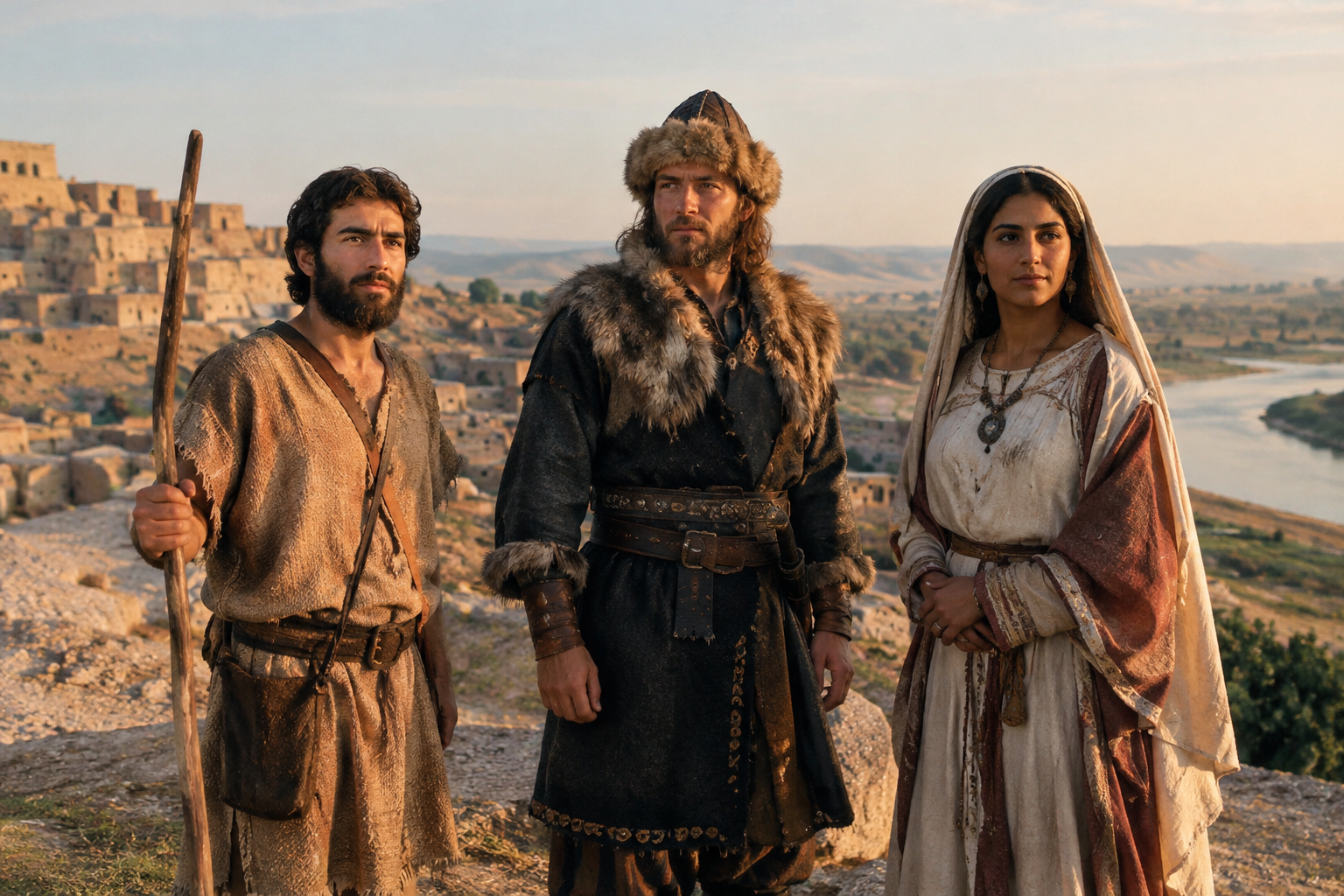
At Szeged-Fehert in early medieval Hungary, one male burial dated to around AD 700 stands out for a very modern sort of reason: it helps place the Y-DNA haplogroup J1a2a1a2d2b2b2c4 in a real archaeological landscape. The individual is catalogued as SZF-26, from an Avar-period cemetery in the Carpathian Basin. That matters because this is not a lineage turning up in only one cultural world. In the evidence assembled here, it appears in a strikingly wide arc that reaches back into the Bronze Age Levant.
The three ancient men associated with this branch come from very different settings: Avar Hungary, Bronze Age Jordan, and ancient Alalakh in the Amuq Valley. That does not mean they belonged to one people, spoke one language, or formed one continuous dynasty. Y-DNA follows only one direct paternal line. But it can still be historically revealing, especially when the same narrow paternal trail appears at sites linked by trade, movement, and long-term contact across the Near East and into southeastern Europe.
SZF-26, dated to about AD 700, belongs to the Avar-period population of Hungary. The Avar Khaganate is often imagined in rather blunt terms, as if it were simply a steppe power dropped into central Europe. Ancient DNA has made that picture much more interesting. Avar-period cemeteries include people with very different ancestral backgrounds, reflecting mobility, mixture, and the layered social world of the post-Roman Carpathian Basin.
In that context, a paternal line connected with J1a2a1a2d2b2b2c4 is a reminder that Avar-period communities were not genetically uniform and cannot be reduced to a single origin story. Some lineages in these cemeteries point eastward, others toward local European or more southerly West Eurasian connections. Research on the region has repeatedly shown that early medieval Hungary was a meeting ground rather than a sealed ethnic box, a point also visible in broader discussions of elite and non-elite burials in the basin.
That does not make SZF-26 a migrant freshly arrived from the Levant, nor does it prove an unbroken family memory stretching back two millennia. What it does show is that by the Avar period, this paternal branch had become part of the human mosaic of the middle Danube. For anyone carrying this haplogroup today, that is a useful corrective to simplistic labels: lineages travel through empires, frontier zones, and mixed communities.
The older evidence is especially valuable because it places the branch much farther south and much earlier. At Baqah in Jordan, the individual I3705, dated to around 1400 BC, links this paternal line to the Bronze Age southern Levant. Here we are in a world of towns, agricultural hinterlands, and regional exchange networks shaped by larger powers around them, from Egypt to Syria and Mesopotamia.
Even without inventing details about the burial itself, the date and place are enough to make I3705 important. Bronze Age Jordan was not an isolated backwater. It sat within a corridor of movement running north and south through the Levant and east-west toward Arabia and Mesopotamia. A Y-line found here and again farther north fits a pattern of long-lived regional connectivity rather than a neatly bounded tribal history.
An ancient DNA study of Near Eastern populations published in Cell helped show just how dynamic these Bronze Age societies were, with substantial continuity in some places but also clear evidence of interaction across neighboring regions. That wider background matters for interpreting a branch like J1a2a1a2d2b2b2c4: not as the badge of a single ancient ethnicity, but as one paternal thread moving through interconnected Levantine populations.
The third key sample, ALA026, comes from ancient Alalakh and is dated to about 1685 BC. Alalakh, in the Amuq Valley of today's southern Turkey near the Syrian border, was one of the important urban centers of the Middle and Late Bronze Age northern Levant. It was a place of diplomacy, trade, craft production, and political entanglement, very much plugged into the wider world of Syria, Anatolia, and Mesopotamia.
That setting makes ALA026 especially revealing. If Baqah gives us a southern Levantine point, Alalakh offers a northern one. The appearance of this paternal branch in both places suggests that its ancient history belongs within the broader human landscape of the Levant and its neighboring regions, not in a single isolated pocket. Urban centers such as Alalakh drew in people, ideas, and goods; their cemeteries can preserve exactly the kind of mixed yet regionally grounded histories that Y-DNA sometimes captures.
Researchers investigating Alalakh and its population history in Current Biology emphasized mobility and local continuity as overlapping realities rather than opposites. That is a useful frame here. A lineage can persist in a region for centuries while also appearing in people whose lives were shaped by movement between cities, valleys, and political spheres.
The exact label J1a2a1a2d2b2b2c4 is a very fine-grained terminal branch, much narrower than the broader haplogroup J1. That distinction matters. Broad J1 is widespread and historically deep; this particular subclade is a much smaller twig on that tree. The ancient evidence here should therefore be read carefully. It supports association with a paternal line present in Bronze Age Levantine settings and later seen in an early medieval Avar-period context, but it does not license grand claims about one exclusive homeland or one named biblical, ethnic, or royal descent.
Still, the pattern is historically meaningful. The oldest samples in this set are not from Arabia, the Caucasus, or western Europe, but from the Levantine world of Bronze Age Jordan and Alalakh. Then, much later, a related paternal signal appears in the Carpathian Basin inside a politically and genetically mixed early medieval society. In other words, the story here is less about a single migration event than about long-distance historical connectivity.
Put the three men together and a clear picture begins to emerge. ALA026 at Alalakh and I3705 at Baqah place this branch in two different parts of the Bronze Age Levant, separated by geography but joined by exchange and shared historical horizons. SZF-26 then shows that a descendant branch of that paternal heritage was present, by around AD 700, in one of early medieval Europe's most complex frontier societies.
For a tester who belongs to J1a2a1a2d2b2b2c4, that is the most grounded takeaway. Your direct paternal line is associated, in the ancient record we have so far, with the interconnected worlds of the Bronze Age Levant and with later movement into the mixed populations of the Carpathian Basin. It is a lineage that seems to have travelled through cities, corridors, and empires rather than remaining locked within a single corner of the map.






Comments