Haplogroup I2c2b2

– 6 min read


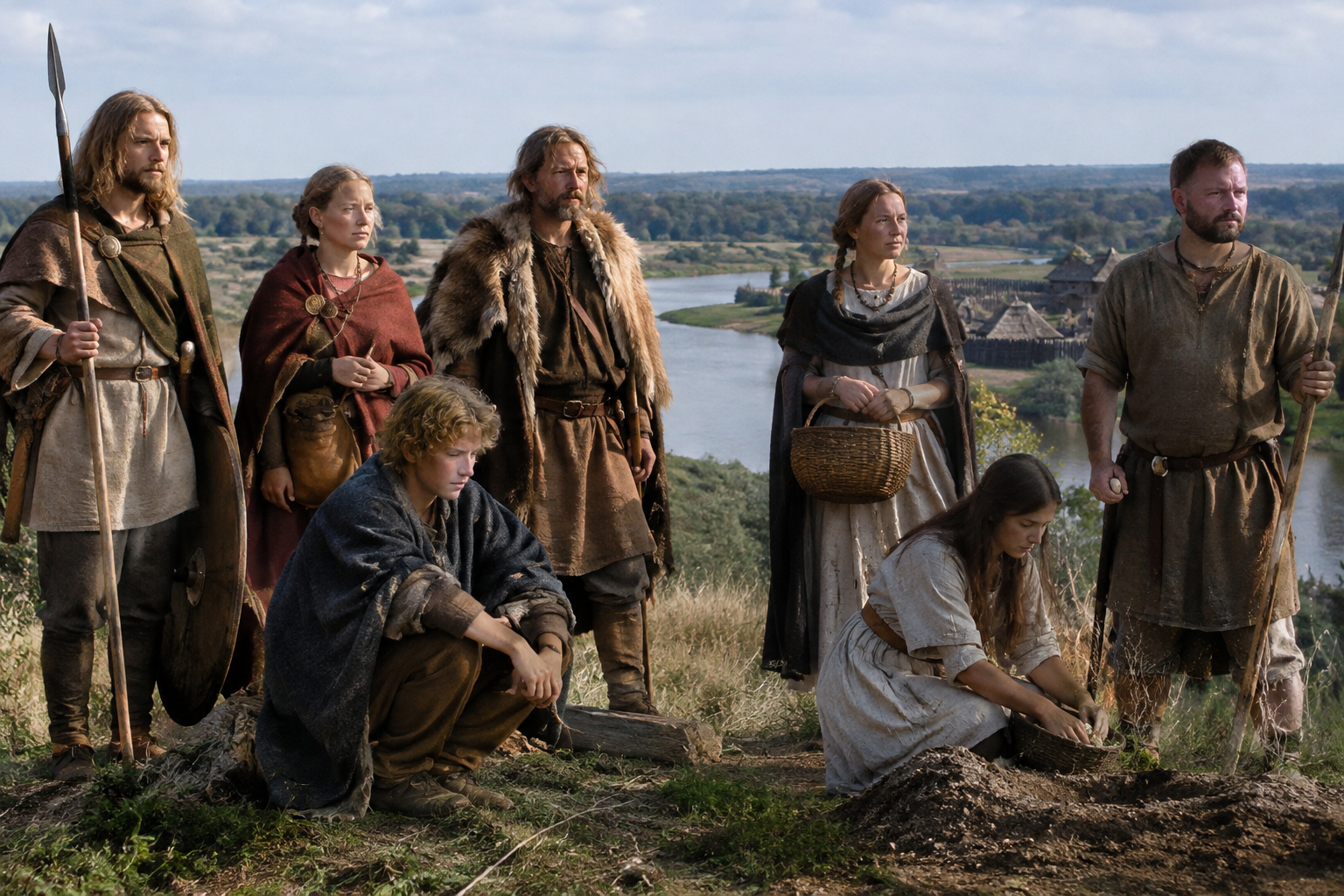
Some Y-DNA haplogroups come wrapped in familiar historical labels. Others are more elusive, and that is part of what makes I2c2b2 so interesting. It belongs within the broader Y-chromosome haplogroup I, one of the old paternal lineages of Europe, but this particular branch does not lend itself to neat slogans about a single people, kingdom, or migration. Instead, it appears in a scattering of ancient contexts that force us to think historically rather than romantically: Mesolithic Scandinavia, Bronze Age central Europe, and the late Roman frontier world of the Alemanni.
That matters because Y-DNA traces only one narrow line of ancestry: the direct paternal line, father to son to son. It does not describe a person's whole ancestry, culture, language, or identity. But when ancient DNA finds the same broad paternal line in very different times and places, it gives us a rare way of watching male lineages persist, move, and sometimes disappear from view, long before surnames, coats of arms, or castle records enter the story.
For readers interested in the bigger archaeological picture of early paternal lineages, MyTrueAncestry's wider introduction to the field is well worth exploring.
With a lineage as specific as I2c2b2, caution is essential. We should not simply project the entire history of haplogroup I2 onto this smaller branch. Even so, the available ancient samples suggest that its story belongs broadly to the long and complicated history of European paternal lines, especially among populations living across the north and center of the continent.
One striking early anchor is I0012, from Neolithic Kanaljorden Motala Sweden, dated 5710 BC. Motala is famous in European prehistory because it captures a world before the great political maps of Europe existed at all: communities of foragers living in northern landscapes of lakes, woodland, and waterways. A Y-line appearing in that setting reminds us that some paternal branches now seen as obscure may once have belonged to people who were entirely at home in post-Ice Age northern Europe.
Then there is I0116 from Bronze Age Esperstedt Germany, dated 2100 BC. By that date, central Europe was already a zone of movement, exchange, and social change. Metalworking, long-distance contacts, and new burial customs were transforming communities. A paternal lineage linked to I2c2b2 in that world hints not at isolation, but at survival through upheaval. If the Motala sample evokes deep northern antiquity, Esperstedt suggests that related male lines were still present in central Europe after the great demographic shifts of later prehistory.
That broader transition from forager worlds into later prehistoric Europe makes a useful comparison with another MyTrueAncestry article on Scandinavian population change.
Read about the Mesolithic-Neolithic transition
The most vivid cluster in the supplied evidence comes from Basel-Waisenhaus in Switzerland, where several individuals are listed as Alemanni burials dating to 387 AD. These include KH201125, KH201125a, KH201125b, KH201110, and KH201127.
This is a marvellous reminder that the Roman frontier was not a clean line separating one world from another. By the late fourth century, the Upper Rhine region was a contact zone full of military service, raiding, settlement, alliance, and intermarriage. The label "Alemanni" itself is useful historically, but it should not mislead us into imagining a genetically uniform tribe marching in lockstep across Europe. Ancient cemeteries repeatedly show that such frontier communities were mixed, local, mobile, and socially layered.
So what do these Basel-Waisenhaus individuals contribute to the story of I2c2b2? Above all, they place this paternal branch, or a closely related assignment, into a very specific historical landscape: the late Roman-Germanic borderlands of the fourth century AD. That does not prove that I2c2b2 was "an Alemannic haplogroup," still less that everyone called Alemanni carried it. But it does show that this paternal line participated in the world of post-Roman central Europe, where identities were political and local as much as biological.
Readers interested in how ancient DNA complicates old ideas about Gothic and other so-called barbarian peoples may enjoy this related piece.
Discover late antique Gothic diversity
Not every haplogroup lends itself to a grand arrow on a map, and perhaps that is for the best. The evidence here suggests a paternal lineage with roots in ancient Europe and appearances stretching from Scandinavia into central Europe across thousands of years. That is already interesting enough.
A careful reading would be this: lineages connected to I2c2b2 seem to have been present among early northern European populations, persisted into Bronze Age central Europe, and later appear in a late Roman frontier context in the Upper Rhine region. That pattern may reflect long-term regional continuity mixed with repeated episodes of migration and cultural change. What it does not allow us to say is that one simple ethnic label explains the entire history of the branch.
Ancient DNA is especially good at puncturing those older fantasies. It shows paternal lines surviving political collapses, turning up in unexpected cemeteries, and crossing the boundaries historians once drew too sharply between "forager," "farmer," "barbarian," and "kingdom." If you want a wider view of how paternal and maternal patterns can shift differently over time, this comparison from southeastern Europe is particularly useful.
Explore shifting paternal lineages
And then, suddenly, the story turns east to Georgia - not because ancient DNA lets us draw a direct line from Motala or Basel to a named medieval house, but because noble families preserve something different: historical memory tied to land, service, and architecture.
The supplied family here is the House of Tsitsishvili, associated with Tsitsishvili Castle, also called Tsitsishvilebis Tsikhe Darbazi, in the village of Tsitsamuri near Mtskheta in eastern Georgia. The family were important local aristocrats for centuries, and the site belonged to the wider history of Kartli, where nobles had to balance loyalty to kings, rivalry with neighboring elites, and the pressure of invading empires.
This is exactly the kind of place that historians love because it is not just a fortress and not just a house. The description suggests a fortified residence with a domestic, hall-like aspect implied by the word darbazi. In other words, this was a seat of family power, but also of household life: decision-making, alliance-building, local authority, and display. Its main development in the late Middle Ages and early modern period places it in a Georgia that was politically resilient but persistently under strain.
We must be careful here. A historical association between I2c2b2 and the Tsitsishvili family does not prove that every member of the house carried that Y-DNA line, nor do the ancient European samples prove direct descent from those medieval nobles. The responsible point is subtler and, to my mind, more interesting: paternal lineages can persist across very long spans of time, while the written record only begins to catch them much later, when families become visible through titles, estates, and castles.
If you would like to follow that Georgian noble context further, MyTrueAncestry has a dedicated article on the family itself.
Read about the House of Tsitsishvili
Ruined though it is today, Tsitsishvili Castle still matters because castles are one of the ways the medieval and early modern world fixed families into place. Ancient DNA gives us scattered men in graves: a forager at Motala, a Bronze Age burial at Esperstedt, several late Roman individuals at Basel-Waisenhaus. A castle gives us something else entirely - a documented social landscape in which lineage, property, memory, and political status were made visible.
Near old Mtskheta, one of Georgia's most historically resonant regions, the remains of Tsitsishvili Castle speak of noble households living in a contested world. They do not provide genetic proof. They provide context: the setting in which paternal descent could become part of legal inheritance, aristocratic identity, and regional power.
That is the real meeting point of genetics and history. DNA can show that a paternal branch existed in Europe across long spans of time. Historical records and castles show how, much later, some lineages became socially legible and politically important. The two kinds of evidence are not rivals. They answer different questions.
I2c2b2 is a good example of why ancient DNA is so valuable. It resists simplistic storytelling. Its known ancient appearances suggest depth, endurance, and geographical spread, but not a single tidy ethnic script. Instead, it points to a paternal lineage participating in multiple chapters of European history: northern forager communities, Bronze Age central Europe, and the mixed frontier society of the late Roman world.
For modern testers, that is both humbling and exciting. A Y-DNA match to a haplogroup such as I2c2b2 does not make someone "Alemanni," "Swedish hunter-gatherer," or Georgian nobility. What it does offer is a disciplined, evidence-based way to place one narrow paternal line within the very long human past.
That, really, is the pleasure of it. Not fantasy descent from every castle on the horizon, but the chance to see how one paternal branch can flicker into view in ancient burials, then disappear again into the ordinary business of history until later families, places, and ruins bring lineage back into focus.
If your Y-DNA belongs to I2c2b2 or a related branch, MyTrueAncestry can help you explore how your paternal line fits into the wider story of ancient Europe and later historical worlds. Ancient DNA comparisons can reveal fascinating similarities to archaeological samples and past populations, even though they do not by themselves prove direct descent from a particular ancient individual or noble family.
Upload your DNA and see whether your results connect with the kinds of ancient people discussed here - from Mesolithic Scandinavia to late Roman frontier burials and the historical landscapes of noble houses.






Comments