Haplogroup I2a2a1a2a1a1

– 5 min read


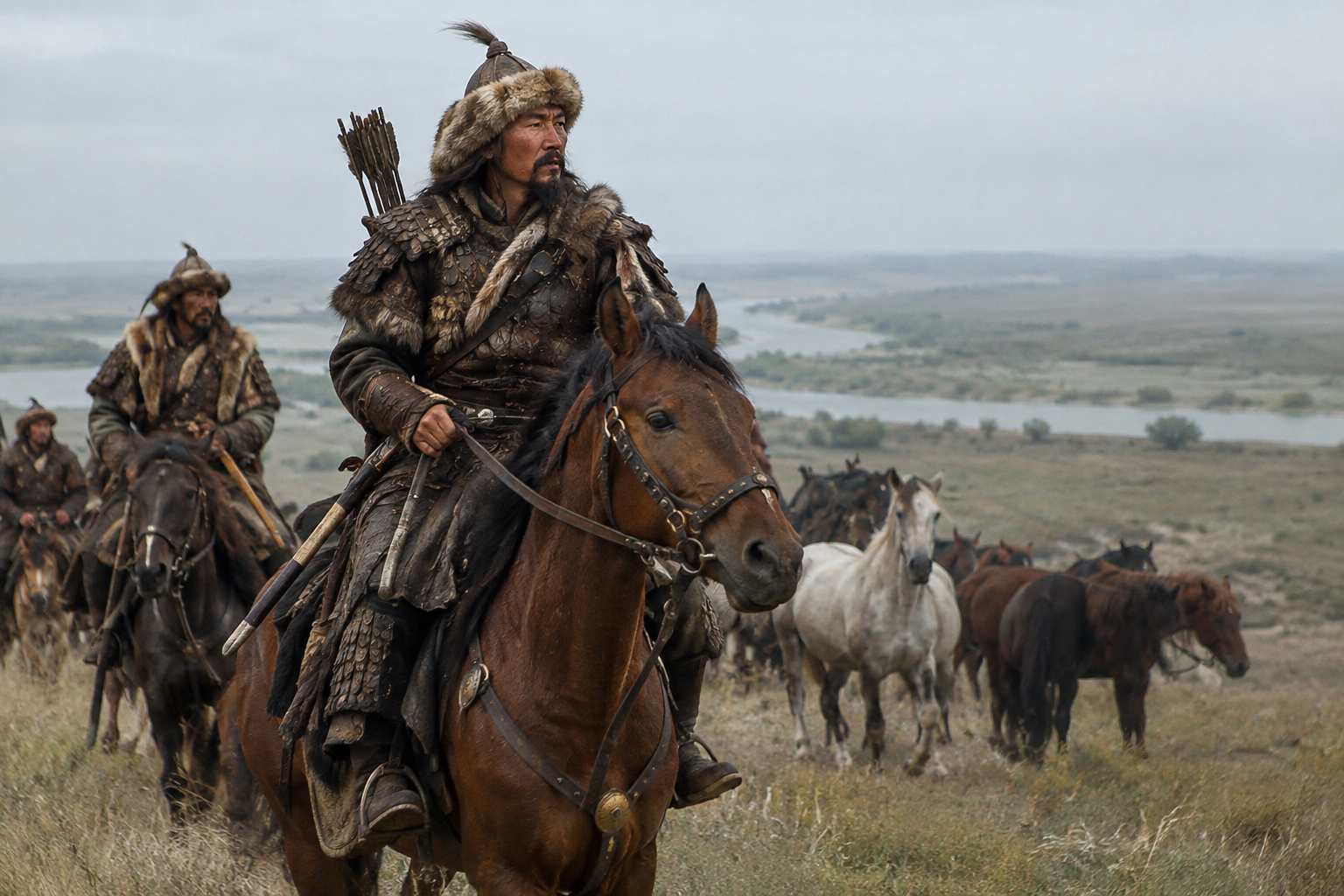
One of the clearest ancient anchors for the Y-DNA haplogroup I2a2a1a2a1a1 in this dataset is an individual identified as HNF054, dated to around AD 450 and described as a Hun-period invader from the Danube-Tisza region of Hungary. That is already an arresting context. We are not looking at a quiet village cemetery from a stable century, but at a burial from the turbulent decades when the Carpathian Basin sat at the centre of the Hunnic world and of the political collapse of Roman power in central Europe.
The important thing, though, is not to turn one Y-chromosome result into a whole identity. Y-DNA traces a single direct paternal line, not a person's total ancestry, language, or political allegiance. Even so, the appearance of I2a2a1a2a1a1 in a Hun-period context is historically interesting precisely because the Hunnic sphere was not genetically uniform. It drew in people of very different backgrounds, and that mixture is one of the great themes now emerging from ancient DNA.
The Danube-Tisza Interfluve, the broad plain between two major rivers in present-day Hungary, was one of the key landscapes of the 5th century AD. Armies moved through it, imperial diplomacy circled around it, and communities living there experienced the abrupt reordering of power that came with the rise of Attila's empire. A man buried there around AD 450, and classified in this record as a Hun invader, belongs to exactly that unstable frontier world.
What makes HNF054 valuable is not that he solves the "origin of the Huns" on his own - he plainly does not - but that he gives us a documented paternal lineage inside a historically charged setting. The Hunnic confederation brought together steppe-derived groups, local populations of the Carpathian Basin, and people with roots in wider European barbarian and post-Roman societies. In that sort of environment, an I2 lineage is a reminder that the men moving under Hunnic power were not all cut from one biological cloth.
A recent ancient DNA study examining Hun-period and related burials in the Carpathian Basin has helped sharpen exactly this point, showing just how diverse these communities could be in ancestry and biological background: research on these Migration Period populations has been especially important in moving the conversation beyond old labels and into the more complicated reality of mixed communities.
Haplogroup I is one of the old paternal families of Europe, with deep roots on the continent. But that broad statement can easily mislead if it is pushed too far. The article haplogroup here is not haplogroup I in general, nor even every branch of I2. It is the much narrower branch I2a2a1a2a1a1, and the ancient record for so specific a subclade is inevitably thinner than for its parent lineages.
That is why HNF054 matters. In practical terms, a single well-contextualised ancient sample can be more informative than pages of vague speculation about where a lineage "must" have come from. Here, the defensible claim is modest but useful: a branch associated with I2a2a1a2a1a1 appears in a 5th-century burial tied to the Hunnic horizon in Hungary. That places the lineage within the moving, militarised, politically layered world of late antiquity in the middle Danube.
It also fits a broader pattern seen across Migration Period archaeology. Labels such as Hun, Goth, Alan, Roman, or Germanic tell us about historical coalitions, political roles, and material culture, but they do not map neatly onto one paternal line. The same mixed picture appears in other MyTrueAncestry discussions of late antique mobility, including studies of frontier blending and multi-origin communities.
It is worth pausing over the place itself. The Carpathian Basin was never merely a stopping point. Long before the Huns, it had been a corridor and a settlement zone linking the Balkans, the Eurasian steppe, central Europe, and the Roman world. By the 5th century AD it had become a political magnet, attracting followers, dependants, captives, allies, and opportunists.
That helps explain why genetic results from the region so often resist tidy stories. A man buried under Hunnic power might have paternal ancestry deeply embedded in Europe, genome-wide ancestry reflecting several regions, and a cultural identity shaped by military service or elite patronage. In other words, the question is not whether a lineage is "European" or "steppe", as though the answer must be one or the other. The archaeology of this period is full of people whose lives were made in the overlap.
For readers exploring their own paternal line, this is perhaps the most useful historical lesson. If your line falls under I2a2a1a2a1a1, it does not automatically make your direct male ancestors Huns, nor does it detach them from the great late antique migrations. Instead, it places your lineage within a world where older European paternal lines could be absorbed into rapidly changing confederations and new political orders.
With only one sample provided here, caution is not a formality; it is the substance of the exercise. We should not claim a dynasty, a tribe, or a single migration route for I2a2a1a2a1a1 on the basis of HNF054 alone. Nor should we silently assume that the full terminal resolution of the modern haplogroup label was uniformly reported in every ancient analysis. The safest reading is that this ancient individual is associated with the branch discussed here, in a Hun-period context that is historically meaningful.
Yet sparse evidence is not worthless evidence. Quite the reverse. One securely located ancient man can show that a paternal line was present in a precise time and place, and sometimes that is exactly the sort of fixed point needed to keep family-history imagination tethered to the ground. HNF054 gives us such a point: middle Danube, around AD 450, in the disturbed and mobile society of the Hunnic age.
There is a wider historical significance here too. For generations, the end of the Roman world was written as a drama of peoples marching about with ready-made ethnic identities. Ancient DNA has not abolished those identities, but it has complicated them wonderfully. Communities could be culturally coherent and genetically varied at the same time. Men with different paternal backgrounds could serve the same power, bury their dead in similar ways, and enter the same historical labels.
That broader insight has been especially visible in recent work on Germanic-language expansion, frontier societies, and post-Roman mixtures across Europe. The lesson is not that identity meant nothing; it is that identity was historical, social, and political, not just biological.
So the most distinctive thing we can presently say about I2a2a1a2a1a1 from this evidence is not grandiose, but it is solid. This paternal branch is represented in the Carpathian Basin during the 5th century AD, in the person of HNF054, a man linked to the Hun-period upheavals of Hungary's Danube-Tisza region. For anyone researching this haplogroup today, that places at least one ancient bearer not on the margins of history but in one of late antiquity's most volatile centres, where older European male lines could be drawn into the making of new powers.






Comments