Haplogroup I2a1b2a2b2b

– 6 min read


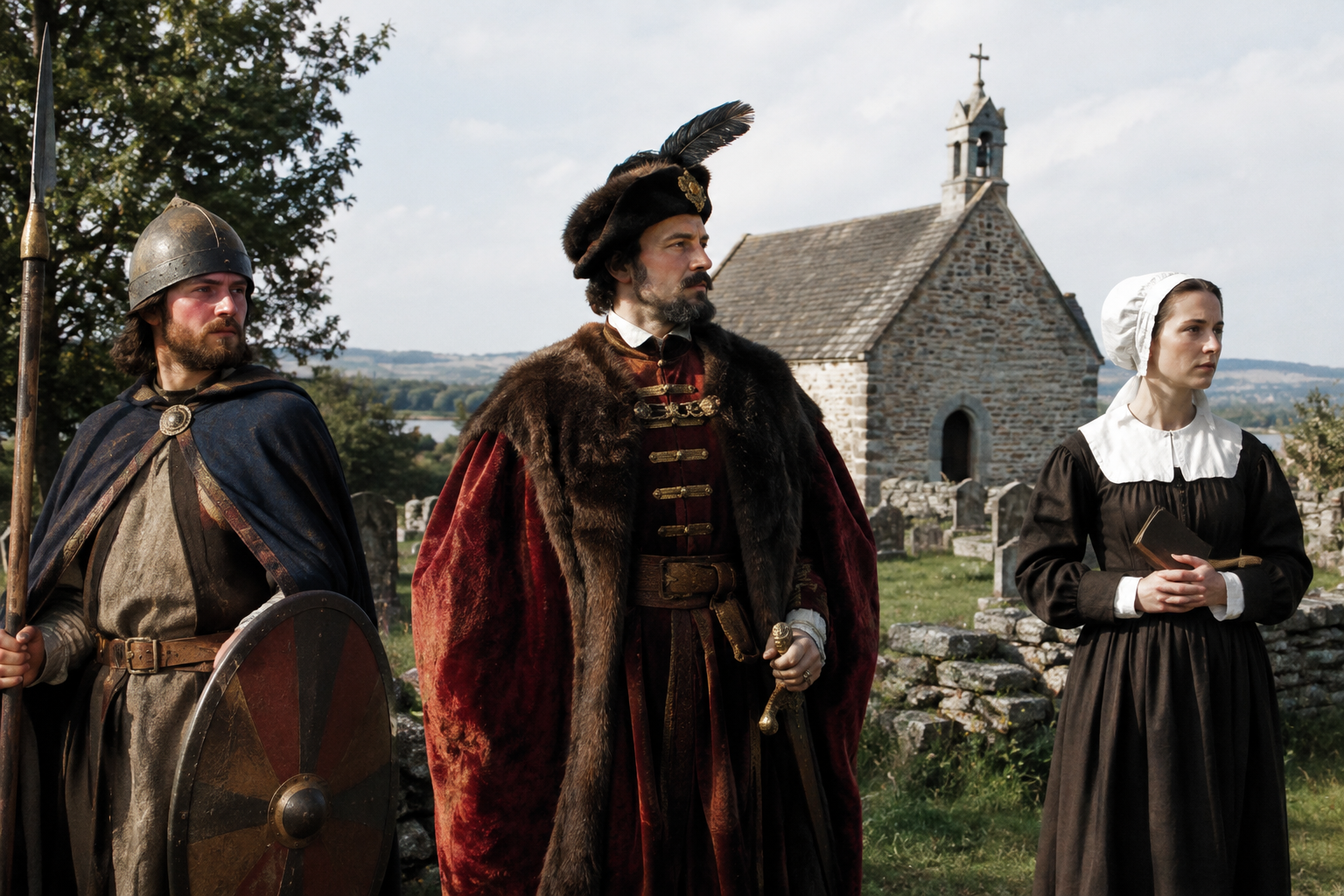
Some Y-chromosome lineages announce themselves with imperial fame or huge modern numbers. Others are more interesting precisely because they do not. Haplogroup I2a1b2a2b2b belongs to that second category: a very specific paternal branch whose story is best approached not as a single grand ethnic label, but as a set of clues scattered across medieval graves, regional histories, and the long afterlife of European male lines.
That is worth saying plainly at the start. A Y-DNA haplogroup traces one direct paternal line only: father to father to father. It does not describe a person's whole ancestry, culture, language, or identity. But it can still be extraordinarily revealing. In the case of I2a1b2a2b2b, the evidence points us into a wider European I2 landscape often associated, at broad scale, with deep southeastern and central European roots, later reshaped by migrations, local continuity, and the political churn of the early and high Middle Ages. For a narrow branch like this one, caution matters. We should not simply pour the entire history of haplogroup I2 into this subclade and call the matter settled. Still, the samples we do have are enough to make the past feel pleasingly concrete.
Haplogroup I is one of the old European Y-chromosome families, and I2 is among its best-known branches in European archaeogenetics. Broadly speaking, I2 lineages have appeared in different parts of Europe across long spans of prehistory and history. Some branches are especially important in discussions of the Balkans, the Carpathian Basin, and parts of central and eastern Europe. But that broad framework is only background. A downstream lineage such as I2a1b2a2b2b represents a much narrower paternal thread, one that may have expanded regionally, persisted locally, or moved with particular medieval populations rather than with some vast, timeless "people."
That distinction matters because ancient DNA keeps showing us the same lesson: paternal lines can persist while languages, states, burial customs, and political loyalties change around them. A man carrying an I2-derived lineage in early medieval Croatia was not thereby identical in identity or experience to a nobleman in 16th-century Hungary, still less to a colonist in 17th-century Maryland. Yet the recurrence of related paternal branches across these settings hints at durable male-line continuities within the wider European world.
Explore Ancient DNA and Archaeogenetics
The most useful way into this haplogroup is through the individuals themselves. Ancient DNA works best when it brings us back to real bodies in real places.
First there is VEM029, from Early Medieval Croatia Velim-Velistak, dated to 775 AD. This is perhaps the most evocative of the three because it sits in the early medieval Balkans, a region where the wider I2 family has often been historically relevant. Velim-Velistak belongs to that complicated Adriatic and inland Croatian zone where Roman provincial legacies, post-Roman population change, Slavic-speaking communities, and local continuities all meet. A paternal lineage in this setting is not a tidy ethnic badge. It is evidence that one branch of this wider Y-chromosome family was present among men living in the eastern Adriatic world during a formative period of medieval state-making and settlement.
Then we move to PER11, described as Medieval Hungarian Bathory Male Nobility Pericei, dated to 1500 AD. This is the sort of sample that tempts people into rash conclusions, so it deserves careful handling. PER11 is exciting not because it "proves" some sweeping noble genealogy, but because it places this paternal branch in a late medieval or early modern elite context in the Hungarian sphere, specifically one associated with Bathory nobility. That tells us that a lineage within this branch was present in a socially elevated male line in that period. It does not mean every Bathory man carried it, nor that everyone with this haplogroup today descends from that family. But it does anchor the branch in the aristocratic world of the Carpathian Basin.
Finally there is I15292, from the Historic St. Mary City Chapel Field Cemetery Maryland, dated to 1667 AD. Here the story takes an Atlantic turn. A paternal line with older European roots appears in colonial North America, in the burial ground of the 17th-century capital of Maryland. This is exactly the sort of case that reminds us how Y-DNA branches moved not only in prehistory or during barbarian migrations, but also through documented early modern mobility: colonization, military service, trade, coerced migration, and settlement.
Discover Early Medieval Croatia DNA
If we place VEM029, PER11, and I15292 side by side, a pattern emerges. The branch appears in southeastern Europe, in the Carpathian Basin, and later in the colonial world shaped by European expansion. That is not proof of one uninterrupted family tree connecting all three men. It is, however, good evidence that the lineage belonged to the sort of European paternal background that could persist through medieval regional societies and then cross the ocean in the early modern era.
PER11 is especially useful because noble burials tend to come with stronger historical framing than ordinary graves. In this case, the Bathory association helps us see how ancient DNA can intersect with written history. Genealogies tell us about names, offices, marriages, and estates. DNA tells us about biological lineages. Sometimes the two illuminate one another; sometimes they complicate one another. The sensible position is to let each do its own work.
Readers interested in that Hungarian context may want to look further into elite burials from the region, especially as ancient DNA has increasingly sharpened our picture of how medieval power in Hungary sat atop a biologically mixed and historically layered population.
Read About Medieval Hungary's Elite DNA
The supplied noble connection here is the House of Wittelsbach, and with it the Munich Residenz. Now, one must be careful. The presence of a noble house in a haplogroup article does not by itself prove that the dynasty's paternal line was I2a1b2a2b2b, nor that all Wittelsbach rulers shared a single confirmed modern genetic assignment. What it does provide is a historical setting in which to think about paternal continuity, dynastic memory, and the architecture of power.
The Munich Residenz began as a moated castle in 1385 and grew over roughly six centuries into the great city palace of the Wittelsbach rulers of Bavaria. That growth is historically delicious because the building became, in effect, a stone genealogy. Gothic foundations remained beneath Renaissance galleries; Baroque apartments sat alongside Rococo decoration and later Neoclassical rooms. Dynasties do this sort of thing all the time. They build not just to live, but to announce antiquity, legitimacy, and permanence.
And that is where the connection to Y-DNA becomes genuinely interesting. A castle or palace does not preserve a haplogroup in any scientific sense. But it does preserve the idea of lineage: fathers and sons, succession and inheritance, claims to territory, carefully curated ancestral memory. The Residenz is therefore a fitting historical counterpart to a haplogroup article. Both are about continuity through time, though one is written in masonry and the other in chromosomes.
The palace was badly damaged by bombing in the Second World War, then substantially rebuilt. Today it survives as one of Germany's major palace museums, and as a reminder that dynasties were never just families. They were institutions, and institutions were always keen to make their bloodlines look older, steadier, and more glorious than life usually allows.
Explore the Royal House of Wittelsbach
The real fascination of I2a1b2a2b2b lies in this spread of contexts. A branch within the wider I2 family appears in an early medieval Croatian burial, in a Hungarian nobleman associated with the Bathory sphere, and in a 17th-century grave in Maryland. That sequence does not give us a neat saga of one tribe marching across Europe. It gives us something better: a historically plausible picture of how paternal lines endure across changing worlds.
States rise and fall. Languages shift. Aristocratic houses sponsor palaces. Families cross oceans. Yet particular male lines can continue, sometimes obscurely, sometimes in elite settings, sometimes in colonial cemeteries far from their older European homelands. Ancient DNA is so useful precisely because it catches those continuities without pretending they were simple.
For readers intrigued by the Atlantic end of that story, the colonial Maryland evidence is a reminder that Europe's paternal landscape did not stay in Europe. It became part of the demographic making of the Americas, where old-world lineages entered entirely new social and historical settings.
Explore Colonial St. Mary's City DNA
So what does haplogroup I2a1b2a2b2b reveal? Not a royal identity. Not a guaranteed ethnic label. Not proof that one descends from a particular noble house. What it offers instead is a direct paternal thread linking the present to the deep and uneven history of Europe: the Balkans and Adriatic world, the Carpathian Basin, medieval aristocratic society, and the overseas expansion of the early modern age.
That is, in truth, quite enough. It is the sort of result that invites further exploration rather than hasty certainty. Ancient DNA is at its best when it makes the past larger, stranger, and more human, not when it is forced into a family myth.
If your own DNA includes a lineage like I2a1b2a2b2b, MyTrueAncestry can help you explore how your direct paternal ancestry may connect with ancient individuals, archaeological sites, and historical populations. Those matches do not by themselves prove direct descent from a medieval nobleman or membership in a dynasty, but they can open a remarkably vivid window onto the worlds your ancestors inhabited.






Comments