Haplogroup I2a1b2a2a1

– 6 min read


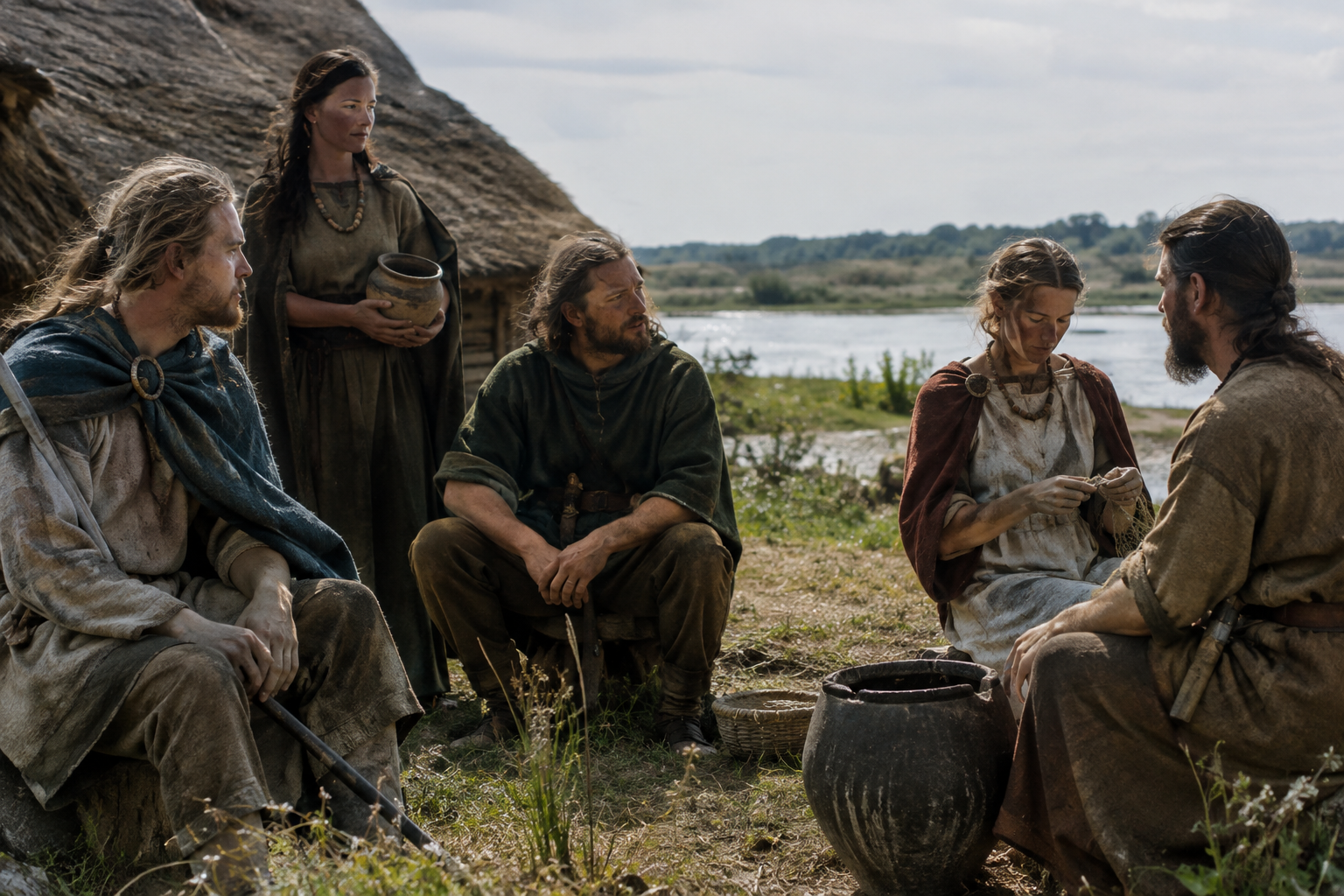
Some Y-chromosome haplogroups announce themselves with thunder: royal tombs, famous skeletons, dramatic migrations. I2a1b2a2a1 is more interesting for a different reason. It appears in the record not as a single imperial signature, but as a durable paternal thread running through prehistoric and Iron Age Europe - from Bronze Age Denmark and Silesia to Iron Age Bohemia and later Celtic France. That is exactly the sort of evidence ancient DNA handles best: not legends about where a people "must have come from," but the quieter, more stubborn traces left by actual men in actual graves.
As always, a note of caution matters. Y-DNA haplogroups trace one narrow line of descent: the direct paternal line, father to son across generations. They do not describe a person's whole ancestry, identity, language, or culture. Still, they are invaluable. A lineage like I2a1b2a2a1 helps us ask how old European paternal lines persisted, shifted, and reappeared as societies changed from Bronze Age chiefdoms to Iron Age tribal worlds and, much later, to the manor houses and family traditions of medieval and early modern Britain.
I2a1b2a2a1 belongs within the wider haplogroup I, one of the long-established Y-chromosome lineages of Europe. Broadly speaking, branches of haplogroup I are often associated with deep European prehistory, though different subclades had very different later histories. That matters here, because we should not lazily pour the whole history of haplogroup I into one narrow branch. What the evidence supplied for I2a1b2a2a1 really shows is a lineage present across parts of temperate Europe in later prehistory and the Iron Age, especially in a corridor stretching through Central Europe and reaching into Scandinavia and Gaul.
That distribution is historically suggestive. It places this paternal line in regions that saw repeated cultural transformations: Bronze Age exchange networks, the rise of fortified communities, the spread of cremation and inhumation traditions, and later the emergence of Celtic-speaking societies in some areas. Ancient DNA does not let us equate a haplogroup with "the Celts" or "the Bronze Age people" in any simplistic sense. But it does let us see that some paternal lines endured across those transitions, even while languages, political structures, and burial customs changed around them.
Explore Archaeogenetics and Ancient DNA
The supplied ancient samples make this lineage unusually tangible. One of the most evocative is CGG106805, from Nordic Bronze Age Denmark Odense Kavslunde Eng, dated to 1380 BC. Here the haplogroup appears in southern Scandinavia during the Nordic Bronze Age, a world of metalwork, maritime contacts, and impressive elite display. Denmark in this period was not an isolated fringe. It was tied into northern European exchange systems reaching southward into Central Europe and beyond.
Then there is poz498, from Bronze Age Lower Silesia Karczyn, dated to 1750 BC, and poz720, from Bronze Age Silesia Pielgrzymowice Grave 669, dated to 1375 BC. These two Silesian finds are especially useful because they show the lineage not as a single outlier, but as part of a broader Bronze Age presence in Central Europe. Silesia was no backwater either. It sat in a strategic zone between the north European plain, the Oder basin, and routes leading toward Bohemia and the Danube lands. A paternal lineage found there more than once begins to look less like an accident and more like part of the regional human landscape.
What can we say responsibly? Not that these three men belonged to one tribe, one "race," or one dynasty. But we can say that I2a1b2a2a1 had a foothold across a remarkably wide area by the Bronze Age, from Denmark to southwestern Poland. That suggests either a wider distribution already in place or sustained movement and interaction across these regions.
Discover Late Bronze Age Central Europe
By the Iron Age, the same paternal branch appears again in different settings. I17327, from Iron Age Prague Central Bohemia, dated to 300 BC, places the lineage in the heart of Bohemia. This was a region deeply bound up with the archaeological worlds often linked to later Celtic Europe. Central Bohemia was a crossroads: economically active, politically significant, and connected to wider continental networks. The presence of I2a1b2a2a1 here suggests continuity, mobility, or both across the long centuries between the Bronze Age and Iron Age.
Even more striking is GLN32, from Gallic Tribe Yonne Gurgy Les Noisats France, dated to 200 BC. Now our lineage is found in Iron Age France, in a context explicitly described as Gallic. This does not prove that I2a1b2a2a1 was a "Gallic haplogroup" - that would be far too crude. But it does show that this paternal line was present among populations living in Celtic Gaul. Combined with the Bohemian sample, it helps sketch a pattern across the European interior, from Central Europe westward into France.
Seen together, these finds are rather elegant. Bronze Age Silesia, Bronze Age Denmark, Iron Age Bohemia, Iron Age Gaul: not a straight line, not a family tree, but a map of persistence. This is how ancient DNA often works at its best. It gives us a set of points, and history begins in the careful interpretation of the spaces between them.
Explore Ancient DNA and Celtic Origins
How does any of this connect to later historical families? Carefully - and without pretending that a Bronze Age burial in Silesia can somehow identify the exact paternal line of a Devonshire house. What ancient DNA provides is context, not a ready-made pedigree.
The noble association supplied here is the House St Leger and Annery House near Monkleigh in north Devon. Annery stands on a site layered with long local memory. Tradition linked it to the ancient manor of Annery, and later writers sometimes tried to push that story back into the Saxon period. Yet, as so often, the firmer documentary history begins in the medieval world, when the estate passed through important local families and became a notable seat in the region.
What survives at Annery today reflects especially the sixteenth and seventeenth centuries, with rebuilding and alteration over time. The house is associated with the Raleigh family and with Sir John Chichester, whose murder in 1596 became one of Devon's most famous local stories. In other words, Annery is not a frozen relic from one age. It is a place where architecture, family ambition, local feud, and retrospective legend all accumulated layer upon layer.
That is precisely why it makes a good historical companion to a haplogroup article. Y-DNA deals in one line of fathers and sons; manor houses deal in inheritance, marriage, legal transfer, rebuilding, and memory. The two forms of evidence are not the same. A family's association with a haplogroup does not prove that every bearer of the surname shared the same paternal line, nor does the existence of an old estate prove anything genetic by itself. But together they remind us how regional histories are built: some through documents, some through stone, some through burial archaeology, and some through DNA.
Read About the House of St Leger
I2a1b2a2a1 is historically interesting because it seems to belong to that stubborn category of European paternal lines that do not vanish when archaeological labels change. It appears in Bronze Age Central Europe, in Bronze Age Denmark, and later in Iron Age contexts in Bohemia and Gaul. That does not mean unbroken local continuity everywhere, still less a single ethnic identity stretching unchanged across fifteen centuries. It means something subtler and, to my mind, more interesting: men carrying this paternal branch were part of several different European societies over a long span of time.
That is also the proper way to think about any possible later connection to regions like Britain. Medieval and early modern noble houses such as the St Legers belonged to a world shaped by migration, conquest, marriage, service, and estate-building. If a present-day tester belongs to I2a1b2a2a1, ancient DNA can place that paternal line within a broad historical landscape reaching back into Bronze Age and Iron Age Europe. It cannot, by itself, prove descent from a Gallic tribesman, a Bohemian Iron Age man, or a Devon manor family.
Still, it can do something better than a romantic fantasy. It can show that your direct paternal line may be part of a very old European story, one that runs through real excavated individuals like CGG106805, poz498, poz720, GLN32, and I17327. Those men are not symbols. They were people who lived in the societies that built Bronze Age exchange networks, Iron Age communities, and the long regional histories from which later Europe emerged.
For readers interested in how such regional histories played out in Britain after Rome and into the early medieval world, MyTrueAncestry also has excellent material on broader population change and continuity.
Explore Ancient DNA in Post-Roman Britain
If your Y-DNA belongs to I2a1b2a2a1, or to a nearby branch, you may be looking at a paternal lineage with deep roots in prehistoric and Iron Age Europe. MyTrueAncestry lets you compare your DNA with ancient individuals and historical populations, offering a fascinating way to place your family history beside archaeology and genetics. Those matches do not automatically prove direct descent or noble status, but they can open an unusually vivid window onto the ancient world behind your ancestry.






Comments