Haplogroup I2a1b1a2b1a2a1a1a

– 6 min read


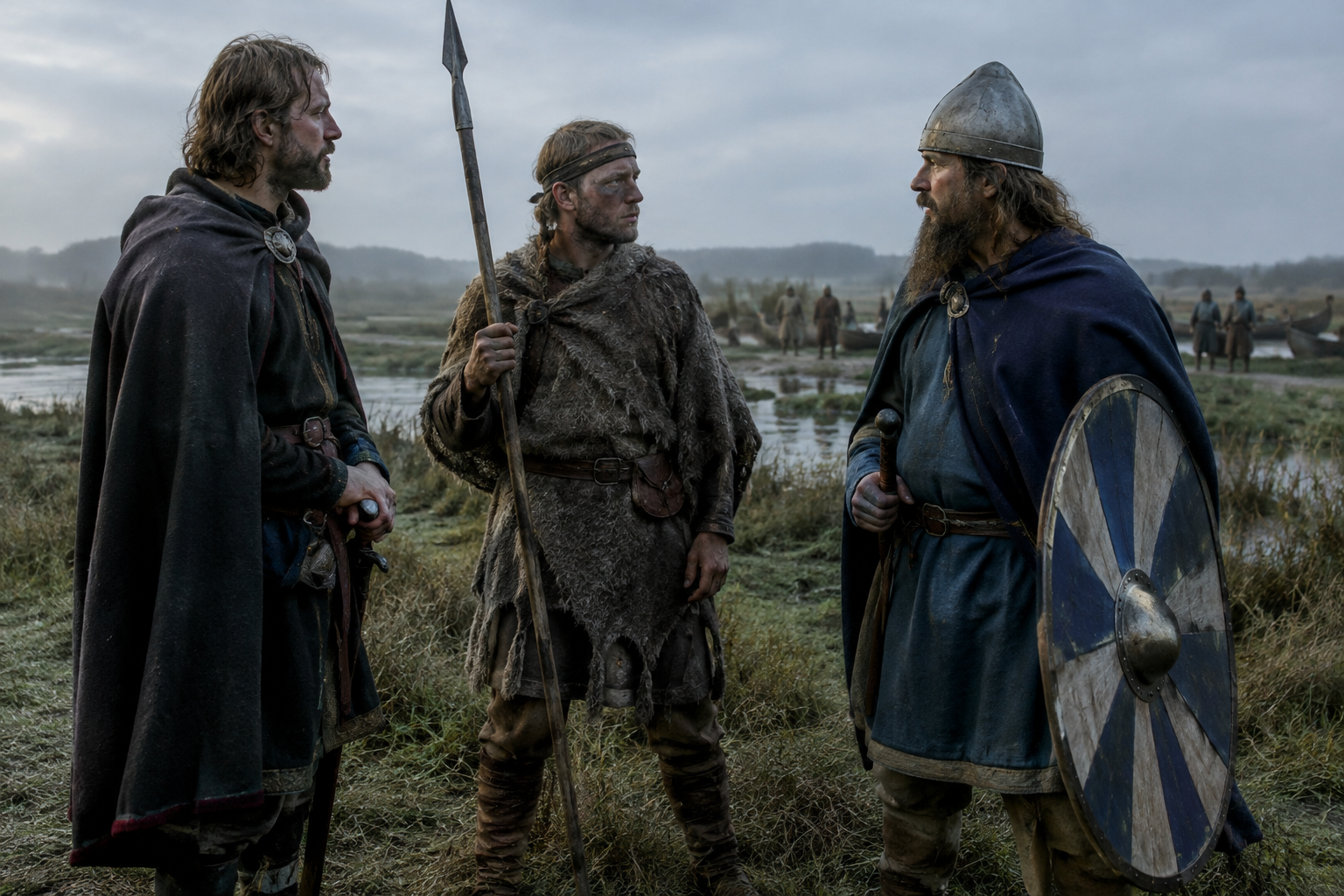
Some Y-chromosome lineages announce themselves with grand imperial fame. Others are more interesting precisely because they do not. Haplogroup I2a1b1a2b1a2a1a1a belongs to that second category: a very specific paternal branch whose story emerges not from a single dynasty or dramatic founding legend, but from a scatter of ancient men across northern Europe, from bogs and burials to medieval landscapes and noble memory.
That is exactly why it matters. Y-DNA haplogroups trace one very narrow line of ancestry: the direct paternal line, father to son to son. They do not describe a person's whole ancestry, culture, language, or identity. But when ancient DNA places related paternal branches in different times and places, it gives us something wonderfully concrete: evidence that particular male lines were present in real historical communities. In the case of I2a1b1a2b1a2a1a1a, the picture that emerges is tied to northern and central Europe, especially the world linking Denmark, Sweden, and Germany across the first millennium AD.
Broadly speaking, haplogroup I is one of the old European Y-chromosome families, with deep roots in prehistoric Europe. Within that wider tree, the I2 branch has long been important in discussions of European paternal ancestry. But one must be careful here. The history of the broad parent haplogroup is not automatically the history of this much narrower subclade. A highly specific branch such as I2a1b1a2b1a2a1a1a represents just one twig on a large and ancient tree.
What can be said responsibly is that this branch appears in contexts that point toward a northern European setting in later prehistory and early history, and that ancient DNA has become essential for tracing that pattern. Instead of guessing from modern surnames or present-day distributions alone, we can now see related paternal lines turning up in a Jutland war deposit, a Merovingian Frankish burial in southern Germany, and a Viking Age individual on Oland. That does not prove a single uninterrupted family tale. It does show that branches in this paternal neighborhood were moving through, or persisting within, the societies of the Baltic and North Sea worlds.
Readers interested in the broader background of how ancient DNA transformed this kind of work may enjoy the MyTrueAncestry article below.
Explore the rise of archaeogenetics
The most revealing evidence here comes from three supplied ancient individuals, each separated by centuries yet linked by geography and historical setting.
The earliest is CGG019201, described as a Jute Early Roman Era Denmark Jutland Bog War Alken Enge individual, dated to 11 AD. Alken Enge is one of those archaeological discoveries that catches the imagination at once: a wetland deposit associated with conflict, human remains, and the violent realities of Iron Age society in Jutland. This sample matters because it places a related paternal lineage in a region central to the later history of Germanic-speaking northern Europe. Not because one man from a bog can stand in for an entire people, but because he anchors the lineage in a real place, among communities living on the edge of the Roman world yet deeply connected to it through trade, warfare, and rumor.
Then there is Mln13, a Merovingian Period Frankish individual from Moemlingen Germany, dated to 650 AD. By now we are in a different world: post-Roman, Christianizing, and politically reshaped by the Frankish kingdoms. The importance of Mln13 lies in continuity of presence across region and era. We are no longer in Jutland but in the orbit of early medieval Germany, where old local populations, newcomers, military retinues, and expanding kingdoms overlapped in ways far messier than tidy ethnic labels suggest.
That is where ancient DNA is so useful. Written sources like to talk in large categories, Franks, Saxons, Jutes, and others, as if they were sealed boxes. The genetics often shows something more human and more untidy: overlapping communities, mixed origins, and paternal lines that can persist while political identities change around them.
For a wider look at this shifting frontier world, this related article makes an excellent companion read.
Read about the German frontier world
The third sample, VK348, comes from Viking Age Oland Sweden, dated to 950 AD. Now the story reaches the Viking Age Baltic. Oland, off the southeast coast of Sweden, sat in a maritime zone of trade, raiding, travel, and local power. This is not the same setting as early Roman Jutland or Merovingian Germany, yet the appearance of a related paternal branch here suggests that the lineage belonged to the broad human traffic of northern Europe rather than to one isolated enclave.
If you want to push the Scandinavian background further back in time, the MyTrueAncestry article on Denmark's transition from forager to farmer is worth exploring, not because it proves this exact subclade's origin, but because it shows the deeper population history behind later northern European lineages.
Discover early Danish population history
If we stand back from these three individuals, a pattern begins to emerge. This is a lineage associated, at least in the evidence supplied here, with the northern European corridor linking southern Scandinavia, the Baltic, and the German lands. That does not mean every bearer was Scandinavian, Germanic, Viking, or Frankish in some simple sense. It means that related paternal lines were present in those historical worlds.
And this is where geography matters. The Baltic and North Sea zones were never backwaters. They were corridors. Men moved with armies, traders, settlers, marriage networks, lordship, and faith. The route from Jutland to northern Germany and onward into the Elbe and Mecklenburg regions is not a fantasy map drawn after the fact; it is one of the most important historical arteries of early medieval northern Europe.
So when we later encounter an associated noble house in Mecklenburg, we should not leap to claims of direct descent from CGG019201, Mln13, or VK348. That would be irresponsible. But we can say something more interesting and more defensible: the medieval noble landscape of Mecklenburg occupied a region where paternal lineages of this broad northern European kind had long historical depth.
The supplied noble connection brings us to the House von Weltzien and to Kloster Dobbertin in Mecklenburg. The site began in the 13th century as a Benedictine nunnery and grew into one of the region's richest religious houses, with lands, mills, and fishing rights around Dobbertiner See. That detail is telling. Medieval power was not only about swords and heraldry. It rested on control of water, grain, rents, labor, and sacred patronage.
After the Reformation in the 16th century, Kloster Dobbertin did not simply disappear into ruin, as so many monastic foundations did. Instead, it was transformed into a Protestant ladies' convent for unmarried noblewomen. That second life is part of what makes the complex so historically rich. Its church, cloisters, and domestic buildings preserve layers of medieval, early modern, and later history, showing how institutions change without entirely losing their memory.
In the 19th century the complex was restored and expanded; in the 20th it passed through war, dictatorship, and changing state uses. Today it survives as an important monument of Mecklenburg's religious, social, and architectural past. For readers of paternal ancestry, that matters not because a building can prove a haplogroup, of course it cannot, but because places like Dobbertin preserve the regional world in which lineages, records, landholding families, and social identities endured.
The House von Weltzien is best approached, then, as a historical association rather than a proven genetic endpoint. A noble family linked with Mecklenburg belongs to the same broad north German-Baltic sphere in which our ancient evidence also appears. That geographical overlap is suggestive and worth exploring, but it is not proof that every von Weltzien male carried this exact Y-DNA branch, still less that the family descends directly from any named ancient sample.
For readers who want to follow that family history more closely, MyTrueAncestry has a dedicated article here.
Explore the House von Weltzien
Haplogroup I2a1b1a2b1a2a1a1a is a reminder that ancient ancestry is often most compelling at the regional level. Not a cartoon of a single tribe marching across the map, and not a fairy tale in which a modern tester is neatly descended from one excavated warrior. Rather, we see a paternal branch turning up in northern Europe across very different settings: an Early Roman Era bog context in Jutland, a Merovingian Frankish burial in Germany, and a Viking Age burial in Sweden.
That spread hints at long-term presence and movement across the Scandinavian-German world. It also shows why Y-DNA is so powerful and so limited at once. Powerful, because it can illuminate one direct paternal thread across centuries. Limited, because one thread is not the whole fabric. Culture changed, languages shifted, kingdoms rose and fell, monasteries became Protestant foundations, and noble houses adapted to new worlds. The paternal line persisted through all that, but it was only one part of the story.
If your own Y-DNA connects with this branch, the most exciting possibility is not that you have solved your entire ancestry with a single label. It is that you may share deep paternal history with the kinds of northern European populations represented by samples like CGG019201, Mln13, and VK348, and with the later historical landscapes of places such as Mecklenburg and Dobbertin.
Upload your DNA to MyTrueAncestry to explore ancient matches, compare yourself with archaeological samples, and see how genetics can add depth to family history. Those connections may open remarkable windows onto the past, even when they do not prove direct descent from a particular ancient individual or noble house.






Comments