Haplogroup I2a1b1a2b1
– 6 min read


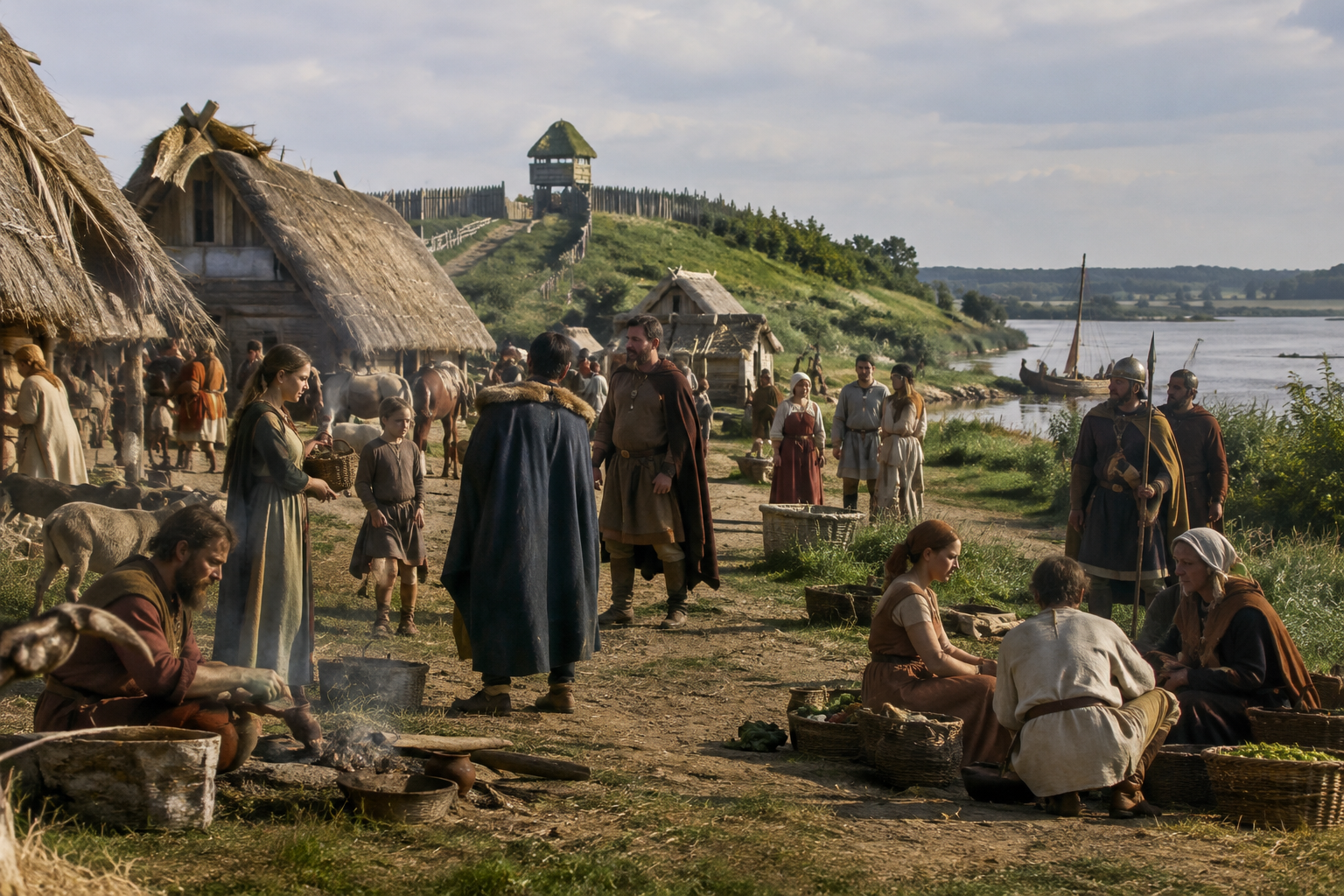
Some Y-chromosome lineages are easy to stereotype. This one is not. I2a1b1a2b1 appears in a string of ancient finds that begins deep in prehistoric Europe, turns up in the Balkans, the North Sea world, the Carpathian Basin, Anglo-Saxon England, medieval Belgium, and post-Viking Hedeby, and refuses to sit neatly inside one tidy ethnic label. That is precisely what makes it historically interesting.
As a Y-DNA haplogroup, I2a1b1a2b1 traces one direct paternal line: father to father to father, across many generations. It does not describe a person's whole ancestry, culture, language, or identity. But it can be remarkably useful for following the long history of male-line continuity and movement. In this case, the evidence suggests a lineage with very old European roots whose later branches became part of several different prehistoric and historical populations. Ancient DNA has made that story much less abstract. We are no longer talking only about labels on a tree. We are talking about men buried in caves, bogs, churches, cemeteries, and frontier settlements.
Broadly speaking, haplogroup I is one of the old Y-chromosome lineages of Europe, and branches within I2 are often discussed in connection with prehistoric European hunter-gatherer ancestry and later regional persistence. But one has to be careful here. The full history of haplogroup I2 is not automatically the history of the narrower branch I2a1b1a2b1. A downstream lineage may have spread in quite specific ways, and its historical footprint can be narrower than that of its parent clades.
What is striking in the supplied ancient evidence is the sheer timespan. The line appears in Mesolithic Serbia at Vlasac in the Iron Gates, with samples I4881 from 6413 BC, I4882 from 5875 BC, and I4880 from 5863 BC. Those are among the oldest signposts in this set, and they place the paternal story of this branch, or a closely related one, in the post-glacial Balkans. Later finds in Neolithic and Chalcolithic Romania, including Urzi10 from Urziceni dated 4000 BC and I7135, I15617, I18113, and I18114, suggest that lineages in this part of the tree were still present as farming societies developed in southeastern Europe.
This is a useful reminder that Europe's prehistory was not a simple replacement of one people by another. Paternal lines could persist, contract, expand, and be absorbed into new cultural worlds over thousands of years.
Explore Balkan Hunter-Gatherer Origins
Then the map widens. The lineage appears in Neolithic Britain and Scotland with I36003 from Holm of Papa Westray in North Scotland, dated 3193 BC, I36019 from Rattar in East Scotland, dated 3446 BC, and I2650x from the Neolithic Orkney Islands, dated 3200 BC. It is also present in MAD01, a Neolithic sample from Madonna Bianca in Alpine Italy, dated 6300 BC. Those finds do not prove one single migration episode for this exact subclade, but they do show how widely distributed related paternal lines had become across Europe by the Neolithic.
The Bronze Age samples add another layer. IV3008 from Ipatovo, a Middle Bronze Age Caucasus kurgan grave dated 1950 BC, and later finds from Romania and Bulgaria such as I19452, I10480, and I10559 place this paternal story in a broad zone stretching from southeastern Europe toward the steppe fringe and Caucasus. That does not mean I2a1b1a2b1 was a "steppe haplogroup" in any simple sense. It means men from this paternal background were part of the real human mixtures that connected the Balkans, the Carpathian Basin, and neighboring regions over a very long period.
By the Iron Age and Roman era, the evidence shifts decisively toward the North Sea and southern Scandinavia. Here the samples begin to feel less like abstract prehistory and more like recognizable historical worlds: CGG019202, a Jute from Alken Enge in Jutland dated 81 AD; VK582 from the Alken Enge battlefield dated 100 AD; CGG107412 from Iron Age Varpelev in eastern Sjaelland dated 115 AD; CGG106811 from Jutland Hamahus dated 175 AD; and CGG107415 from a Danii context at Koge in Sjaelland dated 375 AD.
That cluster matters. It suggests that this lineage, whatever its deeper prehistoric story, was clearly present among populations of Iron Age and late Roman Denmark. In other words, if you are looking for a later historical setting in which I2a1b1a2b1 was active and visible, southern Scandinavia is hard to ignore.
From there, the Migration Period evidence becomes especially vivid. Two early Anglo-Saxon era burials from Buckland Dover in England, BUK037 and BUK053, both dated 400 AD, place the lineage in one of the best-known migration zones of early medieval Europe. Another English example, LAK001 from Lakenheath in Suffolk dated 650 AD, and SED017 from Anglo-Saxon Sedgeford in Norfolk dated 760 AD, show it continuing within early medieval England.
Again, caution is needed. A shared haplogroup does not make every one of these men close kin. Nor does it prove a single tribe carried the lineage wholesale into Britain. But it does fit the wider pattern of movement across the North Sea, where paternal lines present in Denmark and northern Germany also appear in early Anglo-Saxon England.
On the Continent, the lineage also appears in Migration Period and post-Roman settings further south and east: BRC029x from Bruecken in Saxony-Anhalt dated 500 AD, IND006 from a Merovingian grave at Alt-Inden in North Rhine-Westphalia dated 600 AD, and a notably rich cluster in Pannonia and Barbaricum. These include HMU044, HMU072, SZL045, HMU037, MFC007, and SZL027, all from the 525-550 AD horizon in present-day Hungary, spanning Gothic, post-Roman, post-Gothic, and Longobard period contexts.
The Gothic samples A181014 and A181019 from Kecskemet-Mindszenti in Transtisza, both dated 450 AD, are especially revealing. They show this lineage not just in the northern world but also in the mobile societies of the Danube frontier and the post-imperial east-central European plain. If anything, the lesson is that paternal lineages do not obey the tidy ethnic categories of old history books.
By the early and high medieval periods, I2a1b1a2b1 is still very much in view. In Belgium, ST0552 and ST2390 from Sint-Truiden Onze-Lieve-Vrouwekerk, both dated 900 AD, place it in an urban Christian setting in the Low Countries. In Germany, OBM042 from Obermoellern in Thuringia dated 1050 AD appears in a Western Slav context, while SWG010 from Hedeby Schleswig Rathausmarkt in Southern Jutland dated 1100 AD places the lineage in one of the great trading towns of the Viking and post-Viking north.
That is a wonderful spread of evidence: Mesolithic foragers in the Iron Gates, Neolithic island communities in Orkney, Iron Age Danes and Jutes, Anglo-Saxon burials in England, Gothic and Longobard age burials in Hungary, medieval burials in Belgium, a Western Slav context in Thuringia, and post-Viking Hedeby. Not one people, then, but a long-running paternal line woven into many peoples.
The supplied field for associated noble families and castles is empty here, and that absence is worth stating plainly. Without specific family names, seats, or castle data, it would be irresponsible to manufacture a grand bridge from this haplogroup to a particular medieval dynasty. Still, the historical settings of the samples themselves offer a kind of substitute landscape: church burials at Sint-Truiden, the battleground of Alken Enge, the cemeteries of Anglo-Saxon Kent and East Anglia, the frontier communities of Pannonia, and the commercial world of Hedeby. These are the places where paternal history survives in bone and soil, even when heraldry and pedigree do not.
What, then, does I2a1b1a2b1 reveal? First, that some paternal lines have extraordinary longevity in Europe. Second, that continuity and movement are not opposites. A lineage can be ancient in southeastern Europe and later widespread in the North Sea world. Third, that ancient DNA is at its best when it complicates old assumptions. It does not hand us simple tribal badges. It shows men living in changing societies, carrying older lines into new political and cultural worlds.
For family historians, that is both thrilling and sobering. If your Y-DNA falls within I2a1b1a2b1, the ancient evidence gives you context, not a medieval passport. It may connect your direct paternal line to broad zones of ancient presence in the Balkans, the Carpathian Basin, Scandinavia, Britain, and the Low Countries. It does not prove descent from a named Gothic warrior, an Anglo-Saxon settler, or a later noble house. But it does place your paternal story inside one of Europe's longer and more geographically varied histories.
If you want to explore that bigger picture, MyTrueAncestry is exactly the right sort of place to do it: comparing your DNA with ancient individuals, archaeological cultures, and historical populations, while keeping the distinction clear between genetic similarity and documented genealogy.
Upload your DNA to MyTrueAncestry and see whether your results show connections to ancient samples like I4881 at Vlasac, CGG019202 at Alken Enge, BUK037 at Buckland Dover, or SWG010 at Hedeby. The results may not identify a direct ancestor, but they can open a remarkably concrete view onto the ancient worlds through which your paternal line once moved.






Comments