Haplogroup I2a1b1a2a1a1

– 6 min read


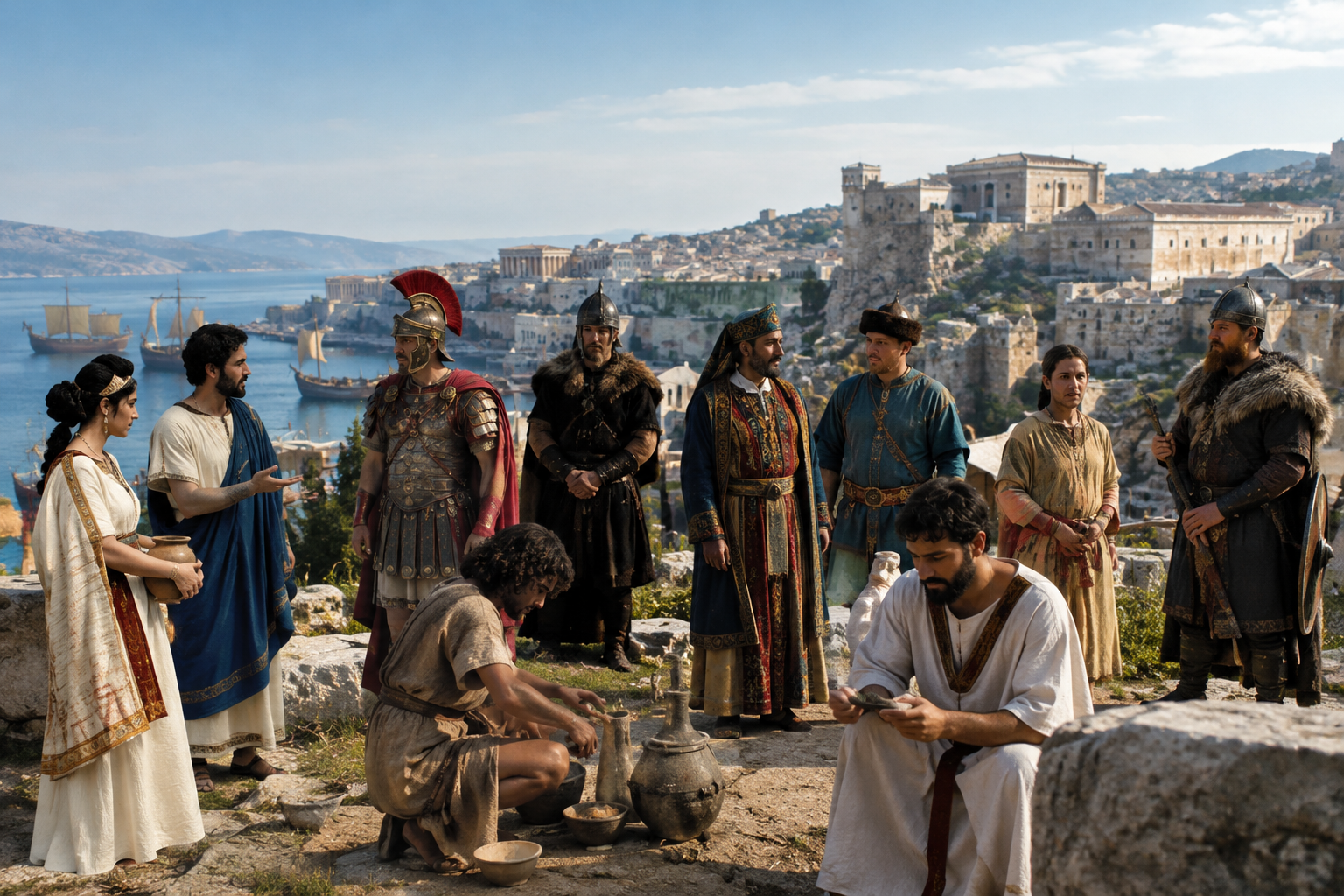
Some Y-chromosome lineages announce themselves with a neat national label or a familiar royal story. Haplogroup I2a1b1a2a1a1 does not quite behave so tidily. What makes it historically interesting is precisely that it appears in a wide arc of ancient contexts: Bronze Age Bosnia-Herzegovina, the Aegean coast of Anatolia, western Sicily, Roman Croatia, Gothic-period Bulgaria and Spain, late medieval Albania, and even Viking Age Sweden. That is not a single dynasty marching in lockstep through history. It is something far more human: a paternal line moving through the crowded corridors of Europe and the Mediterranean, sometimes local, sometimes mobile, sometimes turning up where historians would least expect it.
As ever with Y-DNA, a caution comes first. A haplogroup traces one direct paternal line only: father to father to father, back through time. It does not represent a person's whole ancestry, culture, language, or identity. Nor does sharing a haplogroup prove direct descent from any ancient individual or noble house. But used carefully, Y-DNA can show us where particular male lineages appear in the archaeological record, and that can illuminate the movement of people in ways that written history alone cannot.
Haplogroup I belongs to one of the oldest broad paternal clusters in Europe, and its many branches have long been part of the continent's population history. A very specific branch such as I2a1b1a2a1a1 should not simply be handed the full biography of all haplogroup I lineages. Still, the evidence supplied here places this branch, or closely related paternal lines, across southeastern Europe, the Aegean, parts of the central Mediterranean, and later medieval and northern settings as well.
The oldest samples in this set are striking. I5737, from Early Bronze Age Izmir in Aegean Anatolia and dated to 1960 BC, places the lineage in a region that was never a cultural backwater, but a meeting place of seaways, traders, farmers, and warriors. Then there is I19561 from Klakar in Bosnia-Herzegovina, dated to 1500 BC, suggesting that related paternal lines were also established in the western Balkans during the Bronze Age. Those two finds alone warn us against any simplistic map. This was not a lineage confined to one mountain valley or one later medieval people.
That wider setting matters because the Balkans and Aegean were not edges of the ancient world. They were crossroads. Movements between Anatolia, the Adriatic, the Danube basin, and the Mediterranean islands repeatedly brought populations into contact, and paternal lineages could persist locally while also appearing in new political and cultural worlds.
Explore Deep Balkan Genetic History
The ancient samples supplied for this haplogroup read less like a straight line and more like a dossier from several centuries of excavation.
Consider I3311, an Ancient Dorian Halikarnassos Aegean Coast individual dated to 177 BC. Halikarnassos, on the southwestern coast of Anatolia, sat inside a world of Greek-speaking cities, regional mobility, and imperial entanglements. Nearby in the central Mediterranean we have I7648, a Hellenic Individual Carthaginian-Era Mozia Western Sicily dated to 400 BC. Mozia was one of those places where Phoenician, Greek, and local histories overlapped untidily, as they usually did in reality. The presence of this paternal lineage in both the Aegean and western Sicily shows just how unsuitable neat ethnic boxes can be.
Then the Roman centuries bring their own complications. OSIJ004, a Roman-period Warrior Mursa Croatia Third Century Crisis dated to 260 AD, appears in a turbulent era of military strain, frontier pressure, and rapid imperial turnover. Mursa lay in a strategic zone where armies moved, loyalties shifted, and local communities lived with empire at close quarters. A paternal lineage turning up here could reflect local continuity, military mobility, or both.
The late Roman and post-Roman finds make the story even more interesting. I40571, from a Late Roman Gothic Grave Aquae Calidae Bulgaria Roman Era dated to 350 AD, and R6730, a Germanic Tribe Sirmium Serbia individual dated to 430 AD, place the lineage in contexts associated with the Gothic and wider migration-period world of the Balkans. And then we find I29631, a Visigothic Early Medieval Spain Tarragona Manuel de Falla individual dated to 506 AD. This is the sort of evidence that reminds us how much late antique Europe was shaped by movement, recruitment, alliance, and settlement across former imperial frontiers.
Read About Gothic DNA in Late Antique Bulgaria
None of that proves one continuous family line from Bulgaria to Spain. What it does show is that this paternal branch belonged to the same broad historical worlds through which Goths, soldiers, settlers, and provincials moved. Ancient DNA turns these labels from textbook abstractions into populations composed of real men with real paternal histories.
One of the most valuable things about this sample set is its chronological spread. It does not stop in antiquity. I14686, a Late Medieval Albania Bardhoc Kukes District individual dated to 1550 AD, shows a later appearance of the lineage in the western Balkans, a region where deep local continuity and repeated outside influence often existed side by side. That makes this sample particularly helpful when thinking about how ancient paternal lines can survive through changing states, religions, and languages.
Then there is VK427, from Viking Age Skara Varnhem Sweden dated to 1050 AD. At first glance Sweden may seem an odd northern outlier in a story otherwise centered on the Balkans, Aegean, and Mediterranean. But by the Viking Age, long-distance movement across Europe was commonplace. Scandinavia was tied into trade, warfare, mercenary service, pilgrimage, and dynastic politics stretching southward into the continent and eastward into the Baltic and beyond. A lineage with earlier southern and southeastern appearances turning up in medieval Sweden is not proof of a single migration route, but it is entirely consistent with the complexity of medieval Europe.
What emerges, then, is not a tribal badge but a pattern of persistence and dispersal. This haplogroup seems to have been present in ancient southeastern Europe and adjacent Mediterranean regions, with later appearances in Gothic, Visigothic, Balkan, and Viking Age contexts. That is precisely the sort of long-range historical distribution that ancient DNA is good at revealing.
Discover Ancient Croatian Lineage Change
By the time we reach the great houses of early modern and modern Britain, we are in a very different world from Bronze Age Klakar or Visigothic Tarragona. Yet these later families belong to the same larger story of regional history, landholding, and paternal descent, even if genetics cannot be assumed from architecture or surname alone.
The House of Wentworth is linked with Wentworth Woodhouse in South Yorkshire, one of the grandest country houses in Britain. Its immense eighteenth-century facade speaks the language of aristocratic power with very little modesty. This was not a castle in the medieval military sense, but a statement in stone about lineage, property, politics, and rivalry. The estate later endured wartime use, industrial encroachment, and decline before restoration efforts sought to rescue it as a monument to how elites shaped landscape and memory. If a haplogroup article seems an odd place to mention such a house, it is worth remembering that Y-DNA often meets history not in battlefields alone, but in archives of inheritance and family continuity.
The House Molyneux, associated with Croxteth Hall near Liverpool, offers a related but distinct picture. Beginning as a late sixteenth-century hunting lodge, it expanded over centuries into the seat of the Earls of Sefton, with gardens, parkland, and the infrastructure of a great estate. Its history preserves not only elite display but also the working life that sustained aristocratic households. In other words, behind every noble facade lies a social world much broader than one surname.
We should be careful here. The presence of these houses in association with haplogroup I2a1b1a2a1a1 does not prove that every Wentworth or every Molyneux male carried this lineage, nor that any ancient sample named above was an ancestor of these families. The responsible way to read such connections is geographically and historically. These are later family landscapes in parts of Britain shaped by centuries of migration from the continent, from Roman and post-Roman movements to Viking and later medieval currents. Haplogroups help provide context for how paternal lines can travel into the worlds later preserved by genealogies, houses, and heraldry.
Explore the House of Wentworth
The real fascination of I2a1b1a2a1a1 lies in its refusal to sit still in a single historical category. It appears in the Early Bronze Age Aegean with I5737, in Bronze Age Bosnia-Herzegovina with I19561, in Hellenic and Carthaginian-era Mediterranean settings with I3311 and I7648, in Roman military and frontier contexts with OSIJ004, in Gothic and Visigothic worlds with I40571, R6730, and I29631, and in later medieval Albania and Viking Age Sweden with I14686 and VK427.
That is a reminder that paternal lineages are historical survivors. Kingdoms rise and vanish; burial customs change; languages spread and retreat; grand houses are built, abandoned, and restored. Yet a Y-chromosome branch can pass through all of this, quietly, one father at a time. Ancient DNA does not replace written history, and written history does not make ancient DNA unnecessary. Together they show us the difference between a surname, a people, a place, and a lineage.
If this part of the story interests you, the Molyneux connection is worth following further, especially for how family history and place can preserve regional memory long after the political world that created them has changed.
Discover the House of Molyneux
Upload your DNA to MyTrueAncestry to explore whether your results show links to ancient individuals, historical populations, and the long paternal histories uncovered by archaeology. These matches do not by themselves prove direct descent from a particular ancient person or noble family, but they can open a remarkable window onto the deeper past behind your ancestry.






Comments