Haplogroup I2a1b1a1b1a1a1

– 6 min read


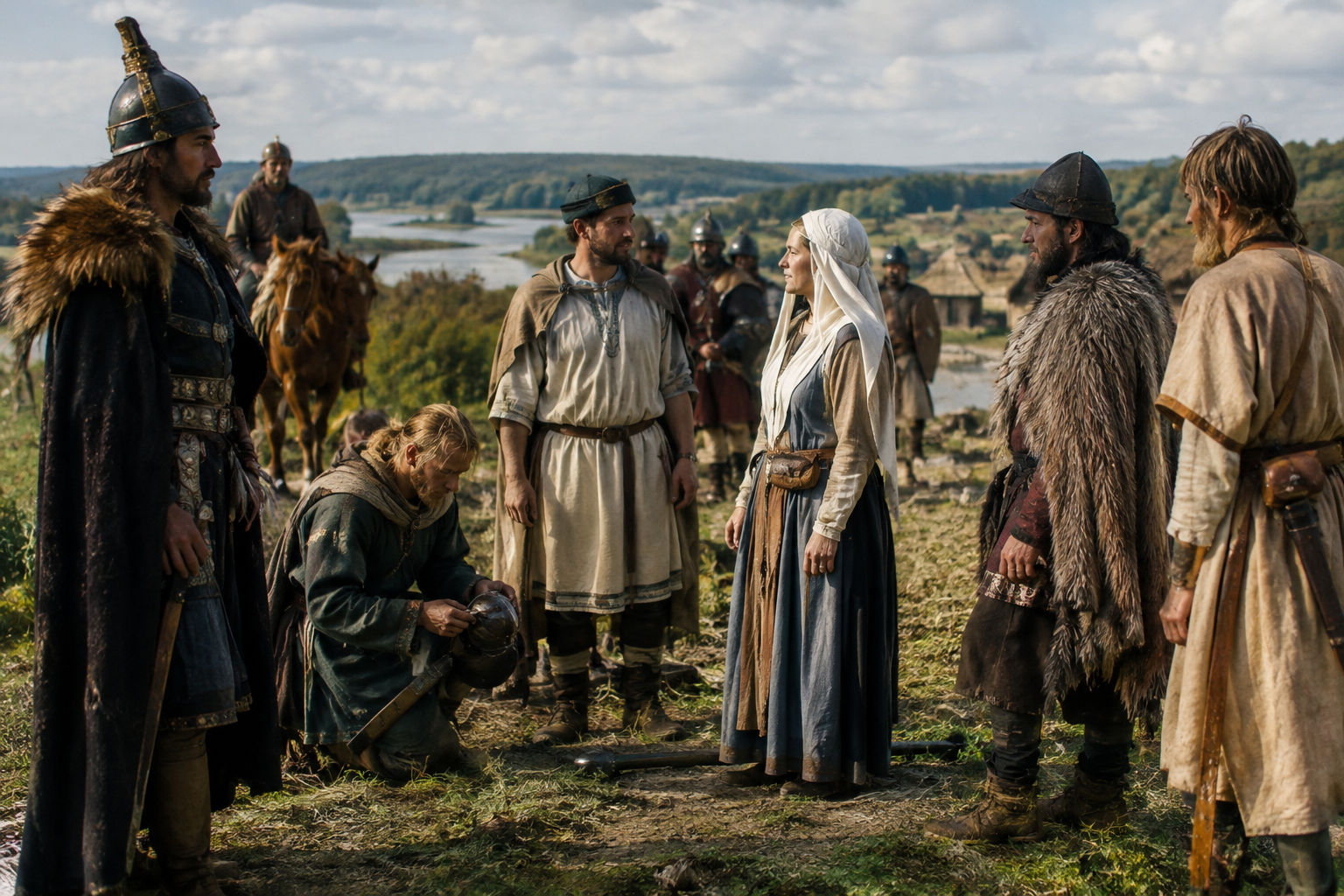
There is something wonderfully humbling about a Y-DNA haplogroup this specific: I2a1b1a1b1a1a1. At first glance it looks less like history and more like a railway timetable gone wrong. But behind that string of letters and numbers lies a very human story: fathers and sons, migrations and settlements, battlefields and churchyards, and eventually the landed families of medieval Europe who built their authority not only in parchment and stone, but in place.
Y-DNA haplogroups trace a direct paternal line only: one narrow line out of the vast web of your ancestry. They do not describe all of who a person is, nor do they prove membership in a people, kingdom, or noble house. What they do offer is something more precise and, in its own way, more haunting: a view down one male line across centuries, sometimes millennia, when ancient DNA gives us enough evidence to glimpse where that line appeared in the past.
This branch belongs within the wider haplogroup I, one of the old paternal lineages of Europe. More specifically, it sits within the large and historically important I2 family, whose many branches have been found in different parts of Europe across deep time. That broader I2 story stretches across prehistory and into later European populations, but caution is needed here: the full history of I2 cannot simply be pasted onto one very narrow downstream branch like I2a1b1a1b1a1a1.
What the supplied ancient evidence does suggest is that lineages connected with this branch, or with its close paternal neighborhood, were present across a striking swathe of central, southeastern, and western Europe. The samples linked here appear in Bronze Age northern Germany, Iron Age Slovenia, Migration Period Hungary and Bulgaria, and medieval Belgium and Germany. That is not proof of one single uninterrupted family saga. It is, however, a strong clue that this paternal line belonged to the long and complicated population history of Europe rather than to one neatly bounded tribe or kingdom.
For readers interested in the deeper prehistoric setting behind many European paternal lines, this broader background is explored in more detail here:
The oldest supplied evidence comes from the Tollense Valley Battlefield in Mecklenburg-Vorpommern, Germany, dated to 1250 BC. Two individuals from that violent Bronze Age landscape, WEZ51 and WEZ15, place this lineage in one of Europe's most evocative archaeological settings: a battlefield full of broken bones, weapons, and the remains of men caught in organized conflict on a scale that once surprised archaeologists. Whatever else I2a1b1a1b1a1a1 may represent, it was already present in the world of Late Bronze Age northern Europe.
That matters because it helps anchor the lineage in a period long before medieval surnames, long before kingdoms such as Scotland took recognizable shape, and long before chroniclers began assigning peoples tidy identities. If a branch like this appears in Bronze Age Germany and later in other parts of Europe, we are looking not at a single migration event neatly labelled in a textbook, but at a paternal lineage participating in many different societies over time.
Another important waypoint is I5689 from Grofove njive, Slovenia, dated to 575 BC. Here the lineage turns up in an Iron Age Balkan-Central European zone, a region that was never a sealed cultural box. Trade, warfare, marriage networks, and mobility all moved people through these landscapes. A Y-line found here reminds us that paternal ancestry can persist through changing material cultures and political worlds.
Readers curious about the wider Central European backdrop of such discoveries may want to continue with this excellent related piece:
Explore Late Bronze Age Central Europe
The Migration Period samples are where the story becomes especially vivid. CGG021899, described as a Celto-Gepid individual from Subotica, Migration Period Hungary, Madaras and dated to 375 AD, sits in a world where old Roman frontiers were fraying and new political confederations were forming. Labels such as Gepid, Gothic, Hun, or Slav are historical and archaeological categories, not genetic essences. Still, ancient DNA lets us see that men carrying related paternal lines were present in precisely these turbulent frontier societies.
I40932, from a Gothic Grave Aul of Kan Omurtag Bulgaria Han Krum Village dated to 400 AD, reinforces that point. So does HNF019, a Hun Invader from Hungary Danube-Tisza dated to 450 AD. These are not proof that I2a1b1a1b1a1a1 was a "Gothic haplogroup" or a "Hun haplogroup" - that would be far too simplistic. What they show instead is that this paternal lineage, or close branches around it, was present in the mixed and mobile populations of late antique eastern and central Europe.
This is exactly the sort of evidence that has complicated older, simpler tales about migration-era peoples. Gothic and Hunnic worlds were not biologically uniform blocs marching across the map. They were coalitions, communities, and power networks. For that reason, readers may enjoy this related article on the diversity within Gothic populations:
Discover Gothic DNA in Bulgaria
By the medieval period, the lineage appears in clearly settled urban and village contexts. ST2000 from Sint-Truiden Groenmarkt, Belgium, dated to 1100 AD, places it in a busy Low Countries town. SDN037 from Sachsen-Anhalt Western Slav Settler Steuden, dated to 1050 AD, places it in a region where Slavic settlement, German expansion, and Christianization overlapped. The pattern is revealing: a paternal line that once appeared in battlefields and frontier graves is later found in market towns and farming communities. That is a neat summary of European history itself.
So how does all this connect, carefully and responsibly, to the later world of noble families? In the supplied material, the relevant historical association is Clan Chalmers, specifically Gadgirth in Ayrshire near the River Ayr. Gadgirth was an old castle and barony with medieval roots and ties to the powerful Kennedy family. Over time, the lands passed through noble hands, and the place shifted from stronghold to estate as political conditions and aristocratic fashion changed.
That is very recognizably the story of later medieval and early modern Scotland. Fortified residences that once mattered in local struggles of lordship became less military and more landed. The old castle at Gadgirth largely disappeared, but the name remained, carrying with it the memory of jurisdiction, inheritance, kinship, and local power. Castles often survive in history even when they barely survive in stone.
What genetics can offer here is context, not a fairy tale. A haplogroup association does not prove that every Chalmers or Kennedy male carried this exact branch, nor that a man from Bronze Age Tollense was the direct forefather of a laird on the River Ayr. But if a lineage like I2a1b1a1b1a1a1 has deep roots across parts of Europe and later appears in historical populations connected to the British Isles, then Scottish paternal lines may sometimes preserve chapters of a much older continental past.
For readers interested in the clan setting around this story, one natural companion article is:
The real fascination of I2a1b1a1b1a1a1 is not that it can be pinned to one people, one language, or one grand historical label. Quite the opposite. Its value lies in how stubbornly it resists simplistic identity. It appears in Bronze Age Germany, Iron Age Slovenia, Migration Period Hungary and Bulgaria, and medieval Belgium and Germany. That is the profile of a lineage woven into the long settlement history of Europe, surviving political collapse, cultural change, and the endless human business of moving, marrying, fighting, farming, and founding families.
When we set that against a place like Gadgirth in Ayrshire, the contrast is irresistible. On one side, ancient DNA from skeletal remains identified only by site code and burial context. On the other, medieval baronies, clan memory, and the traces of a vanished Scottish stronghold. Neither source tells the whole story on its own. Together they show how the paternal past can be glimpsed from two directions at once: from the grave and from the archive.
If Scottish regional history is your next stop, the wider context of movement into Britain is worth exploring too:
Explore North Sea Migrations to Britain
If your paternal line belongs to a branch such as I2a1b1a1b1a1a1, ancient DNA can place it in a far bigger historical landscape than any surname pedigree alone. MyTrueAncestry lets you compare your DNA with ancient individuals and archaeological populations, offering clues about where parts of your ancestry may fit into the human past. Those matches do not necessarily prove direct descent from a particular ancient person or noble family, but they can open a remarkable window onto the worlds your ancestors once inhabited.






Comments