Haplogroup I2a1b1a1a1a1a

– 6 min read


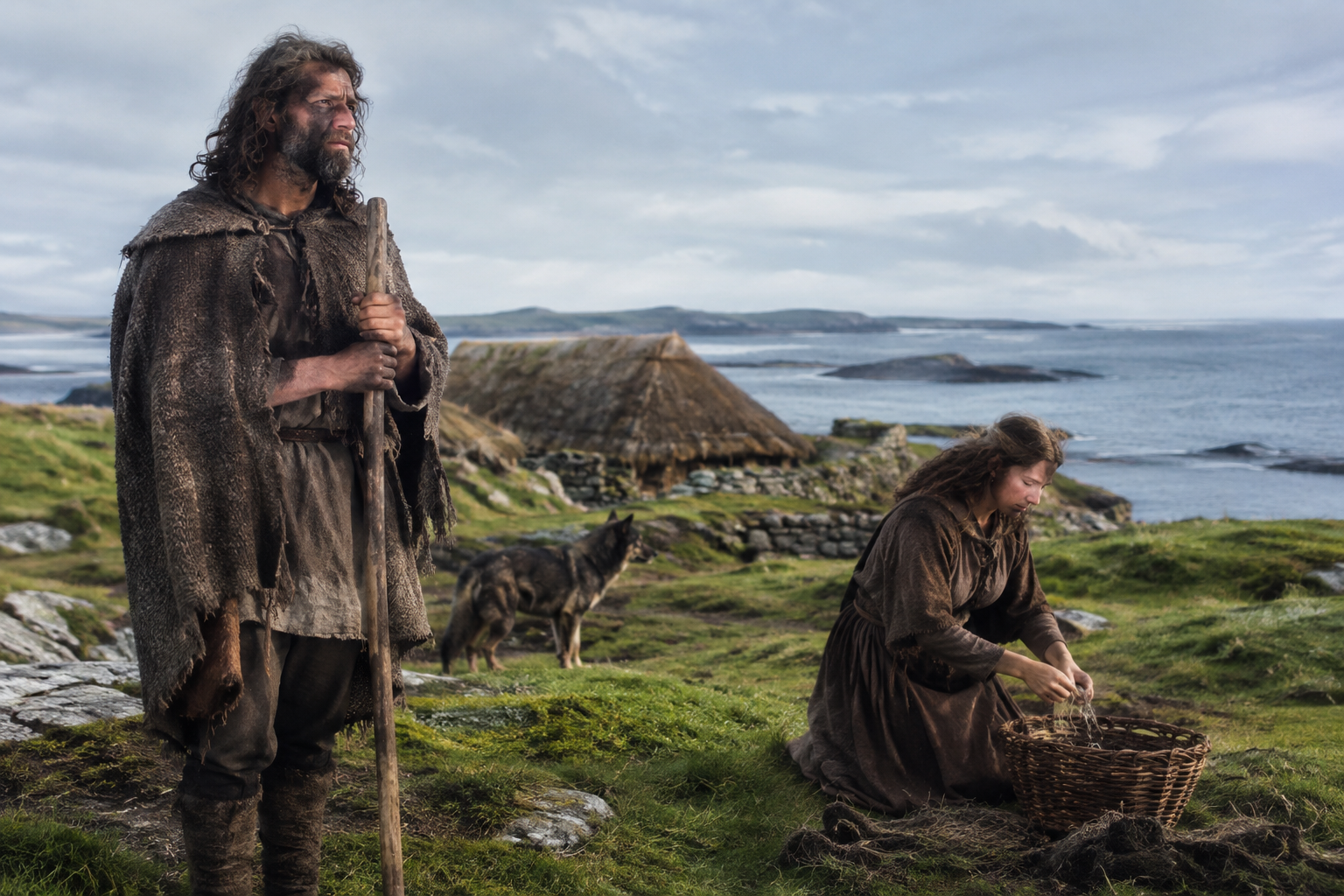
Some Y-chromosome lineages are famous because they appear in royal tombs or because they are common enough to sketch broad maps of migration. Others are interesting for a subtler reason: they remind us how much of Europe's paternal history survives in fragments. The haplogroup I2a1b1a1a1a1a belongs in that second category. It sits deep within haplogroup I, one of the major old European Y-chromosome lineages, and its story is best approached not as a neat label for a people, but as a clue to long male-line continuity, regional survival, and movement across centuries.
That matters because Y-DNA tracks only one line of ancestry: the direct paternal line, father to son to son. It does not describe a person's full ancestry, culture, language, or identity. But when ancient DNA turns up a paternal lineage in a burial, especially in a place as evocative as Atlantic Scotland, it gives us a rare glimpse of how one branch of the male past was distributed in the real world. In the case of I2a1b1a1a1a1a, the evidence supplied here points us toward Britain and especially Scotland, where archaeology, landscape, and later family history create a striking backdrop.
Haplogroup I as a whole is widely associated with ancient European hunter-gatherer ancestry, and over time its different branches became distributed across various parts of the continent. The subclade I2, in particular, has often appeared in prehistoric and historic European contexts. But one must be careful here: the narrower branch I2a1b1a1a1a1a is not automatically entitled to the full history of all I2 men everywhere from the Mesolithic onward. Specific downstream branches can have much more local and recent histories than their parent clades.
What we can responsibly say is that this lineage belongs to an old European paternal family tree, and that such branches help population geneticists trace patterns of continuity as later migrations reshaped the continent. Britain and Ireland, and parts of Atlantic Europe more broadly, are especially interesting in this respect because ancient local lineages, incoming farmer ancestry, and later Bronze Age and Iron Age changes all intersect there. In other words, this is not the story of a single "tribe gene." It is the story of one surviving branch in a crowded and changeable human landscape.
Explore How Ancient DNA Rewrites History
The most vivid anchor in this article is the ancient individual I2655, from Pabay Mor Isle of Lewis Scotland, dated to 1350 BC. That places him in Bronze Age Scotland, on an island landscape of sea routes, shifting local communities, and deep connections between mainland and island worlds. Lewis today may feel remote, but in prehistory remoteness is often a modern illusion. Coasts were roads. Islands were stopping points. Water linked communities as much as it separated them.
The presence of this paternal lineage in I2655 is important precisely because it gives us a securely dated instance in northern Britain. He is not evidence that everyone in Bronze Age Scotland belonged to this haplogroup, nor does he prove direct descent to any later family. What he does offer is a firm archaeological point on the map: by 1350 BC, a man carrying this line was living in the Outer Hebrides.
That matters for two reasons. First, it shows that this branch, or a very close paternal relative of it, had already reached or persisted in Atlantic Scotland in the Bronze Age. Second, it places the lineage in a region where later historical memory remained intensely local. Scottish landscapes are full of long continuities: farms reused, burial places revisited, territories renamed but not forgotten. Ancient DNA does not tell us the language I2655 spoke, the gods he knew, or whether his community thought of itself as islander, kin group, or something else entirely. But it does let us say that one thread of later Scottish paternal diversity had deep roots there.
Discover Ancient Kinship in Northern Scotland
It is tempting, whenever a Bronze Age Scottish sample appears, to leap straight to Celts, clans, or medieval surnames. Resist that temptation. The gap between 1350 BC and the world of written Scottish history is enormous. Yet geography still matters. A paternal lineage found in Atlantic Scotland offers context for how later regional populations may have preserved older male lines even while culture, politics, and language changed dramatically.
By the Iron Age and early medieval periods, Britain was a patchwork of communities shaped by local continuity, migration, alliance, and conquest. Some paternal lines vanished; others survived in particular districts. Ancient DNA increasingly shows that large historical changes do not necessarily erase local ancestry. A region can adopt new languages, new elites, and new political identities while retaining substantial ancestry from earlier inhabitants. That is one reason lineages like I2 and its subclades remain so interesting in the British Isles.
For readers interested in the bigger picture, this is also where historical genetics parts company with romantic genealogy. Shared haplogroups may reflect deep regional ancestry rather than any knowable connection between named medieval families. Ancient DNA gives structure to the backdrop, not always to the family tree.
The supplied noble associations bring us into two very different later settings: House Parker at Shirburn Castle in Oxfordshire, and Clan Haldane at Airthrey Castle near Stirling. Both are useful, not because a castle can somehow prove a Y-chromosome, but because they show how paternal-line questions are remembered inside historical landscapes.
Shirburn Castle began as a fortified manor in the 1370s, built by Warin de Lisle after receiving a licence to crenellate from Edward III. That detail alone places it in the muscular world of later medieval lordship, where architecture advertised authority as much as it provided defence. In the early 1700s, the first Earl of Macclesfield transformed it into the Parker family seat, filling it with books, manuscripts, and art. So the building became more than a fortress: it was a repository of lineage, memory, and cultivated status. Medieval masonry and aristocratic scholarship sat side by side.
Airthrey Castle, by contrast, belongs to a later chapter in Scottish landed history. Near Stirling, it began as an estate of the Graham family, while the present house was built around 1791 for Robert Haldane in a neoclassical style. In time the estate passed through several owners, the grounds were shaped into a picturesque landscape, and in the twentieth century it became part of what is now the University of Stirling. That is a different sort of continuity: not a frozen ancestral monument, but a place whose social purpose changed with the centuries.
For genetic history, the important caution is simple. A reported association between a haplogroup and a noble family does not prove that every historical bearer of that surname shared the same paternal line, still less that all branches remained genetically uniform over time. Adoptions, illegitimacy, collateral inheritance, surname changes, and simple genealogical complexity all matter. What castles preserve is not DNA itself, but the regional and familial frameworks within which paternal lines were remembered.
Read About the Noble House of Parker
If there is a particularly suggestive link in this material, it is the Scottish one. The Bronze Age sample I2655 comes from the Isle of Lewis; Airthrey Castle stands near Stirling; and the Haldane association draws us into the long history of Scottish regional identity. This is not proof that Bronze Age Hebrideans were ancestors of the Haldanes in any direct genealogical sense. But it does show how ancient paternal evidence and later documented history can inhabit the same broad map.
That map is what makes archaeogenetics so powerful. Written records in Scotland, as elsewhere, are patchy and late. Ancient DNA reaches much further back, but it usually cannot name families. Castles and charters name families, but they rarely reveal deep biological ancestry. Put the two together, and one gets something more interesting than either alone: not certainty, perhaps, but perspective.
Seen that way, haplogroup I2a1b1a1a1a1a is less a badge than a surviving trace. It hints that some paternal lines in Britain belonged to lineages with deep European roots and that these lines could remain in northern landscapes through immense cultural change. The Bronze Age man from Pabay Mor and the later world of estates, castles, and clans are separated by millennia, but they occupy overlapping ground in the history of place.
Explore the History of Clan Haldane
The real value of a lineage like I2a1b1a1a1a1a is that it teaches restraint as well as curiosity. It can illuminate direct paternal ancestry, show where a line appears in ancient remains, and help frame questions about continuity and movement in Britain. It cannot, on its own, tell you that you are "Celtic," "Scottish," or descended from a particular castle-owning family. Genetics is powerful, but it is not magic, and history is rarely tidy.
Still, there is something arresting about seeing a line from the Y-chromosome tree grounded in a real human being like I2655 on the Isle of Lewis in 1350 BC. Suddenly the haplogroup is no longer an abstract code. It belongs to a man who lived in Bronze Age Scotland, in a world of boats, kinship, burial, and memory. That is where ancient DNA is at its best: not flattening the past into identity labels, but restoring some of its human scale.
If you want to see whether your own DNA connects with ancient individuals, historic populations, or the deeper story behind lineages like I2a1b1a1a1a1a, MyTrueAncestry offers a remarkable way to explore those connections. Your results may reveal fascinating parallels with ancient samples and historical regions, while still requiring the same care and caution that good archaeology and genetics always demand.






Comments